
Beobachtungen:
Augenstrahl
0.1
Experimente und Beobachtungen von 1859, Reichenbach
0.2 eigene
Experimente
1. Das menschliche Auge, Sensoren für unterschiedliche Lichtwellenlängen
2. Brillen2.1 normale Brillen und Filter
2.2 farbige Brillen
3. Eigenschaften des
Augenstrahls
3.1 Beobachtungen
durch Spüren
3.2 Physikalische
Experimente zum Nachweis der Welleneigenschaften
3.2.1
Polarisation, Wellenlänge
3.2.2
Beugungsbilder bei periodisch angeordneten Objekten,
Gitterbeugung
3.2.3
Weitere Eigenschaften der Wellen, zirkulare
Polarisation?
3.3 Erzeugen von
Wirbeln mit dem Augenstrahl bei zylindrischem Objekt
3.4 Erzeugen von
Wirbeln mitdem
Augenstrahl beim Blick durch zwei Löcher
3.5 Aktivieren
eines Drehpendels beim Anstarren mit dem Augenstrahl,
Charles Russ Patent
3.6 Aktivieren
von Objekten mit dem Augenstrahl
3.6.1
Anregung von Spulen etc.
3.6.2
Anregung von Glaskugel und Reflektorprisma
4. Erweiterung der
Untersuchungen mit gerader oder ungerader Anzahl von
Öffnungen und Sendern
4.1 Löcher,
Kerzenflammen, "Dowsing a Dot"
4.2 Drittes Auge
4.3 weitere
Sensoren am Körper
5. PSI-Track Brille,
Ziel sichtbar / nicht sichtbar
5.1 PSI-Track
legen mit gelber Brille
5.2
PSI-Ringabstand Knoten
5.3 Resonanz
6. Hörgeräte Batterien oder Magnete können Augenstrahl anregen
7. Drahtbrille , Chi-Stabilisator
8. Rupert
Sheldrake: The Sense of Being Stared At
0. Overview, Summary
0.1 Experiments and observations from 1859,
Reichenbach
0.2 Experiments
1. The human eye: sensors for different wavelengths of
light
2. Eyewear
2.1 Standard spectacles and filters
2.2 Coloured spectacles
3. Properties of the ocular beam
3.1 Observations through touch
3.2 Physical experiments to demonstrate wave
properties
3.2.1 Polarisation, wavelength
3.2.2 Diffraction patterns for periodically arranged
objects, grating diffraction
3.2.3 Further properties of waves, circular
polarisation?
3.3 Generating vortices with the eye beam when viewing
a cylindrical object
3.4 Generating vortices with the eye beam when looking
through two holes
3.5 Activating additional beam sources on the body by
staring with the eye beam
3.6 Activating objects with the eye beam
4. Extension of investigations with an even or odd
number of openings and transmitters
4.1 Holes, candle flames, “Dowsing a Dot”
4.2 Third eye
4.3 Further sensors on the body
5. PSI-Track glasses, target visible / not visible
5.1 Laying the PSI-Track with yellow glasses
5.2 PSI-Ring distance nodes
5.3 Resonance
6. Hearing aid batteries or magnets can stimulate the
eye beam
7. Wire glasses, Chi stabiliser
8. Rupert Sheldrake: The Sense of Being Stared
At
9. Seeing without eyes
a) Die beiden Augen eines Menschen wirken im
klassischen (optischen) Sinne wie zwei Kameras:
Sie empfangen Licht, das von reflektierenden Oberflächen
oder von selbstleuchtenden Körpern ausgesandt wird.
b) Sie sind Sender von zwei "Augenstrahlen" (Doppelstrahl1), mit denen neben "sichtbaren" 2 Strukturen von Objekten auch andere feinstoffliche Strukturen wahrgenommen werden können. Abb. 00-16 Abb. 03-01-01
- Mit Hilfe der Augenstrahlen können grobstoffliche
Körper (z.B. Kupferspule, Hohlkörper, Wasserglas)
angeregt werden. Die Maße von deren "sichtbarer" und
spürbarer feinstofflicher Ausdehnung sind danach
vergrößert. Durch hartes Klopfen lassen sie sich
wieder in den Ausgangszustand bringen.
Abb. 03-06-01 - Hinweise für Tests von Rutengängern: a) Die Probanden sollten freie Sicht haben 7, b) Einflüsse durch den Augenstrahl anderer Personen sind zu verhindern.
- Beugungsexperimente lassen darauf schließen, daß
eine Wellenart beteiligt ist, die sich mit Gesetzen
der optischen Beugungsoptik beschreiben läßt.
Abb. 03-02-02-01, Abb. 03-02-02-03 - Aus dem Beugungsbild bei periodisch angeordneten
"Hohlraumresonatoren", zwei Eisenkugeln als
Doppeltspalt-Experiment und einem Hohlraumresonator
mit verschiebbarer Rückwand ergeben sich
Wellenlängen im Bereich von wenigen
Zentimetern. Abb. 03-02-02-05, Abb. 03-02-02-02, Abb. 03-10-12
- Diese Hohlraumresonatoren oder Kugeln senden aber nur dann, wenn sie zuvor mit dem Augenstrahl einmalig angeregt (für einige Sekunden intensiv angeschaut) wurden.
- Die Schwingung in den Resonatoren ist (vermutlich) ungedämpft. Sie läßt sich aber durch harte mechanische Beschleunigung (Klopfen, Hammerschlag) auflösen.
- Die mit dem Augenstrahl kommunizierende Öffnung der Resonatoren ist mit einer linear polarisierten Folie 3 verschlossen. Die Anregung des Hohlraums gelingt nur dann, wenn die Ziehrichtung der Folie und die Verbindung beider Augen nicht senkrecht zueinander stehen. Abb. 03-02-01-01
- Beide Augenstrahlen wirken unter
anderem im Wellenlängenbereich von
etwa 550-650 nm. Dies zeigen optische Filter, mit
denen man einzelne Wellenlängenbereiche sperren kann.
So läßt sich z.B. mit einem Blaufilter die Fähigkeit,
"Unsichtbares" zu sehen, unterdrücken. Abb.
02-02-08 ff
- Für das "Sehen" sind wie beim räumlichen Sehen zwei Augen nötig. Hält man ein Auge zu, fehlt diese Fähigkeit. Abb. 03-01-05
- In Strahlrichtung vor den Augen angebrachte
geschlossene Ringe wirken als Hindernisse. Vermutlich
regt die von den Augen in Strahlrichtung ausgehende
Strömung in den Ringen eine dazu orthogonale Strömung4
an.
Abb. 03-01-12 - Beide Strahlen kommunizieren über den
Zwischenbereich an der Nasenwurzel miteinander.
Befindet sich dort ein Hindernis, ist das "Sehen" von
feinstofflichen Strukturen nicht möglich. Als
Hindernis können übergroße Nasenstege von Brillen oder
vor die Nase gehaltene zwei Finger wirken.
Abb. 03-01-05 - Diese Strahlen und die Verbindung im Bereich oben an der Nase bilden ein spitzes Dreieck. Vermutlich ist das Zusammenspiel der drei Elemente wie bei einem Radargerät: der eine Strahl sendet, der andere empfängt, die Auswertung erfolgt in der Mitte und ist nur möglich, wenn das zeitliche Verhalten beider Strahlen gegeneinander verglichen werden kann. Abb. 03-01-01
- Die Qualtitäten der Strahlen sind bei Mann und Frau komplementär 5. Abb. 03-01-03
- Die Verbindung zwischen beiden Augen reagiert auf feinstoffliche Strömungen von Batterien oder Magneten. Bringt man diese Objekte seitlich am Kopf an, so ist das "Sehen" je nach Polung verstärkt oder abgeschwächt. Abb. 03-01-03
- Verwendet man lineare Polfilter als Augengläser
(Sonnenbrille für Autofahrer), so wird das
"Sehen" unterdrückt, wenn man a) den Kopf um 90° zur
Seite dreht oder b) die Filter in der Brille um
90° dreht. Abb. 02-02-15
- Es gibt ein "drittes Auge" an der Stirn oberhalb
vom Ende der Nase. Deckt man diesen Bereich ab, ist
das "Sehen" nicht möglich und es lassen sich auch
keine Objekte durch Anstarren anregen.
Abb. 03-04-11
- Die von Rupert Sheldrake experimentell bestätigte
Wahrnehmung " angestarrt zu werden" läßt sich
damit erklären. kapitel-08
- Wenn einige Menschen in ihrer Umgebung mit ihren
Augen mehr wahrnehmen als andere, dann muß es sich
nicht zwingend um Haluzinationen handeln. Man
kann es als "Sehen" in der Unsichtbarkeit bezeichnen.
Die Beobachtungen können durchaus feinstoffliche
Strukturen von ortsfesten oder beweglichen Objekten
sein.
Ob es sich dabei um Einbildungen, die eine pyschologische Behandlung erfordern, oder echte Wahrnehmungen handelt ("Aura-Sehen") läßt sich z.B. mit einer Aura-Sehen-Test-Brille objektiv feststellen. Abb. 03-01-15
Das wäre eine Erklärung für z.B. die Begriffe "Naturwesen" oder "Heiligenschein" 6 Abb. 00-00
Anstatt die Personen einzusperren oder mit Medikamenten zu behandeln, würde eine spezielle Brille (Magnete, Hindernis über der Nasenwurzel... ) hier eine einfachere Lösung bieten und nachweisen, daß es sich nicht um Einbildung sondern um feinstoffliches Sehen handelt.
- Hinweise für Tests von
Rutengängern:
a) Die Probanden sollten freie Sicht haben 7,
b) Einflüsse durch den Augenstrahl anderer Personen sind zu verhindern.
- Es gibt weitere paarweise
angeordnete Sensoren am Körper, mit denen sich die
Umwelt "beobachten" läßt, sowohl auf der Vorder- als
auch auf der Rückseite. Deren "Blickrichtung" ist wie
bei den Augen einstellbar. Das "Wahrgenommene" läßt
sich nach etwas Übung in das übliche räumliche Bild
der Umgebung übernehmen.
Abb. 04-03-04 - Für das Einrichten von
mentalen Pfaden sind beide Augenstrahlen und das
Dritte Auge erforderlich.
Abb. 03-02-00-01 und kapitel-05
- Doppelstrahl:
https://biosensor-physik.de/biosensor/doppel-strahl.htm
Zwei gekoppelte feinstoffliche Strömungen mit komplementären Eigenschaften.
mechanisches Analogon: die beiden gegenläufigen Propeller eines mit zwei Schrauben angetriebenen Schiffs. - erweiteres Sehen ist so gekennzeichnet: "Sehen"
- Die Frischhaltefolie, durch mechanisches Ziehen in einer Richtung gereckt, wirkt daher als Polarisationsfilter auch für feinstoffliche Wellen.
- Stab-und-Spirale
https://biosensor-physik.de/biosensor/stab-und-spirale.htm
Ring-Strömung https://biosensor-physik.de/biosensor/ring-stroemung.htm - Vermutlich ist das der
Unterschied, warum man bei mentalen Pfaden feststellen
kann, ob sie von einem Mann oder einer Frau gelegt
wurden.
Die Erfahrung zeigt, daß solche Tracks nur von Personen verschoben oder gelöscht werden können, wenn diese das gleiche Geschlecht wie das
des Erzeugers hat. Mit überkreuzten Beinen läßt sich diese Bedingung allerdings umgehen. Dann kehrt sich eine Hauptrichtung
der Körperströmungen um und täuscht das andere Geschlecht vor. https://biosensor-physik.de/biosensor/raunaechte.htm - Baron Karl von
Reichenbach hat um 1850 eine sehr große Anzahl von
Experimenten mit sensitiven Personen durchgeführt,
die in
speziell abgedunkelten Räumen Objekte (Personen, Magnete und andere Gegenstände) wahrgenommen haben.
https://biosensor-physik.de/biosensor/reichenbach.htm - Hans-Dieter Betz Das
WünschelrutenPhänomen ISBN 978-3927369-16-0
(2008), die Abb. 6.8-10 zeigen verhüllte
Testpersonen.
Summary
a) In the classical (optical)
sense, a person’s two eyes function like two cameras:
They receive light emitted by reflective surfaces or
by self-luminous objects.
b) They are emitters of two ‘eye rays’ (double beam
¹), with which, in addition to the ‘visible’ ²
structures of objects, other subtle structures can
also be perceived. Abb. 00-16 Abb.
03-01-01
- With the aid of the eye rays, gross-material bodies (e.g. copper coil, hollow body, water glass) can be stimulated. The dimensions of their “visible” and perceptible subtle-matter extension are subsequently increased. They can be returned to their initial state by tapping them firmly. Abb. 03-06-01
- If some people perceive more with their eyes than others in their surroundings, this does not necessarily mean they are hallucinating. It could be described as ‘seeing’ into the invisible. These observations may well be subtle structures of stationary or moving objects.
- Diffraction experiments suggest that a type of wave is involved which can be described by the laws of optical diffraction. Abb. 03-02-02-01, Abb. 03-02-02-03
- The diffraction pattern
produced by periodically arranged ‘cavity
resonators’, two iron balls in a double-slit
experiment) and a cavity resonator with a movable
rear wall yields wavelengths in the range of a few
centimetres. Abb. 03-02-02-05, Abb. 03-02-02-02, Abb. 03-10-12
- However, these cavity resonators or balls only emit when they have first been excited once by the eye’s gaze (stared at intensely for a few seconds).
- The oscillation in the resonators is (presumably) undamped. However, it can be resolved by a sharp mechanical jolt (tapping, hammer blow).
- The opening of the resonators
communicating with the eye beam is sealed with a
linearly polarised film 3. Excitation of
the cavity is only successful if the direction of
the film’s polarisation and the alignment of both
eyes are not perpendicular to one another. Abb. 03-02-01-01
- Both eye beams operate,
amongst other things, in the wavelength range of
approximately 550–650 nm. This is demonstrated by
optical filters, which can be used to block specific
wavelength ranges. For example, a blue filter can be
used to suppress the ability to see the ‘invisible’.
Abb. 02-02-08 ff
- As with spatial vision, two
eyes are required for this ‘vision’. If one eye is
covered, this ability is lost.
Abb. 03-01-05 - Closed rings positioned in
the direction of the rays in front of the eyes act
as obstacles. Presumably, the flow emanating from
the eyes in the direction of the rays induces a flow
orthogonal to it within the rings 4.
Abb. 03-01-12 - Both rays communicate with each other via the intermediate area at the bridge of the nose. If there is an obstacle there, ‘seeing’ of subtle structures is not possible. Oversized nose pads on spectacles or two fingers held in front of the nose can act as obstacles. Abb. 03-01-05
- These rays and the connection in the area at the top of the nose form an acute triangle. Presumably, the interaction of the three elements is similar to that of a radar device: one ray transmits, the other receives, the evaluation takes place in the centre and is only possible if the temporal behaviour of both rays can be compared against each other. Abb. 03-01-01
- The qualities of the rays are complementary in men and women 5. Abb. 03-01-03
- The connection between the
two eyes reacts to subtle energy flows from
batteries or magnets. If these objects are placed on
either side of the head, ‘vision’ is either enhanced
or diminished depending on the polarity.
- If linear polarising filters are used as eyeglasses (sunglasses for drivers), ‘vision’ is suppressed if one a) turns the head 90° to the side or b) rotates the filters in the glasses by 90°. Abb. 02-02-15
- There is a “third
eye” on the forehead above the tip of the nose. If
this area is covered, “vision” is not possible and
objects cannot be stimulated by staring at
them. Abb. 03-04-11
- This explains the sensation
of ‘being stared at’, which has been experimentally
confirmed by Rupert Sheldrake. kapitel-08
- If some people perceive more
with their eyes than others in their surroundings,
this does not necessarily mean they are
hallucinating. It could be described as ‘seeing’
into the invisible. These observations may well be
subtle structures of stationary or moving objects.
Whether these are delusions requiring psychological treatment, or genuine perceptions (“aura vision”), can be objectively determined, for example, using aura vision test glasses. Abb. 03-01-15
This would provide an explanation for, for example, the concepts of “nature spirits” or “halos” 6 Abb. 00-00
Instead of locking people away or treating them with medication, special glasses (magnets, a barrier over the bridge of the nose... ) would offer a simpler solution here and prove that this is not a figment of the imagination but rather subtle-matter vision.
- Guidelines for testing
dowsers:
a) Test subjects should have a clear view 7,
b) Influences from the eye rays of other people must be prevented.
- There are additional sensors arranged in pairs on the body, which can be used to ‘observe’ the environment, both at the front and at the rear. Just like the eyes, their ‘line of sight’ can be adjusted. With a little practice, what is ‘perceived’ can be integrated into the usual spatial image of the surroundings. Abb. 04-03-04
- Both the rays of the eyes and
the third eye are required to establish mental
pathways.
Abb. 03-02-00-01 kapitel-05
- Double beam: https://biosensor-physik.de/biosensor/doppel-strahl.htm Two coupled subtle-matter currents with complementary properties. Mechanical analogue: the two counter-rotating propellers of a ship propelled by twin screws.
- Extended vision is characterised as follows: ‘seeing’
- Cling film, which has been stretched mechanically in one direction,therefore acts as a polarising filter even for subtle matter waves.
- Rod and spiral
https://biosensor-physik.de/biosensor/stab-und-spirale.htm
Ring flow https://biosensor-physik.de/biosensor/ring-stroemung.htm - This is probably
the reason why, in the case of mental paths, one can
tell whether they were created by a man or a woman.
Experience shows that such tracks can only be moved or deleted by people of the same gender as the
creator. However, this condition can be circumvented by crossing one’s legs. This reverses the main
direction of the body’s energy flows and simulates the opposite gender.
https://biosensor-physik.de/biosensor/raunaechte.htm. - Fig. 03-01-12:
- Around 1850,
Baron Karl von Reichenbach conducted a very large
number of experiments with sensitive individuals
who, in
specially darkened rooms, perceived objects (people, magnets and other items).
https://biosensor-physik.de/biosensor/reichenbach.htm - Hans-Dieter Betz Das WünschelrutenPhänomen ISBN 978-3927369-16-0 (2008), Figures 6.8–10 show masked test subjects.
0.1 Beobachtungen und Experimente von Reichenbach 1854, 1855
Experimente mit sensitiven Personen , die "sehen" konnten. "Heiligenschein"
Reichenbach’s observations and experiments, 1854, 1855
Experiments with sensitive individuals who were able to ‘see’. ‘Halo’
 |
| Abb. 00-00: K.v. Reichenbach, Der sensitive Mensch und sein Verhalten zum Ode, Stuttgart und Tübingen, erster (1854) und zweiter Band (1855) |
| §. 1740. Viele davon sahen nicht bloß
den Kopf in blasser weißlicher Odgluth, sondern sie
sahen ringsherum einen leuchtenden Schein von dem
Kopfe ausgehen. Frl. Zinkel(54. 192,796. 989) sagte
mir die Erste (April 1846) mein Kopf habe einen Heiligenschein;
besonders beobachtete sie dieß immer dann am
auffallendsten, wenn ich mich gebückt hatte und mich
wieder aufrichtete, oder wenn ich gelegen war und
wieder aufstand. Sie schlief mit einem andern
Frauenzimmer in demselben Zimmer, und so oft sie in
dunkler Nacht erwachte, sah sie (565) den Kopf von
jener von einem Lichtscheine, wie von einer
Strahlenkrone umfangen. Die lichten Emanationen,
welche vom Kopfe aufstiegen, fand sie so stark, daß
sie sie durch sanftes Hineinblasen über meinem
Scheitel hinweg zerflackern und sie hin und herwehen
konnte (1049). - Frl. Ernestine Anschütz, Frl. von
Weigelsberg und Hr. Dr. Goldberg (19) sahen mein
Gesicht anfangs nicht, es war schwarz wie ein
Schattenriß, aber dadurch kenntlich, daß es mit
einem leuchtenden Schein, wie mit einem Heiligenscheine
rings umgeben war. Letzterer sah auch den Kopf des
zufällig in der Dunkelkammer anwesenden Hrn. Delhez
in diesem lichtumkränzten Zustande. Frl. Beyer (165)
sah mich unzähligemal in der Lichthülle und Frl.
Reichel scherzte über mein heiliges Aussehen, so oft
wir in der Dunkelkammer waren. Frl. Poppe (33 ) fand
meinen Kopf mit einem ganz regelmäßigen und
vollständigen Heiligenscheine umfangen. Diese
Beobachtung kam mir noch unzähligemal von andern
Sensitiven vor. - So stoßen wir auch hier auf den Ursprung religiöser Ueberlieferungen. Der Heiligenschein ist nicht bloß aus der Phantasie religiöser Schwärmerei geschöpft, - er ist in der Wirklichkeit vorhanden, jeder Mensch trägt ihn beständig mit sich herum; er ist nur zu fein, um dem gewöhnlichen Auge sichtbar zu werden. Die Sensitiven in der Vorzeit haben ihn längst gesehen und gekannt. Aber unbekannt mit seiner physischen Natur haben sie ihn für etwas Außerordentliches, für etwas Uebermenschliches und Heiliges gehalten und haben ihn denen beigemessen, die sie göttlich verehrten. Daß er aber oft genug beobachtet worden, beweist schon der Umstand, daß sie ihn nicht der Gottheit allein, sondern noch vielen andern, ihren höhern Priestern und allen denen beilegten, denen sie größere Ergebenheit oder sonst engelgleiche Tugenden beimaßen. Der Heiligenschein ist somit von nun an eine Naturerscheinung, in der Physik und in der Physiologie fest begründet, jedem einigermaßen sensitiven Auge nach längerem Verweilen in der Finsterniß ganz gut sichtbar. |
| §. 1740. Many
of them saw not only the head in a pale, whitish
glow, but also a luminous radiance emanating from
the head all around it. Miss Zinkel (54. 192,796.
989) was the first to tell me (April 1846) that my
head had a halo; she observed this most
strikingly whenever I had bent down and stood up
again, or when I was lying down and rose again.
She slept in the same room with another woman, and
whenever she awoke in the dark of night, she saw
(565) the head of the other woman surrounded by a
glow of light, as if by a crown of rays. She found
the luminous emanations rising from my head so
intense that she could make them flicker and blow
them to and fro by gently blowing across the top
of my head (1049). - Miss Ernestine Anschütz, Miss
von Weigelsberg and Dr Goldberg (19) did not see
my face at first; it was black as a silhouette,
but recognisable by the fact that it was
surrounded by a luminous glow, as if by a halo.
The latter also saw the head of Mr Delhez, who
happened to be in the darkroom, in this state
encircled by light. Miss Beyer (165) saw me
countless times in this halo of light, and Miss
Reichel joked about my saintly appearance whenever
we were in the darkroom. Miss Poppe (33) found my
head encircled by a perfectly regular and complete
halo. I have encountered this observation
countless times from other sensitive individuals.
- Thus, here too, we come across the origin of religious traditions. The halo is not merely a figment of the imagination born of religious fervour; it actually exists, and every person carries it with them constantly; it is simply too subtle to be visible to the ordinary eye. The sensitives of antiquity saw and recognised it long ago. But, unfamiliar with its physical nature, they regarded it as something extraordinary, something superhuman and sacred, and attributed it to those whom they worshipped as divine. Yet the fact that it has been observed often enough is proven by the circumstance that they attributed it not only to the deity, but also to many others: their high priests and all those whom they deemed to possess greater devotion or other angelic virtues. The halo is thus, from now on, a natural phenomenon, firmly grounded in physics and physiology, quite clearly visible to any reasonably sensitive eye after a prolonged stay in darkness. translated by deepl |
| Beobachtungen mit sensitiven Menschen
in einer Dunkelkammer Seite 55 Leuchten des Kopfes; Heiligenschein K.v. Reichenbach, Der sensitive Mensch und sein Verhalten zum Ode, Stuttgart und Tübingen zweiter Band (1855) reichenbach.htm |
| §. 2443. In Gegenwart der Frl.
Glaser legte ich mich auf den Zimmerboden der
Dunkelkammer auf den Rücken und ließ sie meinen Kopf
betrachten, den ich nach allen Richtungen im Kreise
herumdrehte. Sie sah dann zunächst meinen Kopf mit
einer auf dem Boden liegenden Leuchte umgeben, die
sie einen Heiligenschein nannte. Lag mein
Kopf gen Norden, <<408>>
Odlichtfarben nach Himmelsrichtung der
Glieder. Indem die Füße gegen Süden gerichtet waren,
so war der ganze Schein rings umher der Hauptfarbe
nach blau, jedoch dieß Blau gleichzeitig in
dreifacher Abstufung: auf meiner linken, gegen Ost
gekehrten Kopfseite dunkelblau, ins Violette
ziehend; auf meiner rechten gegen West gekehrten
Seite hellblau; in der Mitte vom Scheitel gerade aus
mittelblau. Eine solche dreifache Farbenschattirung
hatte mein Kopf und die von ihm ausgehende Leuchte
in jeder seiner verschiedenen Lagen. Er war nämlich
in der Richtung mit dem Scheitel nach Ost nach Nord
nach West nach Süd grau; rechts bläulichgrau, links
röthlichgrau; blau; rechts hellblau, links
röthlichblau; gelb; rechts goldgelb, links grüngelb;
roth; rechts trübroth, links gelbroth. In den
Zwischenlagen war mein Kopf in Nordnordost
rothviolett, in Nordwest grün, in Südwest orange, in
Südost grauroth. Mein Kopf befolgte also im
Wesentlichen die Regel eines Magnetpoles in Bezug
auf Odlicht. Aehnliche Versuche stellte ich mit Frl.
Zinkel (192) an. Ich legte mich auf den Zimmerboden,
Kopf nach Nord, Füße nach Süd; sie sah Ersteren, den
sie vorher weißlich graulich gesehen, in blaue
Leuchte gerathen, die letztern in rothe durch die
ledernen Stiefel hindurch. Das Licht umfing den Kopf
wie ein Heiligenschein und beleuchtete den
Boden und die ihn zunächst umgebenden Gegenstände
blaulich. Kehrte ich mich in der Weise um, daß ich
den Kopf nach Süden richtete und die Füße nach
Norden, so wurde nun jener röthlich, und diese
hellblau leuchtend. |
| §. 2443. In the
presence of Miss Glaser, I lay down on my back on
the floor of the darkroom and let her observe my
head, which I turned in a circle in all
directions. She then saw my head surrounded by a
light lying on the floor, which she called a halo.
When my head was facing north, <<408>>
the light colours corresponded to the cardinal
directions of the limbs. As my feet were pointing
south, the entire glow all around was
predominantly blue in colour, yet this blue
simultaneously appeared in three shades: on the
left side of my head, facing east, it was dark
blue, tending towards violet; on my right side,
facing west, light blue; in the centre of the
crown, straight ahead, medium blue. My head and
the light emanating from it possessed such a
threefold shading of colour in each of its various
positions. For it was grey in the direction with
the crown facing east, north, west and south;
bluish-grey on the right, reddish-grey on the
left; blue; light blue on the right, reddish-blue
on the left; yellow; golden-yellow on the right,
greenish-yellow on the left; red; dull red on the
right, yellowish-red on the left. In the
intermediate positions, my head was reddish-violet
in the north-northeast, green in the north-west,
orange in the south-west, and greyish-red in the
south-east. My head thus essentially followed the
rule of a magnetic pole in relation to the aurora.
I conducted similar experiments with Miss Zinkel
(192). I lay down on the floor of the room, head
to the north, feet to the south; she saw the
former, which she had previously seen as
whitish-grey, bathed in a blue glow, and the
latter in a red glow shining through the leather
boots. The light enveloped my head like a halo
and illuminated the floor and the objects
immediately surrounding it in a bluish hue. When I
turned around so that my head was facing south and
my feet north, the former now turned reddish, and
the latter glowed a bright blue. translated by deepl |
| Beobachtungen mit sensitiven Menschen
in einer Dunkelkammer Seite 407 Odlichtfarben menschlicher Glieder K.v. Reichenbach, Der sensitive Mensch und sein Verhalten zum Ode, Stuttgart und Tübingen zweiter Band (1855) reichenbach.htm |
| §. 1493. Es ist vielfältig behauptet worden, daß der Blick auf sensitive Personen eine besondere und starke Reizwirkung ausübe. Ich werde erst das, was Sensitive mir aus ihren Erfahrungen angegeben haben, mittheilen, dann diesem das entgegenhalten, was ich an eigenen Beobachtungen gesammelt habe. Hr. Fichtner (33) machte schon als Knabe die auffallende Bemerkung, daß wenn er in der Schule zufällig irgend einen seiner Mitschüler, wenn er auch 5 bis 6 Bänke vor ihm saß, unabsichtlich fixirte und sich in Gedanken mit ihm beschäftigte, gerade dieser den Kopf umwandte und ihn anschaute. Da sich dieß öfter wiederholte, so fand er es auffallend, daß in solchen Fällen von allen Schülern kein Einziger nach hinten herumschaute, als nur gerade der Fixirte allein, und dann weiter, daß dieser Herumschauende nirgends anderswo hinblickte, als nur gerade ihm ins Gesicht. Er wußte nicht, wie das kam, es trug sich aber so oft zu, daß er es sich gut merkte und noch jetzt in seinem beiläufig fünfzigsten Jahre sehr wohl weiß. Später in seinem Leben und heute noch kommen ihm immer wieder neue Fälle der Art vor, von denen er mir mehrere auffallende Beispiele erzählte, wo Personen, die er von hinten fixirte, sich plötzlich nach ihm umschauten. — Frau Baronin von Natorp behauptete auf das Bestimmteste, es zu fühlen, wenn jemand von hinten sie mit dem Blicke fixirte. — Frau Kienesberger (218) und Frl. Karhan versicherten, daß sie es bestimmt fühlen, wenn jemand sie einige Zeit lange an dem Kopfe anschaue, sey es von hinten oder von vorne; Erstere erhält davon bald Kopfdrücken, dann Kopfschmerz und endlich macht es ihr übel im Magen. Dadurch werde sie endlich genöthigt, sich umzuschauen. — Als ich eines Tages mit der Frau Iohanna Anschütz in der Finsterkammer saß, und wir einander nicht sehen konnten, fragte sie mich abgerissen, ob ich so eben nach ihr geschaut hätte. Es war in der That so, ich hatte nach der Stelle geschaut, wo ich dem Gehör nach wußte, daß sich ihr Kopf befinden mußte. Sie sagte nur darauf, daß sie es empfunden habe, daß meine Blicke nach ihr gerichtet gewesen seyn müßten, und sie sich durch die Frage vergewissern wollte, ob ihre Empfindung richtig gewesen sey. — Ebendieselbe (112) und ihr Gatte erzählte mir, daß es ihr nicht selten im Schauspielhause begegne, daß sie von hinten fixirt werde und dieß immer peinlich empfinde, selbst wenn es über die ganze Breite des Parterres hin über gehe. Wenn es aber auch nicht fremde Leute waren, das Auge ihres eigenen Gatten vertrug sie nicht ohne Mißbehagen, wenn sein Blick sich länger an ihren Kopf heftete. Frau Anschütz ist eine sehr schöne Frau und es mag vielen zum Vergnügen gereichen, auf ihren seinen Zügen zu weilen. Wenn beide Abends einander gegenüber am Tische saßen und jedes in einem Buche las, so vertrug sie es nicht, wenn er, ohne daß sie es wußte, sie länger anschaute. Sie empfand Beunruhigung, Eingenommenheit, Beengung auf der Brust, endlich Magenaffection , kurz positive Aufregung, sie wurde unterbrochen im Lesen, mußte aufschauen und die Blicke abwehren. — Bei Frau Lederer (20) und Frl. Girtler sah ich selbst, daß, sowie ihr Arzt Herr Dr. Horst sie etwas nachdrücklich anschaute, sie geradezu einschliefen. Beide waren dazumal ohnehin sehr dazu geneigt, in somnambulen Schlaf zu verfallen. — Den beiden Fräulein Armida und Jofephine Geraldini war dieß eine längst bekannte Sache. In Kirchen, Theatern und ähnlichen öffentlichen Orten, wo viele Menschen sich häufen, war es jeder von ihnen oftmals begegnet, daß sie von hinten oder den Seiten von Blicken fixirt wurden, Sie fühlten sich jedesmal so unangenehm afficirt, daß sie unwillkürlich zum Umschauen gezwungen waren. — In Carlsbad saßen Berzelius, dessen Gemahlin, der schwedische Graf Carl Löwenhjelm und meine Wenigkeit in der Post um einen Tisch in der Ecke des Zimmers und das Gespräch schwebte über Magnetismus. Der Graf, der in Paris viel mit Magnetiseurs umgegangen war, machte sich anheischig, jede beliebige Person im Saale zum Herumschauen nach ihm zu nöthigen. Wir zuckten ungläubig die Achseln, er aber drang in mich, ihm irgend eine Person zu bezeichnen, von der ich verlangen möchte, daß sie nach ihm herumschaue. Genöthigt wies ich ihm eine blaugekleidete Dame an, die am äußersten andern Ende des Saales ihm den Rücken zukehrte. Es dauerte ungefähr eine Minute und in der That der blaue Seidenhut kehrte sich um und schaute dem Grafen Löwenhjelm ins Gesicht. Berzelins schüttelte lächelnd den Kopf und wußte so wenig als ich, was wir von dem denken sollten, was vor unsern Augen vorging, zu unbegreiflich, um es zu glauben und zu schlagend, um es zu läugnen. §. 1494. Aber später, und erst in neuerer Zeit, habe ich Beobachtungen gemacht, die vielleicht einiges Licht in diese Dinge werfen. Ich ersuchte (im August 1851) die Frl. Jofephine Geraldini in mein linkes Ange erst mit ihrem rechten Auge zu blicken , und wenn dieß etwa eine Minute lange gedauert, mit ihrem linken Auge dasselbe gegen mein linkes zu thun. Dabei saß ich unmittelbar vor ihr, hatte mich ihr bis auf beiläufig eine gute Spanne weit genähert, und blickte ihr fest mit dem meinen in ihr Ange. So lange sie mir mit dem Rechten in das Linke schaute, also odisch ungleichnamige Augen gegen einander gerichtet waren, ging alles gut und mit freundlichem Behagen; sie konnte es fortsetzen so lange ich wollte, so wie sie aber ihr Linkes in mein Linkes richtete, ward es unverzüglich anders; jetzt wurde ihr Blick unstät, unruhig, mißbehaglich, sie wandte ihn alle Augenblicke ab und ich mußte sie nöthigen, auszuhalten. Sie vermochte meinen Blick vom gleichnamigen Auge nicht lange zu ertragen. Er griff sie äußerst unangenehm an; im ganzen Kopfe wurde ihr davon peinlich warm eigener Schmerz ging ihr vom Auge nach dem innern Kopfe hinein und von da nach dem Hinterkopfe, von da hinab durch den Nacken bis in den Magen, wo er ihr übel machen wollte, und ich sofort mich abwenden mußte. §. 1495. Diesen interessanten Versuch wiederholte ich sofort mit Frl. Martha Leopolders' (17). Auch sie fand das Ineinanderblicken ungleichnamiger Augen angenehm, aber das von gleichnamigen hielt sie nicht aus, es brachte ihr peinliches Mißbehagen. — Frau Jofephine Fenzls (318), Fr. Preinreich (61) und Hr. Dr. Köller (52) sprachen sich ungefähr ebenso aus. — Frl. Zinkels (1277) fand es angenehm, mit ungleichnamigen Augen meinen Blicken zu begegnen und sie auszuhalten; mit gleichnamigen hielt sie es aber kaum ein paar Augenblicke aus. Es gab ihr sogleich heftige Stiche im Innern des Kopfes. Besonders war ihr die Haltung vom linken auf linkes Auge noch weit unerträglicher, als vom rechten auf rechtes. — Frl. Beyers (326) fand den Blick meines rechten und ihres linken Auges ganz behaglich in einander fließen; den meines linken aber in ihr linkes nicht zum Aushalten, ihr Auge trübend und bald so verdunkelnd, daß sie damit mein gleichnamiges Auge gar nicht mehr sah, wie wenn es eine trübe Haut über das ihrige zöge. So oft ich dieß wiederholen mochte, immer geschah es mit dem nämlichen Erfolge. Es war dabei gleichgültig, welche Entfernung ich damit einhielt, einen Fuß, eine Elle, oder eine Klafter Abstand. Linkes auf linkes Auge gab ihr warme, widrige Kopfeingenommenheit und peinlich widrige Gefühle im ganzen Kopfe, sonst im übrigen Leib nirgends; rechtes auf linkes Auge dagegen gab ihr kühlen freien Kopf. Beleuchtungen von verschiedener Stärke machten keinen merkbaren Unterschied in der Wirkung. — Denselben Versuch habe ich nach einander wiederholt mit Frau Josephine Fenzl (118), von Rivo (6), von Hauer (9), von Littrows (21), Tschick (15). Frl. von Unckhrechtsberg (9), Blahusch (13), Karhan (8), Schwarz (18), Zinkel-Baier (16), Reichel (221), Ritter von Siemianovski (16). Prälat Freiherrn von Schindler (25), Delhez (198), Klein (13), Dr. Natterer (61), von Ossenheim (27), Ritter von Perger (60), Ranftl(11), Alois Zinkel (133), Weiner (24), Dr. Tillich (39). Schuler (26), Sartorius (26), Stephan Kollar (44), Graf Karl von Coronini (33), Eduard von Bivenot (10) , überall ward ihnen der Blick durch mein gleichnamiges Auge getrübt, durch mein ungleichnamiges erhellt und angenehmer gemacht. Frl. Barbara Hek (4) erhielt, als ich ihr linken Auge in mein linkes richtete, schnell Kopfschmerz. — Frau Cecilie Bauer (104) betrachtete ohne alles Mißbehagen meine ungleichnamigen Augen eines nach dem andern; als sie aber den Blick ihres Linken auf mein linkes fixirte, wurde ihr schnell fast übel, Kopfschmerz und Brustbeklemmung ergriff sie. — Herr Karl Schiller (21) schaute mit dem Linken gerne in mein rechtes, als er es aber auf mein linkes concentriren mußte, fand er dieß ganz unerträglich, das Sehen verging ihm bald und er fühlte, daß es ihm bei längerer Fortsetzung übel werden würde. — Herr Gustar Anschütz (254) hielt den Blick von gleichnamigen Augen keine Sekunde aus, er traf ihn so heftig und schmerzlich, daß er sich unverzüglich abwenden mußte. — Mit Herrn Anton Müller (36) machte ich den Versuch bei Lampenlicht; der Erfolg war kein anderer, als daß er mit seinem rechten Ange in mein linkes klar blickte, in mein rechtes mit Trübung und Mißbehagen. §. 1496. Es erhellt hieraus, daß das Auge, wie die Finger, Zehen, wie Krystallpole und Magnete Od aussendet; daß die Aussendung mit dem Blicke unmittelbar verbunden ist; daß das linke Auge +Od, das rechte -Od emanirt; daß dieß auf ansehnliche Entfernung statt hat und ein Blick aus 2 Ellen Entfernung noch nicht merklich schwächer wirkt als ein solcher aus einer Spanne Abstand; daß folglich die odische Kraft im Blicke mittelst des Willens auf irgend eine Weise zusammengehalten und dann auf den Punkt concentrirt werden zu können scheint, der mit dem Auge fixirt wird. Nach den gegebenen Thatsachen wird es nun einigermaßen begreiflich, daß und wie der Blick angenehm und unangenehm auf gewisse Entfernungen wirken kann. Es ist eine Transmission odischer Kraft, odischen Dynamits mit demselben verbunden, wie eine solche aus Händen, Magneten, Krystallen, Fingern auf viele Schritte weit statt hat. Daß das Od nicht strahlig auseinander läuft, wie es das gemeine Licht von seinen Quellen aus thut, habe ich schon oft gezeigt, am genauesten §. 592 und 593. Wir werden bei den Lichterscheinungen sehen, wie der Augennerv mit der Retina durch die Pupille Od aussendet. Wo es nun ungleichnamigem Ode begegnet, von linkem Auge im rechten, bewirkt es Kühle und Behagen; wo aber Gleichnamiges auseinander fällt, linke auf linke, und rechte auf rechte Augen und Blicke, da wirkt es lauwidrig, rückstrichartig, abstoßend, durch den n. ophthalmicus rückwärts ins Gehirn, und von da hinab bis in den Magen (Frl. Zinkel und Geraldini) schmerzlich und übelmachend. Dieß sind lauter den Vorkommen des Odes normale Erscheinungen und nichts ist daran, was uns nach den hier davon erworbenen Kenntnissen unerwartet seyn könnte. Werden nun Blicke aus einigem Abstande nach einem entblößten weiblichen Nackn oder nach einem unbedeckten Kopfe gesendet und darauf einige Zeit geheftet, so ist es allerdings möglich und wahrscheinlich, daß ebenso gut odische Wirkung darauf ausgeübt werden kann, wie auf weite Anstände durch ausgestreckte Hände, Krystallpole, Magnete, und daß diese Wirkung, wenn sie namentlich von hinten, gleichnamig ist, unangenehme, lauwidrige, peinliche, endlich angreifende Sensationen erzeugen kann, die zum Aufmerken, zur Unterbrechung beim Lesen, zum Umschauen nach der Herkunft der Einwirkung veranlassen und nöthigen. §. 1497. Der Blick also, von einem Menschen auf den andern, besteht nicht bloß in einer optischen Thätigkeit, sondern er schließt auch eine odische ein; und wenn das Ergebniß von jener dem Schauenden zu gute kommt, indem er sieht, so trifft die Wirkung von dieser den Beschauten, indem er odisch bestrahlt, und odischer Einfluß auf ihn ausgeübt wird, dessen nähere Beschaffenheiten Gegenstand weiterer Untersuchung sehn werden. |
| K. v. Reichenbach 1849, 1854 Der Sensitive Mensch und sein Verhalten zum Ode Stuttgart und Tübingen , erster Band (1854) |
translated by deepl
| §. 1493. It has often been claimed that looking at sensitive individuals exerts a particular and powerful stimulating effect. I shall first relate what sensitive individuals have told me from their own experiences, and then contrast this with what I have gathered from my own observations. Mr Fichtner (33) made the striking observation even as a boy that whenever he happened to unintentionally fix his gaze on one of his schoolmates—even if the boy was sitting five or six desks ahead of him—and thought about him, that very boy would turn his head and look at him. As this happened repeatedly, he found it striking that in such cases not a single pupil looked round, save for the one being stared at, and furthermore that this person looking round looked nowhere else but straight into his face. He did not know why this happened, but it occurred so often that he took good note of it and still remembers it very well now, in his fiftieth year. Later in his life, and even today, he continues to encounter new instances of this kind, of which he told me several striking examples where people whom he was staring at from behind suddenly turned to look at him. — Baroness von Natorp claimed most emphatically that she could feel it when someone was staring at her from behind. — Mrs Kienesberger (218) and Miss Karhan assured me that they could definitely feel it when someone looked at their head for some time, whether from behind or from the front; The former soon gets a tightness in her head, then a headache, and finally it makes her feel sick to her stomach. This eventually forces her to turn round and look. — One day, whilst I was sitting in the dark room with Mrs Iohanna Anschütz, and we could not see one another, she asked me abruptly whether I had just been looking at her. It was indeed the case; I had looked towards the spot where I knew, by the sound, that her head must be. She merely replied that she had sensed that my gaze must have been directed at her, and that she had asked the question to ascertain whether her intuition had been correct. — She (112) and her husband told me that it was not uncommon for her to find herself stared at from behind in the theatre, and that she always found this embarrassing, even when the gaze swept across the entire width of the stalls. But even when it was not strangers, she could not bear her own husband’s gaze without discomfort if his eyes lingered on her face. Mrs Anschütz is a very beautiful woman, and many might take pleasure in lingering over her features. When the two sat opposite each other at the table in the evening, each reading a book, she could not bear it if he, without her knowing, looked at her for any length of time. She felt unease, self-consciousness, tightness in her chest, and finally a stomach ache—in short, positive agitation; she was interrupted in her reading, had to look up and avert his gaze. — In the case of Mrs Lederer (20) and Miss Girtler, I saw for myself that as soon as their doctor, Dr Horst, looked at them somewhat intently, they would literally fall asleep. Both were, in any case, very prone at that time to falling into a somnambulistic sleep. — For the two young ladies, Armida and Josephine Geraldini, this was a long-known phenomenon. In churches, theatres and similar public places where large crowds gather, each of them had often encountered situations where they were stared at from behind or from the sides; each time they felt so uncomfortably affected that they were involuntarily compelled to look around. — In Carlsbad, Berzelius, his wife, the Swedish Count Carl Löwenhjelm and myself were seated at a table in the corner of the room at the Post, and the conversation turned to magnetism. The Count, who had spent much time in Paris with magnetisers, boasted that he could compel any person in the room to look round at him. We shrugged our shoulders in disbelief, but he pressed me to name any person from whom I might wish to demand that they turn and look at him. Compelled, I pointed out a lady dressed in blue who was sitting at the far end of the hall with her back to him. It took about a minute, and indeed the blue silk hat turned round and looked Count Löwenhjelm in the face. Berzelin shook his head with a smile and knew as little as I did what we were to make of what was happening before our eyes—too incomprehensible to believe and too striking to deny. §. 1494. But later, and only in more recent times, I have made observations that may perhaps shed some light on these matters. I asked (in August 1851) Miss Josephine Geraldini to look first with her right eye into my left eye, and when that had lasted for about a minute, to do the same with her left eye towards my left. I sat directly in front of her, having moved closer to her by a good span’s length, and gazed intently into her eye with mine. As long as she looked into my left eye with her right, that is, whilst eyes of different names were directed at one another, everything went well and with a pleasant ease; she could continue it for as long as I wished; but as soon as she turned her left eye towards my left, things changed immediately; now her gaze became unsteady, restless, uncomfortable; she turned it away every few moments and I had to urge her to persevere. She could not bear my gaze from the eye of the same name for long. It affected her most unpleasantly; it caused a painful warmth to spread throughout her head; a pain of her own went from her eye into the inner part of her head and from there to the back of her head, from there down through her neck to her stomach, where it threatened to make her feel sick, and I had to turn away immediately. §. 1495. I immediately repeated this interesting experiment with Miss Martha Leopolders' (17). She, too, found the mutual gazing of eyes of different names pleasant, but she could not endure that of eyes of the same name; it caused her painful discomfort. — Mrs Josephine Fenzl (318), Miss Preinreich (61) and Dr Köller (52) expressed themselves in much the same way. — Miss Zinkels (1277) found it pleasant to meet my gaze with eyes of different names and to endure it; with eyes of the same name, however, she could barely bear it for a few moments. It immediately caused her severe stabbing pains inside her head. In particular, the gaze from left to left eye was far more unbearable to her than from right to right. — Miss Beyers (326) found the gaze of my right eye and her left eye flowing together quite comfortably; but that of my left eye into her left was unbearable, clouding her eye and soon darkening it so much that she could no longer see my eye of the same name at all, as if a cloudy film were drawn over hers. However often I repeated this, it always occurred with the same result. It made no difference what distance I maintained—a foot, a cubit, or a fathom away. Left eye to left eye gave her a warm, unpleasant sensation in her head and painfully unpleasant feelings throughout her head, but nowhere else in her body; right eye over left eye, on the other hand, gave her a cool, clear head. Illumination of varying intensity made no noticeable difference to the effect. — I have repeated the same experiment successively with Mrs Josephine Fenzl (118), von Rivo (6), von Hauer (9), von Littrows (21), and Tschick (15). Miss von Unckhrechtsberg (9), Blahusch (13), Karhan (8), Schwarz (18), Zinkel-Baier (16), Reichel (221), Ritter von Siemianovski (16). Prelate Baron von Schindler (25), Delhez (198), Klein (13), Dr Natterer (61), von Ossenheim (27), Ritter von Perger (60), Ranftl (11), Alois Zinkel (133), Weiner (24), Dr Tillich (39). Schuler (26), Sartorius (26), Stephan Kollar (44), Count Karl von Coronini (33), Eduard von Bivenot (10) — everywhere, my gaze clouded their vision through my eye of the same name, whilst my eye of the opposite name illuminated it and made it more pleasant. Miss Barbara Hek (4) quickly developed a headache when I directed her left eye towards my left. — Mrs Cecilie Bauer (104) looked at my eyes of different names one after the other without any discomfort; but when she fixed the gaze of her left eye on my left, she quickly felt almost sick, and a headache and tightness in the chest seized her. — Mr Karl Schiller (21) was happy to look into my right eye with his left, but when he had to concentrate it on my left eye, he found this quite unbearable; his vision soon faded and he felt that he would become ill if this continued for any length of time. — Mr Gustar Anschütz (254) could not bear the gaze of eyes of the same name for a single second; it struck him so violently and painfully that he had to look away immediately. — I conducted the experiment with Mr Anton Müller (36) by lamplight; the result was no different: he looked clearly into my left eye with his right eye, but into my right eye with a clouded vision and discomfort. §. 1496. It follows from this that the eye, like the fingers and toes, emits Od like crystal poles and magnets; that this emission is directly linked to the gaze; that the left eye emanates +Od, the right -Od; that this occurs at a considerable distance, and that a gaze from a distance of two ells is not noticeably weaker than one from a span’s distance; that consequently the odic force in the gaze seems to be held together in some way by the will and then to be capable of being concentrated upon the point fixed upon by the eye. In light of these facts, it now becomes somewhat comprehensible that and how the gaze can have a pleasant or unpleasant effect at certain distances. It is a transmission of odic force, odic dynamite, similar to that which takes place from hands, magnets, crystals, and fingers over many paces. That the Od does not radiate outwards, as ordinary light does from its sources, I have already shown many times, most precisely in §§ 592 and 593. We shall see, in the section on light phenomena, how the optic nerve emits Od through the pupil to the retina. Where it now encounters Od of a different name—from the left eye into the right—it produces a sensation of coolness and comfort; but where like Od diverges, left upon left and right upon right eyes and gazes, there it acts in a lukewarm, repulsive manner, reflecting back through the optic nerve into the brain, and from there down to the stomach (Frl. Zinkel and Geraldini), causing pain and nausea. These are all phenomena normal to the occurrence of the Odes, and there is nothing in them that, according to the knowledge we have acquired here, could be unexpected. If, however, glances are cast from some distance at a bare female neck or an uncovered head and fixed upon them for some time, it is certainly possible and probable that an odic effect may be exerted upon them just as effectively as at great distances through outstretched hands, crystal rods, or magnets; and that this effect, particularly when coming from behind, may produce unpleasant, lukewarm, embarrassing, and ultimately distressing sensations, which cause and compel one to take notice, to interrupt one’s reading, and to look around for the source of the influence. §. 1497. The gaze, therefore, from one person to another, consists not merely of an optical activity, but also involves an odic one; and whilst the result of the former benefits the beholder by enabling him to see, the effect of the latter affects the person being looked at by irradiating him with odic energy and exerting an odic influence upon him, the precise nature of which will be the subject of further investigation. |
| K. v. Reichenbach 1849, 1854 Der Sensitive Mensch und sein Verhalten zum Ode Stuttgart und Tübingen , erster Band (1854) |
Doppelstrahlen: zwei Strahlen mit komplementären
Eigenschaften
Double beams: two beams with
complementary properties
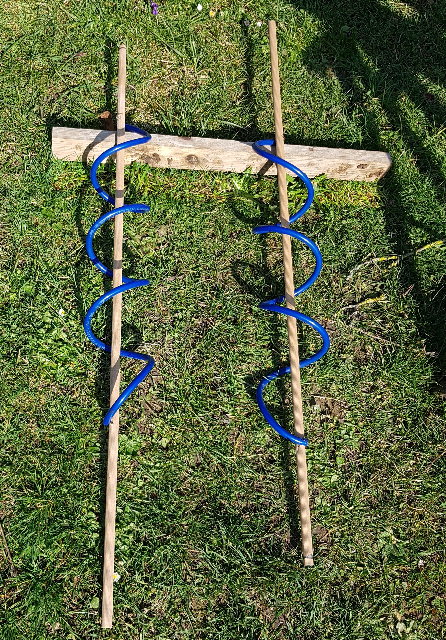 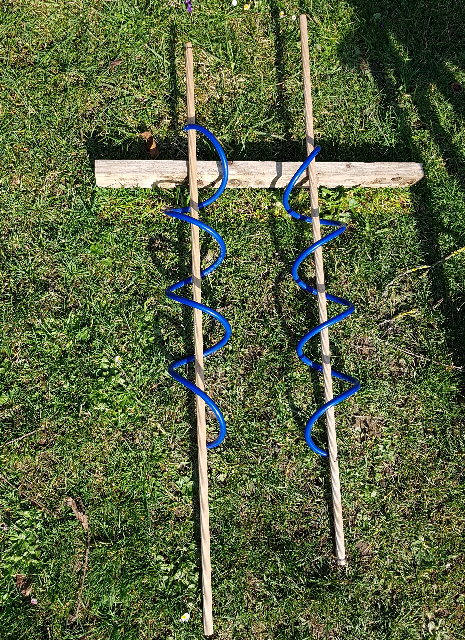 |
| Abb. 00-01a: und Abb. 00-01b: Zwei
Buchenstäbe mit Spiralen aus hartem PE, links: die linke Spirale CW, die rechte CCW, rechts: die linke Spirale CCW, die rechte CW Die Hölzer haben unterschiedliche Wachstumsrichtung: jeweils beim linken Holz nach hinten und rechten Holz zur Kamera. Die Kombination links erzeugt für sensitive Beobachter eine Gesamtströmung nach hinten, die Kombination rechts eine Gesamtströmung zur Kamera. Two beech rods with spirals made of hard PE, left: the left spiral is clockwise, the right one anticlockwise, right: the left spiral is anticlockwise, the right one clockwise The rods have different directions of growth: on the left rod, the direction runs backwards, and on the right rod, towards the camera. For sensitive observers, the combination on the left creates an overall flow towards the back, whilst the combination on the right creates an overall flow towards the camera.(FB) |
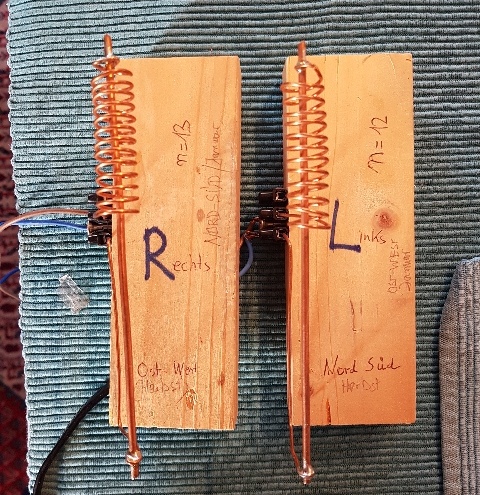 |
| Abb. 00-02: Stab und Spirale,
Flußbeschleuniger, Rechtsgewinde und Linksgewinde. Die natürlichen Strömungen der Erde "Nordwind" und "Ostwind" wirken auf beide. Das Ergebnis ist von der Jahreshälfte und der Orientierung der Spulenachse abhängig: Die linke Anordnung wirkt in Ost-West-Richtung in der zweiten Jahreshälfte, die rechte in der Nord-Südrichtung in der zweiten Jahreshälfte. In der ersten Jahreshälfte sind die Richtungen getauscht. raunaechte.htm aus doppel-strahl.htm#kapitel-03-04Rod and spiral, flow accelerator, right-hand thread and left-hand thread. The Earth’s natural currents, the “north wind” and the “east wind”, act upon both. The result depends on the half of the year and the orientation of the coil axis: The left arrangement acts in an east-west direction in the second half of the year, the right one in a north-south direction in the second half of the year. In the first half of the year, the directions are reversed. The Rod and the Spiral have different characteristics. They react in a complementary manner to the ‘easterly wind’ and the ‘northerly wind’ on a half-yearly basis.(FB) |
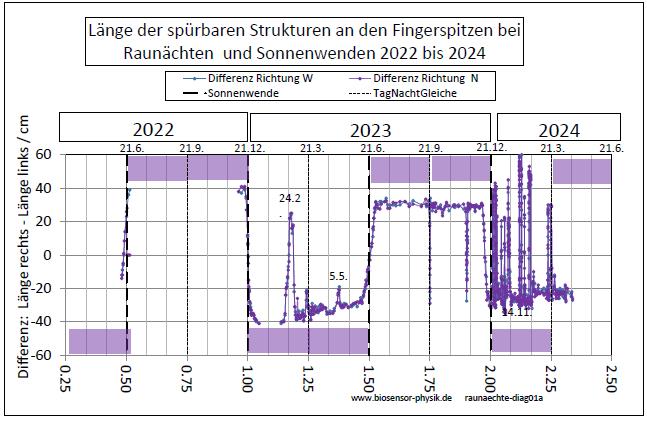 |
| Abb. 00-02:
halbjährliche Veränderungen (Wechsel bei
Sonnenwenden) und zwischenzeitliche
vorübergehende Ausnahmen. biannual changes (occurring at the solstices) and temporary exceptions in between. aus: raunaechte.htm#kapitel-02-01 |
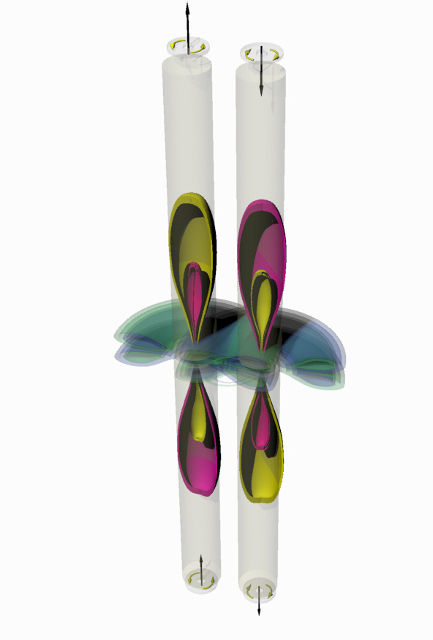  |
Abb. 00-03a und Abb. 00-03b:
oder Abb. 03-02-03 bzw. Abb.
03-02-04
|
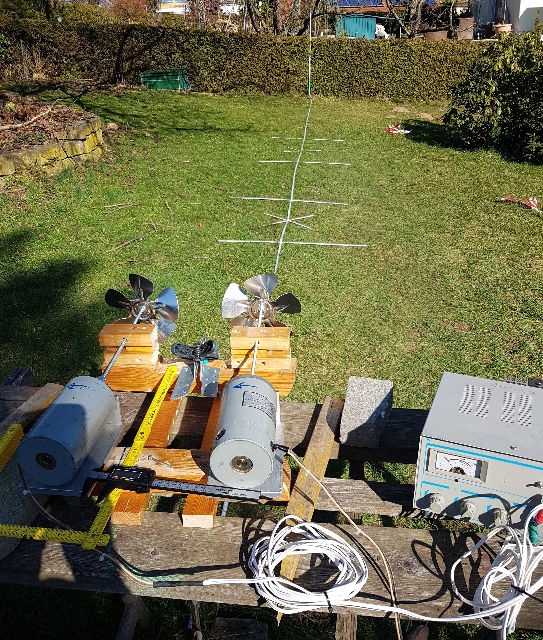 |
| Abb. 00-04: zwei Gleichstrommotore
links: CW, rechts: CCW two DC motors: CW on the left, CCW on the right aus doppel-strahl-zwei.htm#kapitel-07-03 |
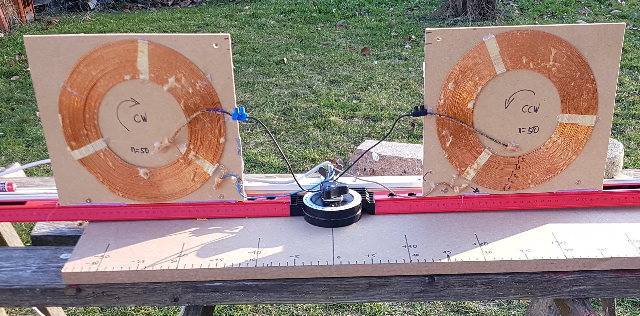 |
Abb. 00-05: aus doppel-strahl-zwei.htm#kapitel-07-01 |
 |
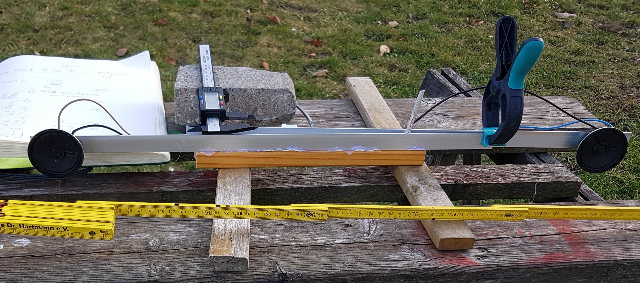
| Abb. 00-06: zwei Plexiglasplatten
werden vom Augenstrahl des Beobachters angeregt. Der
Kippwinkel der beiden Flächennormalen ist
einstellbar. Two plexiglass plates are excited by the observer’s line of sight. The angle of inclination of the two surface normals is adjustable. aus doppel-strahl-zwei.htm#kapitel-07-01 |
 |
| Abb. 00-07: zwei kleine Lautsprecher,
der Differenzwinkel der beiden Achsen ist
einstellbar. two small speakers; the angle between the two axes is adjustable. aus doppel-strahl-zwei.htm#kapitel-07-04 |
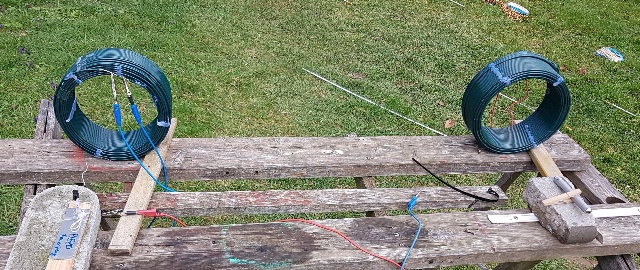 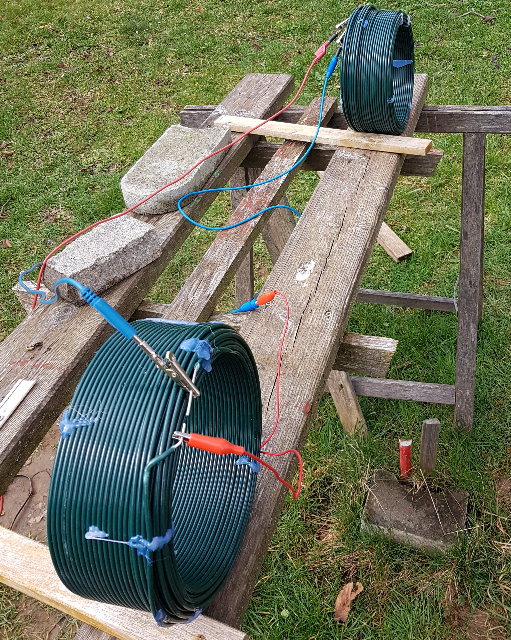 |
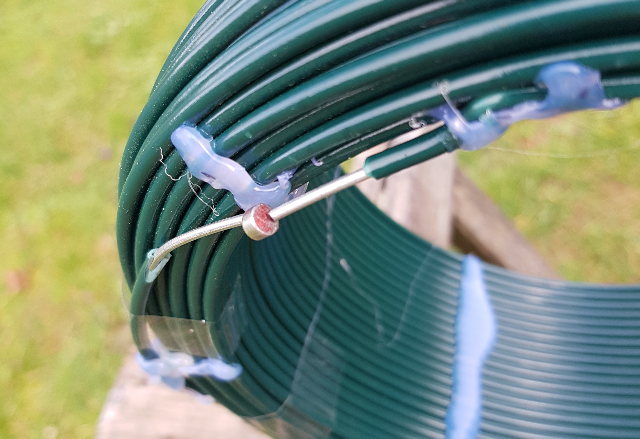
| Abb. 00-08: Zwei Spulen mit
verzinktem Eisendraht (Zaun-Material) mit
Kunststoffüberzug. Version a: elektrischer Gleichstrom nanoAmpere , Version b: zwei kleine Permanentmagnete zwischen den Drahtenden. Anregung mit Schuß aus Laserpointer oder aus Feuerzeug. ???????????????? Strom 230 nanoAmpere |
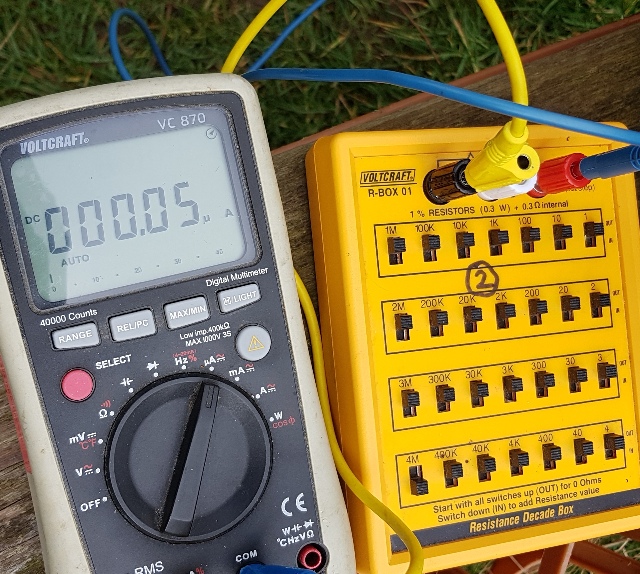 |
| Abb. 00-08a: ganz geringe
Anregung 50
nanoAmpere , 5 MegOhm very slight excitation |
 |
| Abb. 00-09: PinWandMagnet zwischen den Drahtenden.Pinboard magnet between the ends of the wire (FB) |
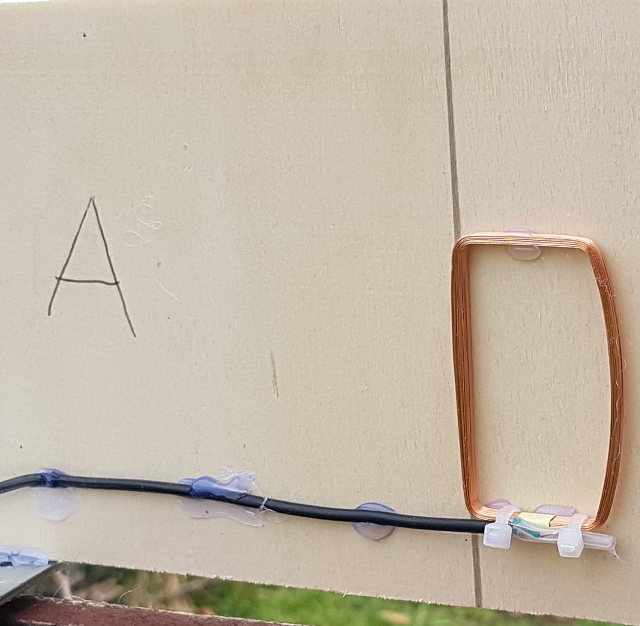 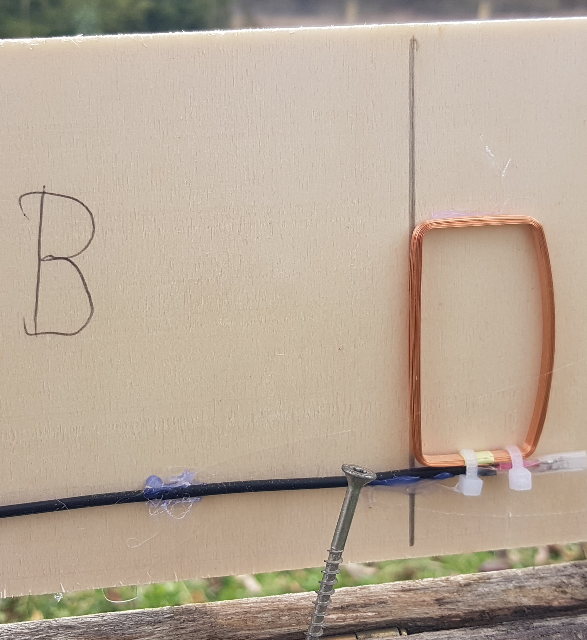 |
| Abb. 00-10: Zwei Luftspulen im
Abstand von 10 Meter Two air coils 10 metres apart (FB) |
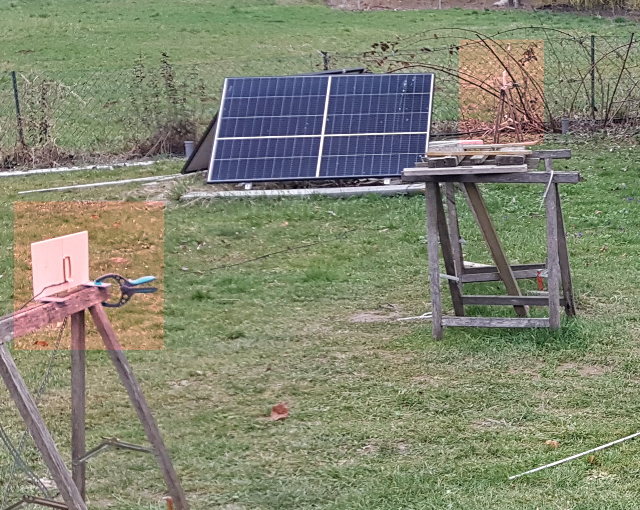 |
| Abb. 00-11: Zwei
Luftspulen im Abstand von 10 Meter Two air coils 10 metres apart(FB) |
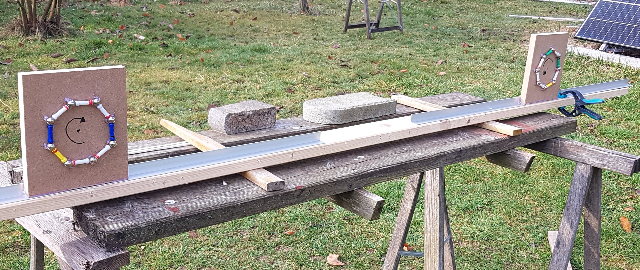 |
Abb. 00-12: Zwei Magnetringe, links CW,
rechts CCW, Winkel der Verkippung ist
einstellbar aus doppel-strahl-zwei.htm#kapitel-07-08 |
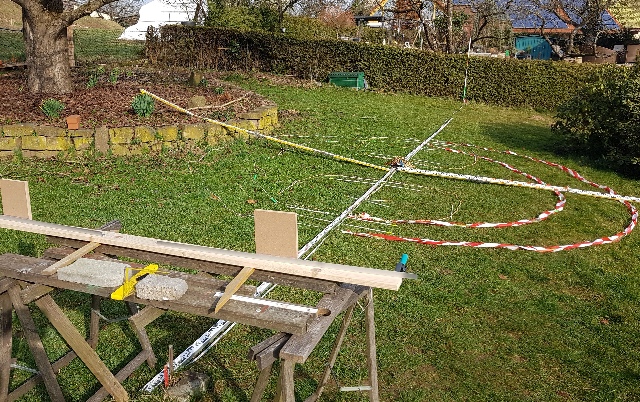 |
Abb. 00-13:aus doppel-strahl-zwei.htm#kapitel-07-08 |
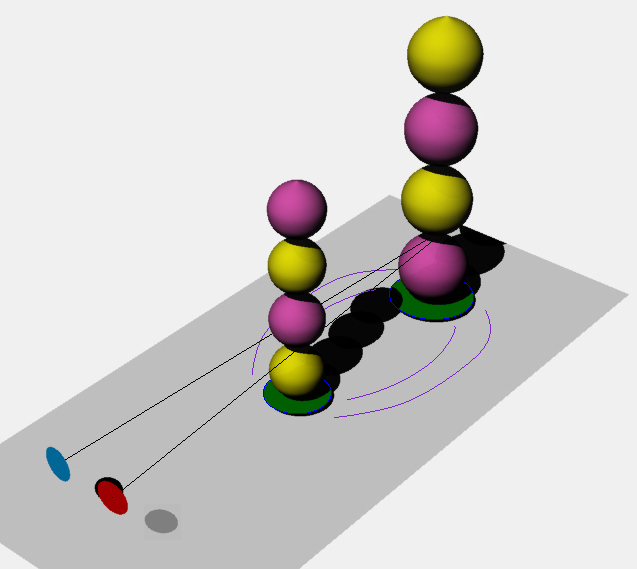 |
Abb. 00-14: große Strukturen auf der
Wiese aus doppel-strahl-zwei.htm#kapitel-07-03 |
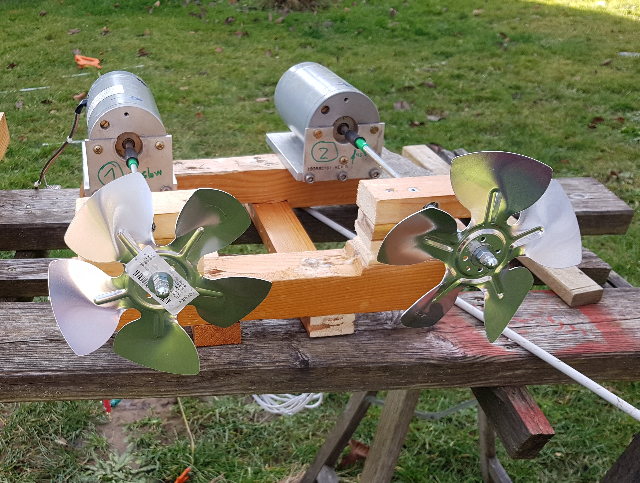  |
| Abb. 00-15: es ist nicht der
Luftstrom zwischen den Propellern, der die großen
Strukturen erzeugt. Sondern die feinstofflichen
Strukturen bedingt durch die Walzrichtung des
Kupferblechs beeinflussen die Wechselwirkung beider
Rotoren. Dreht man das Blech um seine Normale
jeweils um 90° gibt es nicht bei allen vier
Möglichkeiten die großen Strukturen auf der Wiese. It is not the airflow between the propellers that creates the large structures. Rather, it is the subtle structures caused by the direction in which the copper sheet was rolled that influence the interaction between the two rotors. If the sheet is rotated 90° around its normal axis in each of the four possible directions, the large structures do not appear on the meadow in all four cases. (FB) |
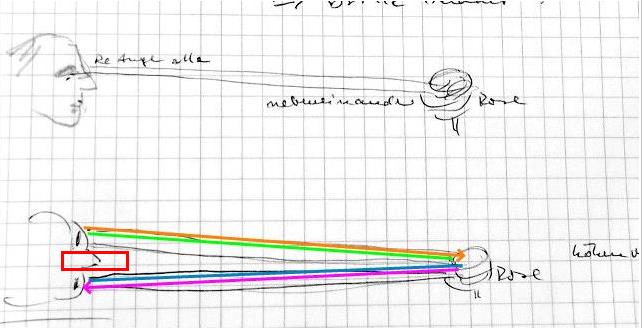 |
Abb. 00-16:Abb. 04-03-01: Die beiden Augenstrahlen haben unterschiedliche Eigenschaften (Drehrichtung und Ausbreitungsrichtung). Ein mechanisches Hindernis zwischen beiden Augen verhindert die Wechselwirkung beider Strahlen. |
 |
Abb. 00-17:aus augenstrahl.htm#kapitel-03-01 |
 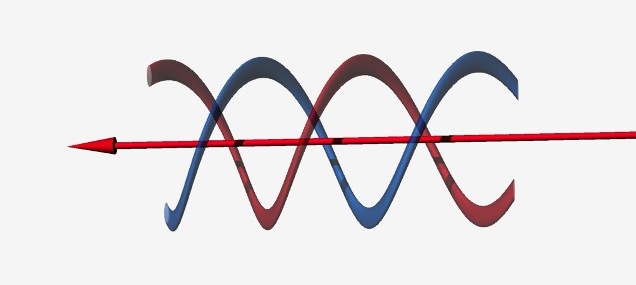 |
Abb. 01-18a: und Abb. 01-18b:aus stab-und-spirale.htm |
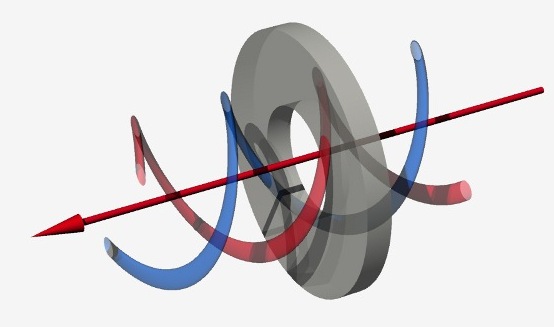 |
Abb. 01-19: aus stab-und-spirale.htm
Die Schrauben beeinflussen das Hindernis
<---> Das Hindernis beeinflußt die
Schrauben
aus ring-stroemung.htm The
screws influence the obstacle
<---> The obstacle influences the screws
Fig. 00b: If linear motion (red arrow) is applied along the axis of a hollow cylinder (grey), the resulting screw movements within the cylinder wall can induce an annular flow. |
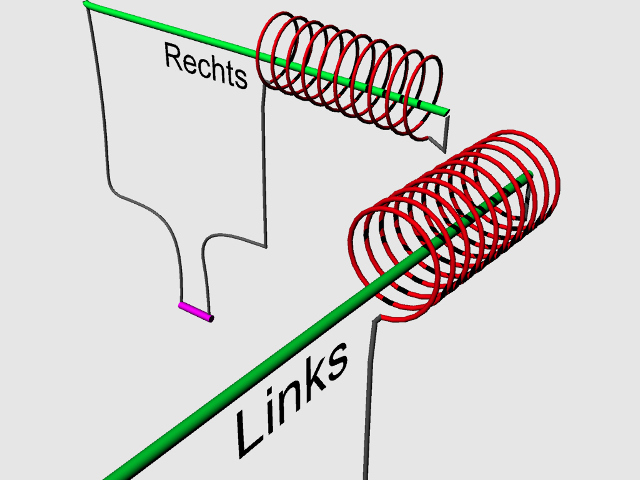 |
Abb. 01-20: aus stab-und-spirale.htm#kapitel-02 |
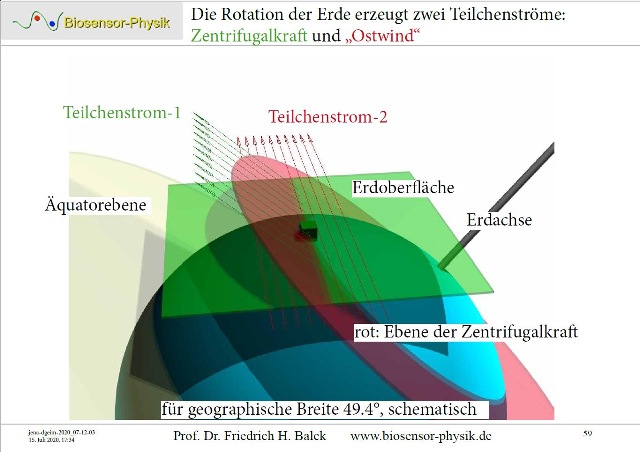 |
Abb. 01-21: aus stab-und-spirale.htm#kapitel-01 |
 |
Abb. 01-22: aus ring-stroemung.htm#kapitel-04 |
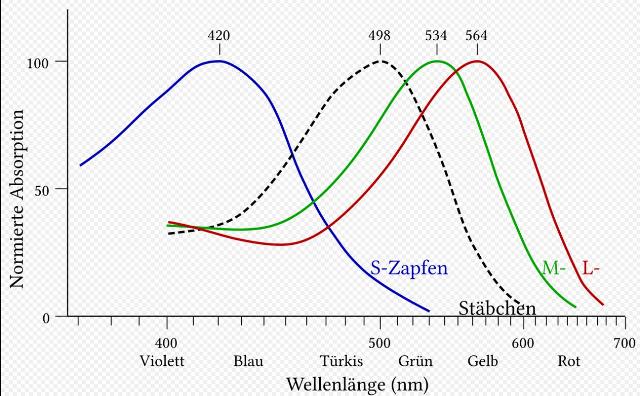
1. Das menschliche Auge, Sensoren für unterschiedliche Lichtwellenlängen
 |
| Abb. 01-01: Stäbchen und Zapfen, blau: S-Zapfen, schwarz-gestrichelt: Stäbchen, grün: M-zapfen, rot: L-Zapfen cone absorbance Augen Farbspektrum Von OpenStax College - Anatomy & Physiology, Connexions Web site. http://cnx.org/content/col11496/1.6/, Jun 19, 2013., CC BY 3.0, https://commons.wikimedia.org/w/index.php?curid=30148003 |
 |
| Abb. 01-02: Stäbchen und Zapfen https://commons.wikimedia.org/wiki/File:Cone-response-de(2).svg#/media/File:Cone-absorbance-de.svg |
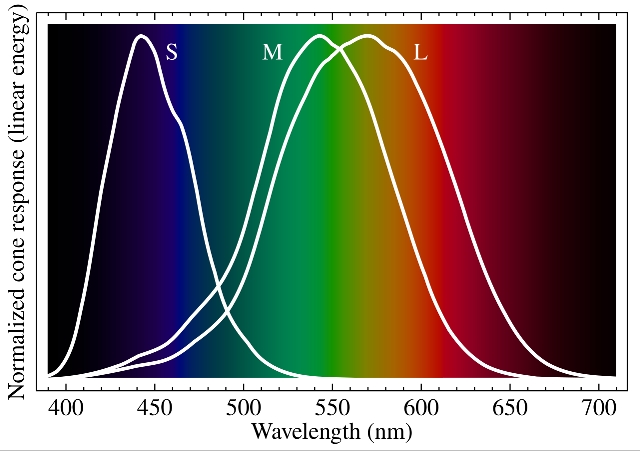 |
| Abb. 01-03: Spektrum der Augen-
Zapfen S-Zapfen, M-zapfen,
L-Zapfen By BenRG - Own work, Public Domain, https://commons.wikimedia.org/w/index.php?curid=7873848 |
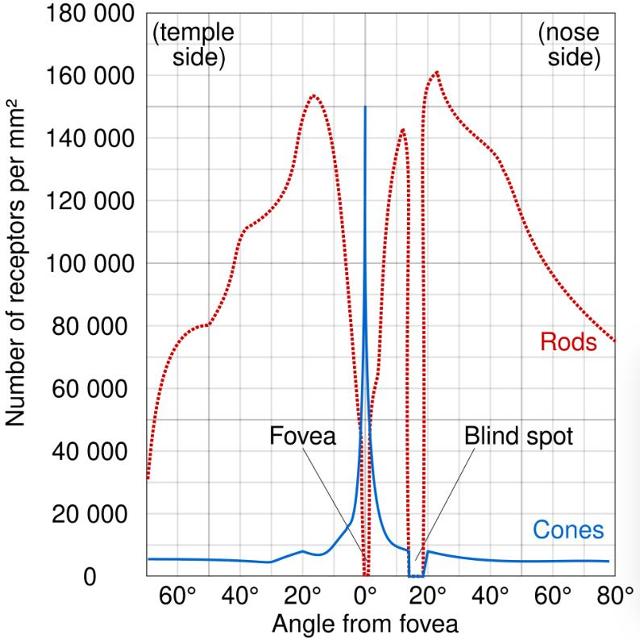 |
| Abb. 01-04: Winkelverteilung der
Rezeptoren rot: Stäbchen, blau: Zapfen By Cmglee - Own work, CC BY-SA 3.0, https://commons.wikimedia.org/w/index.php?curid=29924570 Photorezeptoren im Auge , Winkelabhängigkeit |
2. Brillen, Filter Glasses, filters
2.1 normale Brillen und Filter standard glasses and filters
Wie wirkt eine Brille oder ein Drahtgestell auf das"Sehen" von feinstofflichen Strukturen?
How do glasses or a wire frame affect the “perception” of subtle structures?
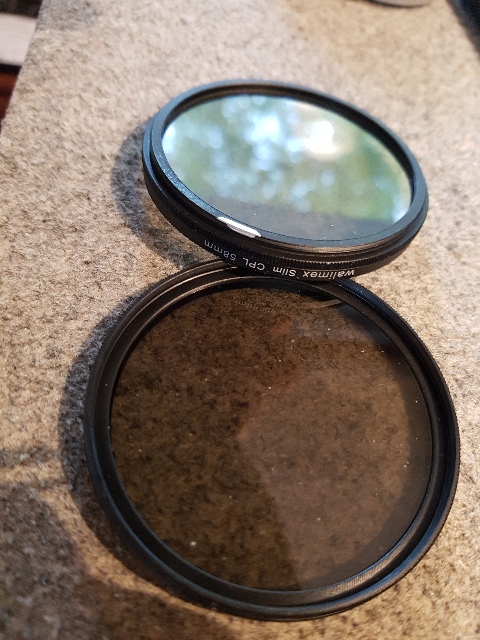 |
| Abb. 02-01-01:
Polarisationsfilter , normal und zirkular Polarising filters, linear and circular (FB) |
 |
Abb. 02-01-02:
aus ostwind.htm#kapitel-03-07 |
 |
| Abb. 02-01-03: Metallrahmen ohne
Gläser, Lesebrille mit einfachen Glas-Gläsern Metal frames without lenses, reading glasses with standard lenses (FB) |
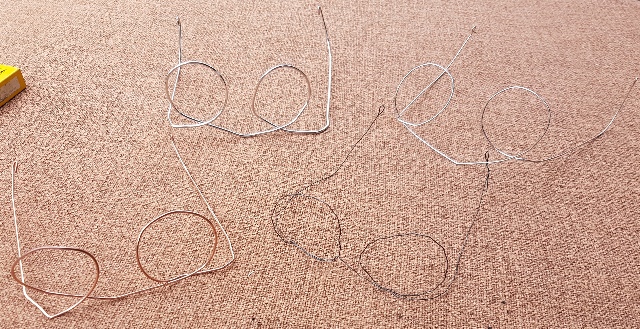 |
| Abb. 02-01-04: Verschiedene
"Nasenfahrräder" auf einfachem Draht Various ‘nose bikes’ made from simple wire (FB) |
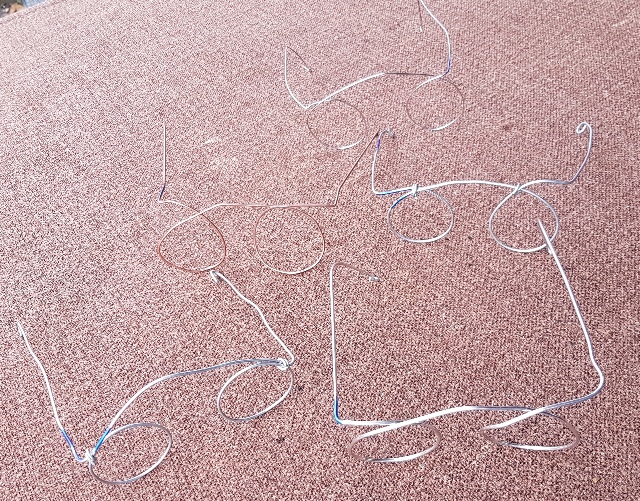 |
| Abb. 02-01-05: verschiedene
Probestücke: Material, Ziehrichtung, Bauart der
Kreuzungen various test specimens: material, drawing direction, design of the junctions (FB) |
 |
| Abb. 02-01-06: Einfache
Nikolaus-Brille Simple Santa Claus glasses (FB) |
2.2 farbige Brillen coloured glasses
VANLO GELB
A grating
spectrometer with a photomultiplier; on the left,
the spectacles illuminated by an LED torch |
| Abb. 02-02-01: Nachtfahrbrille, sie
verhindert das feinstoffliche "Sehen" Night-vision goggles; they prevent “seeing” in the subtle realm (FB) |
 |
| Abb. 02-02-02: Gitterspektrometer mit
Photomulitplier, links die von einer
LED-Taschenlampe beleuchtete Brille A grating spectrometer with a photomultiplier; on the left, the spectacles illuminated by an LED torch (FB) |
 |
| Abb. 02-02-03:
Gitterspektrometer (FB) |
 |
| Abb. 02-02-04: gemessene Intensitäten
bei unterschiedlichen Wellenlängen. rot: ohne Brille, blau: mit Brille, schwarz: Transmission (Verhältnis mit/ohne Brille) Measured intensities at different wavelengths. Red: without glasses, blue: with glasses, black: transmission (ratio with/without glasses) (FB) |
VANLO GELB, GRÜN, BLAU, TÜRKIS, ROSA BAKER-MILLER-PINK
YELLOW, GREEN, BLUE, TURQUOISE, PINK, BAKER-MILLER PINK
 |
| Abb. 02-02-05: Durchstimmen der
Wellenlänge mit Getriebemotor Tuning the wavelength using a gear motor (FB) |
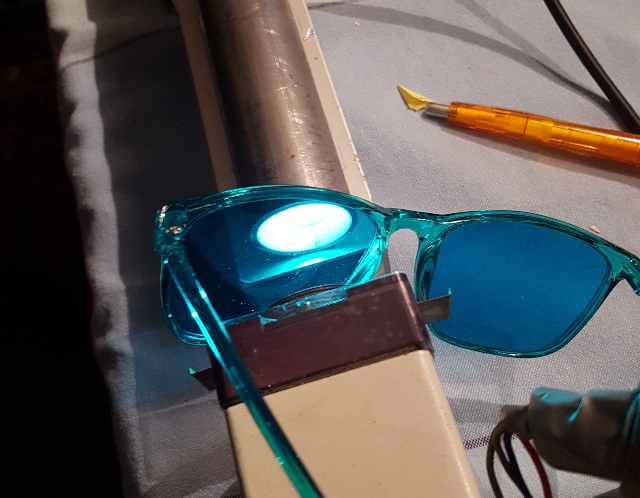 |
| Abb. 02-02-06: Blaue Brille im
Strahlengang. Beleuchtung mit einer 5W
Auto-Glühbirne im 30 mm Stahlrohr als Kollimator. Blue filter in the beam path. Illumination provided by a 5W car bulb housed in a 30 mm steel tube acting as a collimator. (FB) |
 |
| Abb. 02-02-07: Original-Datensatz der
Messung mit Gitterspektrometer und Photomultiplier bei der obersten Kurve gab es Störungen der Hochspannung. Original data set from the measurement using a grating spectrometer and photomultiplier The topmost curve shows evidence of high-voltage interference. (FB) |
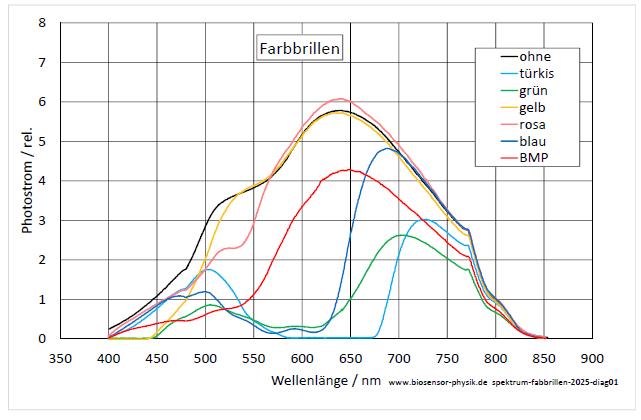 |
| Abb. 02-02-08: Absolute gemessene
Intensitäten bei den verschiedenen Wellenlängen. Um die Transmission zu erhalten, müssen die Werte der Brillenkurven durch die der "ohne" Kurve dividiert werden. Absolute measured intensities at the various wavelengths. To calculate the transmittance, the values of the ‘with’ curves must be divided by those of the ‘without’ curve.(FB) |
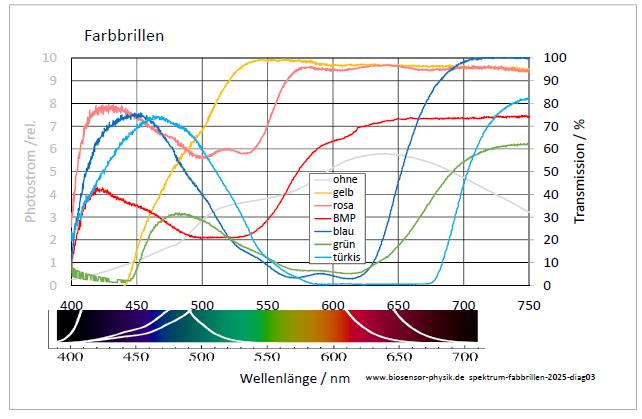 xxx 550 - 650 xxx |
| Abb. 02-02-09: Transmissionen, zum
Vergleich der genutzten Intensität ist auch die
"ohne"-Kurve eingetragen. Unterhalb von 450
nm, ist die Strahlung der Glühbirne vergleichsweise
gering. Daher zeigen die andern Kurven ein
zunehmendes Rauschen. Bereich für die Wahrnehmung von "sichtbaren" Strukturen durch den Autor: 550 bis 650 nm Transmissions; the ‘without’ curve is also plotted for comparison of the intensity used. Below 450 nm, the light emitted by the bulb is comparatively low. Consequently, the other curves show increasing noise. Range for the author's perception of ‘visible’ structures: 550 to 650 nm (FB) |
Farben
Ausdehnung der feinstofflichen Strukturen, wenn man die bunte Kartons mit den Augen intensiv anstrahlt.
Expansion of the subtle structures when one stares intently at the colourful cards.
aus farben.htm#kapitel-02 |
||||
 |
||||
Abb. 02-02-11:
Ausdehnung der "sichtbaren" und spürbaren
Strukturen bei farbigen Papieren
aus farben.htm#kapitel-02 |


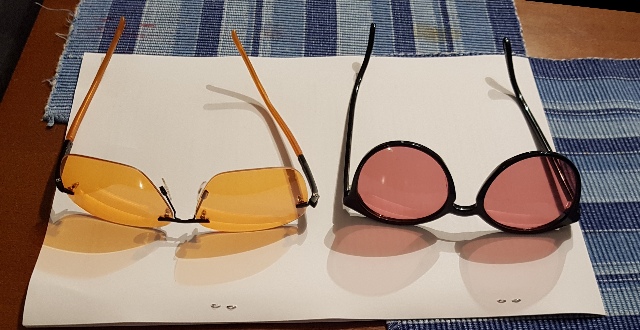 |
| Abb. 02-02-12: Rahmenlose
Brille (links) und eine mit dünnem Rahmen, mit
beiden lassen sich feinstoffliche Strukturen
wahrnehmen. Die linke Brille ist besser
geeignet. Ein Beobachter, der sich seitlich vom Brillenträger (senkrecht zu dessen Augenstrahl) befindet, kann den Strahl im Raum außerhalb der Brille wahrnehmen. Rimless glasses (left) and a pair with a thin frame; both allow one to perceive subtle structures. The glasses on the left are more suitable. An observer standing to the side of the person wearing the glasses (perpendicular to their line of sight) can perceive the beam in the space outside the glasses.(FB) |
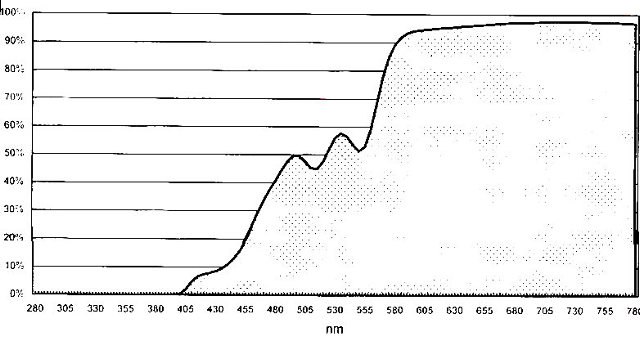 |
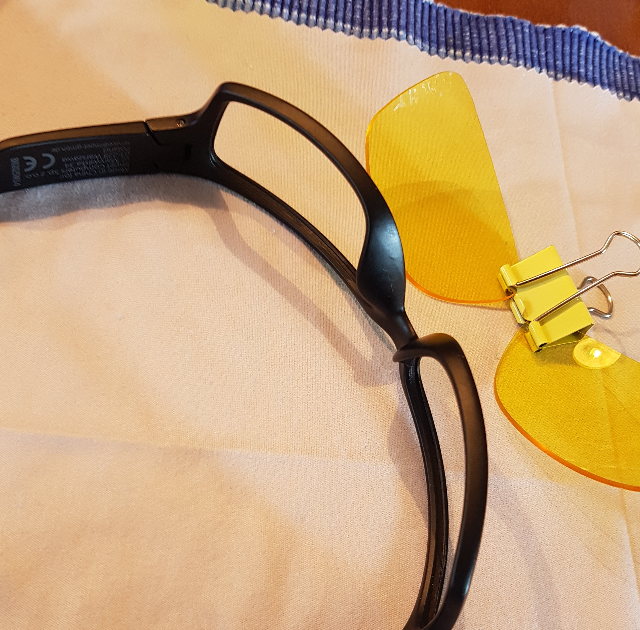
| Abb. 02-02-12a: die linke Brille im
oberen Bild ist ein Kantenfilter, das ab 555 nm
nahezu alles durchläßt The left-hand filter in the top image is a bandpass filter that transmits almost everything above 555 nm |
 |
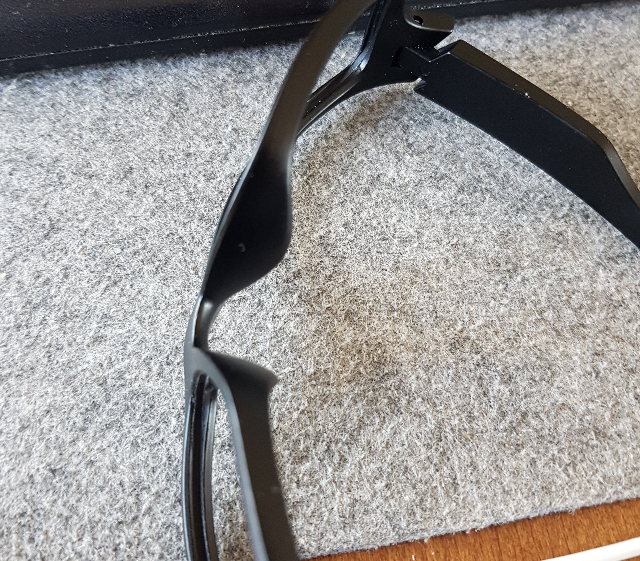
| Abb. 02-02-13: Nachtfahrbrille mit
dicken Nasenstegen. Diese verhindern die
kommunikation beider Augen miteinander. Für
eine permanent "sichtige" Person gut geeignet, um
die feinstofflichen Strukturen auszublenden. Night-vision goggles with thick nose bridges. These prevent the two eyes from communicating with each other. Well suited for someone with permanent ‘clear vision’ to block out subtle structures.(FB) |
 |
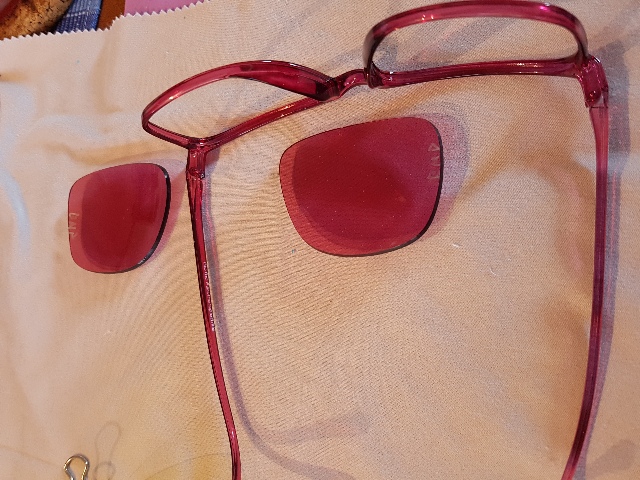
| Abb. 02-02-14: dicke Nasenstege
thick nose bridges
(FB) |
 |
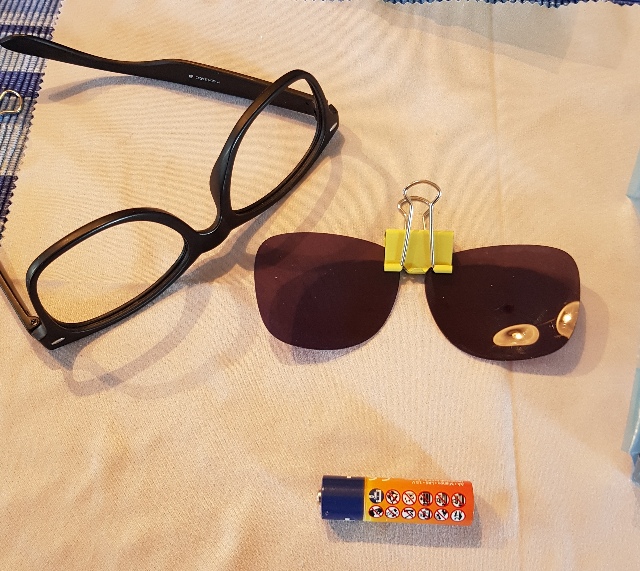
| Abb. 02-02-14: Therapiebrille,
BMP, die Gläser ohne Rahmen erlauben das
feinstoffliche "Sehen", sofern die
Orientierung (bedingt durch die Walzrichtung
bei der Herstellung) wie mit Rahmen bleibt. Therapeutic glasses, BMP: these frameless lenses allow for subtle ‘vision’, provided that the orientation (determined by the rolling direction during manufacture) remains the same as with framed glasses.(FB) |
 |
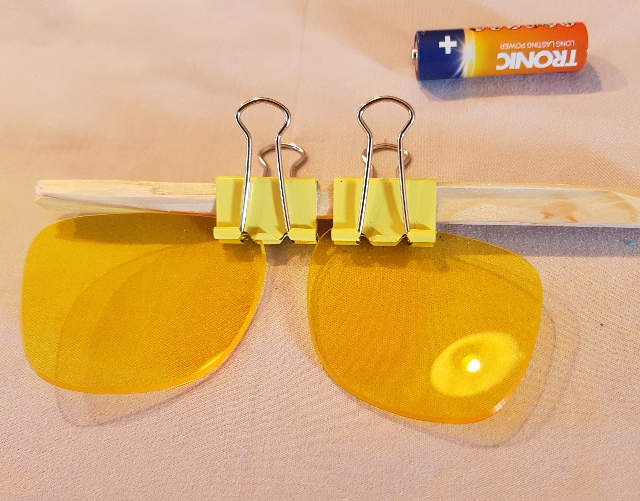
| Abb. 02-02-15: Autofahrerbrille
mit polarisierenden Gläsern. Bei dieser
Ausrichtung ist das "Sehen" möglich Driving glasses with polarised lenses. With this type of lens, clear vision is possible (FB) |
 |
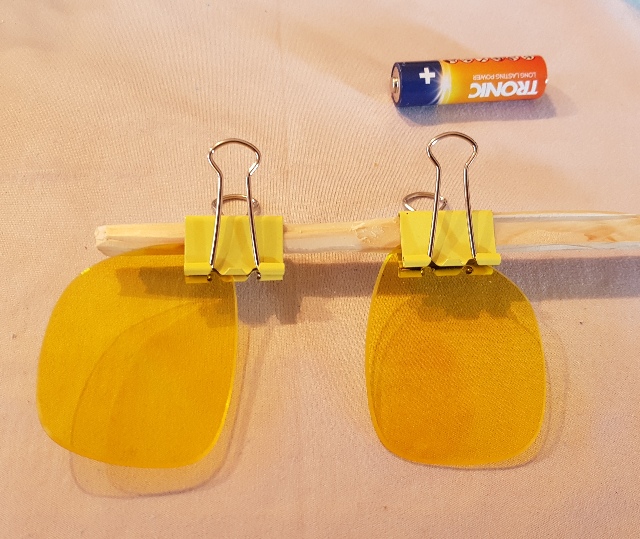
| Abb. 02-02-16: Bei dieser
Ausrichtung ist das "Sehen" möglich, die durch
das Walzen entstandene Polarisierung ist nicht
hinderlich. With this orientation, ‘seeing’ is possible; the polarisation caused by rolling does not interfere.(FB) |
 |
| Abb. 02-02-17: Bei dieser
Ausrichtung ist das "Sehen" nicht möglich,
durch das Walzen sind die Gläser polarisiert und bei
Normalstellung des Kopfes daher für das
feinstoffliche "Sehen" undurchlässig. Wird der Kopf geneigt in Richtung Liegen, dann ist das "Sehen" wieder möglich. In this position, ‘seeing’ is not possible; the lenses are polarised by the rolling process and are therefore opaque to subtle ‘seeing’ when the head is in the normal position. If the head is tilted towards the lying position, ‘seeing’ becomes possible again.(FB) |
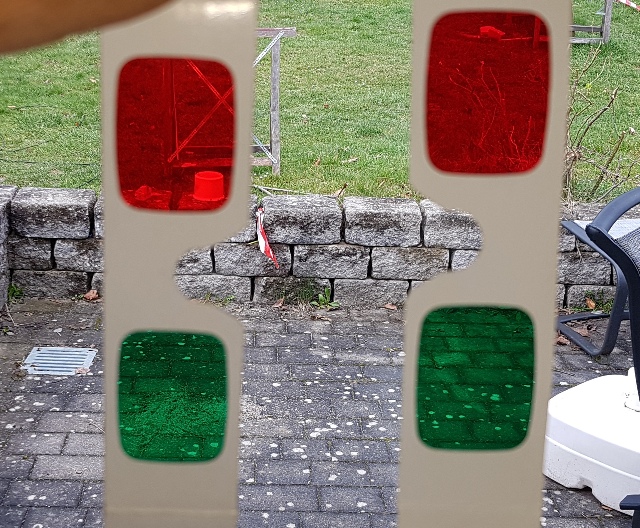 |
| Abb. 02-02-18: zwei 3D-Brillen. Beim Blick durch die beiden roten Fenster bleiben die unsichtbaren Strukturen "sichtbar" und auch bei den grünen Fenstern ist das "sehen" möglich, allerdings etwas schwächer*. * von einem seitlich stehenden Beobachter des Augenstrahls gemerkt. (FB) |
3. Eigenschaften des Augenstrahls Properties of the eye beam
3.1 Beobachtungen durch Spüren Observations through perceiving
Der Augenstrahl bildet ein Dreieck
right eye - object - left eye - right eye
Strahl aussenden und reflektierten Strahl empfangen, danach Vergleich des gesendeten mit dem empfangenen Signal
transmit a beam and receive the reflected beam, then compare the transmitted signal with the received signal
aus ostwind.htm#kapitel-03-08
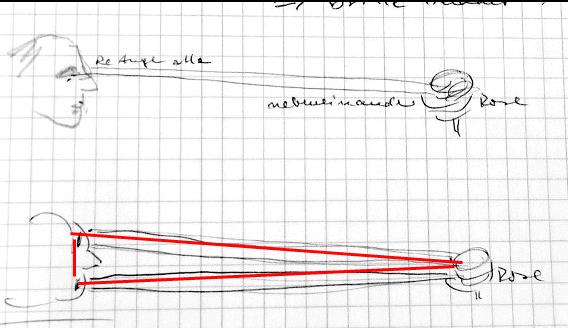 |
Abb. 03-01-01:aus ostwind.htm#kapitel-03-08 |
 |
Abb. 03-01-02:aus ostwind.htm#kapitel-03-08 |
  |
Abb. 03-01-03:aus ostwind.htm#kapitel-03-08 |
 |
Abb. 03-01-04:aus ostwind.htm#kapitel-03-08 |
|
| Abb. 03-01-05: Unterbrechung
des Augenstrahls mit einem Hindernis an der
Nasenwurzel, "das habe ich schon als Kind gewußt, daß man mit einem Finger an der Nasenwurzel das "Sehen" beeinflussen kann." (L.S.) aus ostwind.htm#kapitel-03-08Interruption of the eye beam by an obstacle at the bridge of the nose, “I knew even as a child that you can influence ‘vision’ by placing a finger on the bridge of the nose.” (L.S.) Fig. 03-08-04a: If an object is placed in the intermediate zone, the connection is interrupted. This eliminates the ability to emit an ocular ray, or rather to ‘illuminate’ the surroundings and thus perceive subtle structures ‘see’.?????? (FB) |
|
| Abb. 03-01-05a: Ein
mechanisches Hindernis zwischen beiden Augen
verhindert die Wechselwirkung beider Strahlen (FB) A physical barrier between the two eyes prevents the two beams from interacting (FB) |
Physikalische Geräte, Strömungen in Drähten und Kapillaren
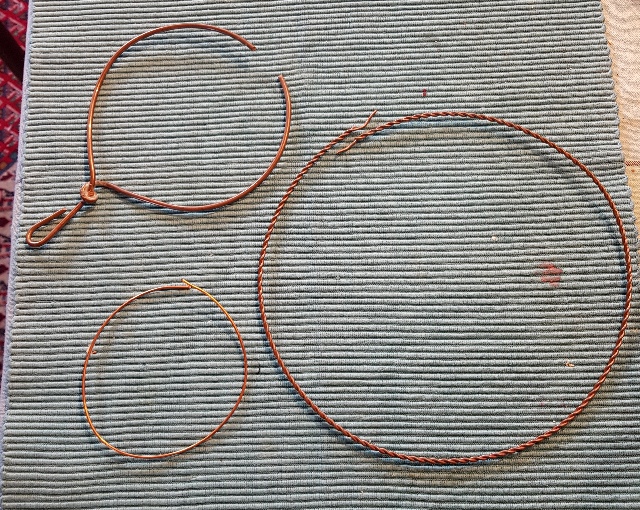
Schleife mit einer Windung:
Das Vorzeichen der "Gewindesteigung" bestimmt die Reihenfolge der feinstofflichen Strukturen.
Physical devices, flows in wires and capillaries
Loop with a single turn:
The sign of the ‘pitch’ determines the order of the subtle structures.
 |
|||||||||||||||||||
| Abb.
03-01-06: Drei verschiedene Schleifen, das
Vorzeichen der "Gewindesteigung" läßt sich durch
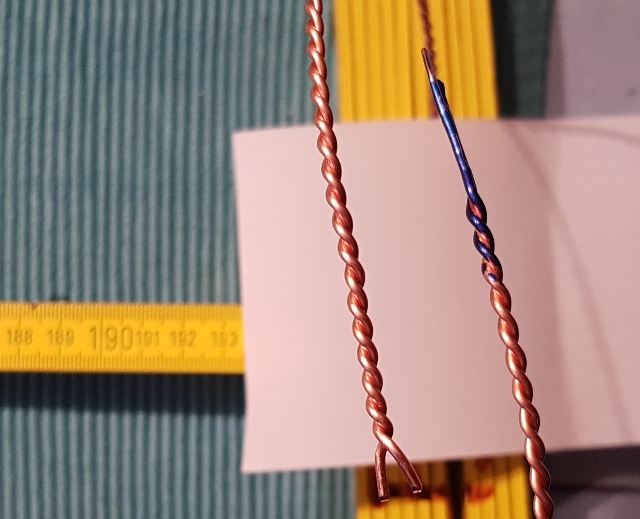
Verbiegen leicht verändern. einfacher Draht, Draht mit Griff, und verdrillter Doppeldraht Three different loops; the ‘pitch’ can be easily adjusted by bending. plain wire, wire with a handle, and twisted double wire(FB) |
|||||||||||||||||||
 |
 |
||||||||||||||||||
| Abb.
03-01-07a und 07b: verdrillter Doppeldraht, zwei
Strukturen auf der linken Seite (West), Ausdehnung
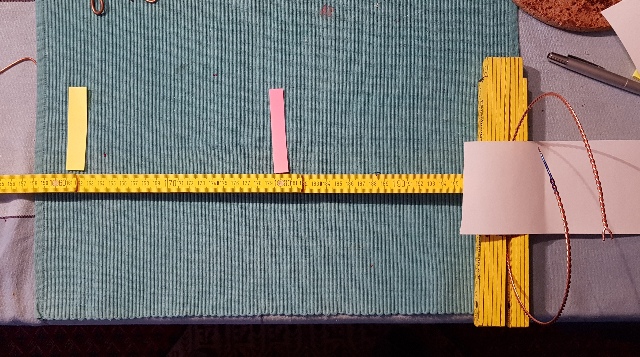
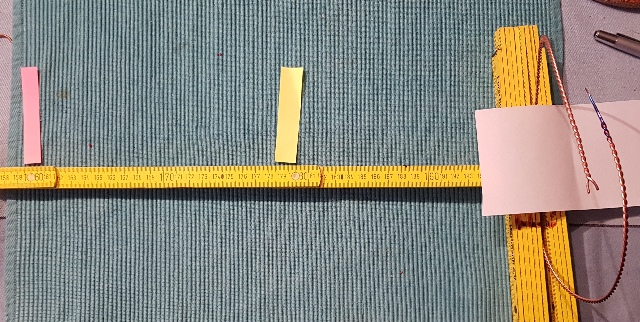
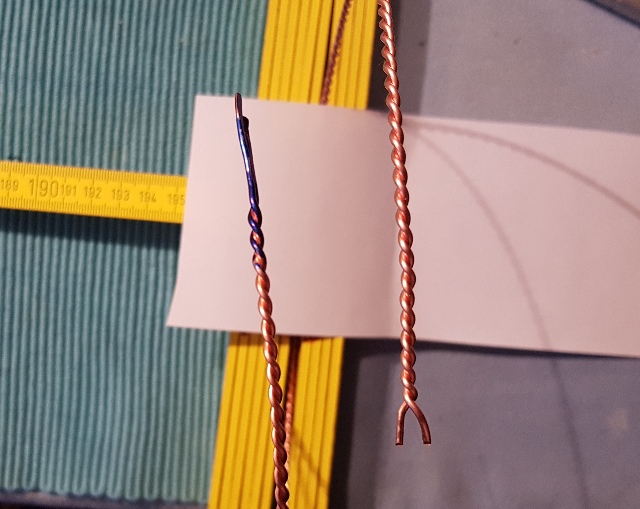
jeweils mit gelb und pink markiert. twisted double wire, two structures on the left-hand side (west), each marked with yellow and pink. (FB) |
|||||||||||||||||||
 |
 |
||||||||||||||||||
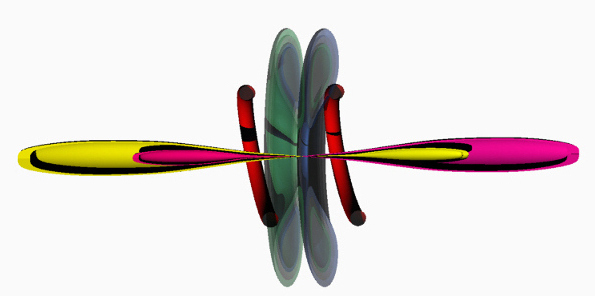
| Abb. 03-01-08a: Ziehrichtung zeigt
etwas nach links. The pull
direction is slightly to the left.(FB) |
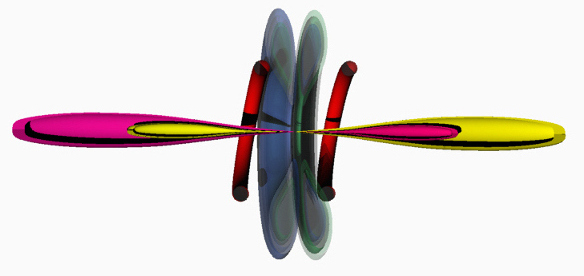
Abb. 03-01-08b: Ziehrichtung zeigt
etwas nach rechts. The pull direction is slightly to the right. (FB) |
||||||||||||||||||
 |
 |
||||||||||||||||||
| Strukturen
schematisch (FB) |
|||||||||||||||||||
| Abb. 03-01-09a: Verdrillter Doppeldraht, das Ende mit der Markierung der Ziehrichtung zeigt etwas nach links. Twisted double wire, with the end bearing the direction-of-draw mark pointing slightly to the left .
|
Abb. 03-01-09b: Verdrillter Doppeldraht, das Ende mit der Markierung der Ziehrichtung zeigt etwas nach rechts. Twisted double wire, with the end bearing the direction-of-draw mark pointing slightly to the right
|
||||||||||||||||||
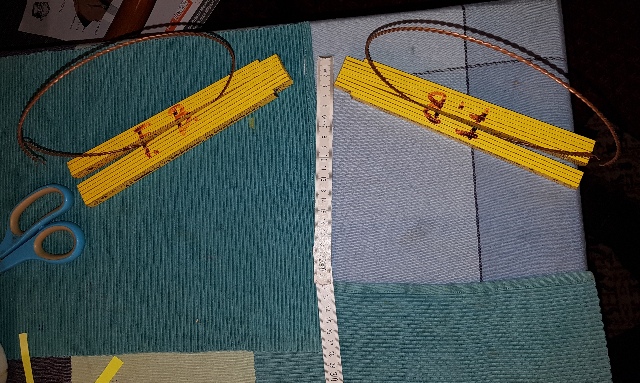
Fokussierung von zwei Strömungen Convergence of two trends
 |
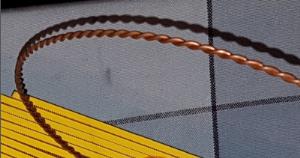 |
| Abb. 03-01-10a: rechts gewendelt CW (FB) | Abb. 03-01-10b: links gewendelt CCW (FB) |
 |
|
| Abb.
03-01-11: Zwei Schleifen aus verdrilltem
Doppeldraht: links CW und rechts CCW Aus jeder Schleife kommt eine Strömung in Achsenrichtung heraus, die sich bei dieser Anordnung an einem Punkt am unteren Bildrand in der Mitte treffen (fokussiert sind). Two loops made of twisted double wire: CW on the left and CCW on the right A flow emerges from each loop in the axial direction; in this arrangement, these flows meet at a point in the centre at the bottom of the image (they are focused). CW (FB |
|
 |
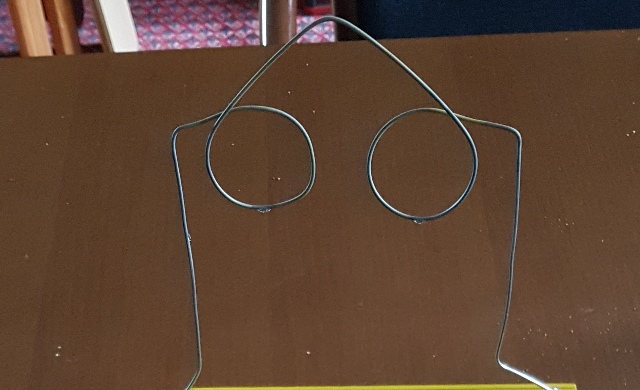
Abb. 03-01-12:
Aura-Sehen-Test-Brille: beim Blick durch diese
"Brille" wird je nach Ziehrichtung des Drahtes der
Augenstrahl gesperrt bzw. durchgelassen. Diese
Version der Drahtführung ist noch nicht optimiert!aus ostwind.htm#kapitel-03-13 Aura-viewing test glasses: when looking through these ‘glasses’, the line of sight is either blocked or allowed to pass, depending on the direction in which the wire is pulled. This version of the wire guide has not yet been optimised! Fig. 03-13-01: “Glasses” bent from a single piece of wire. When stimulated from the outside (earth), a current flows along the wire, which is coupled with a second current along the axis of the loop. The direction in which the wire is pulled determines whether these currents flow towards or away from the eyes. (FB) |
 |
Abb. 03-01-13:
Aura-Sehen-Test-Brille Typ-1: mit optimierter
Drahtführung, die Richtung der schwarzen Pfeile
beschreibt zwei unterschiedliche Strömungenaus ostwind.htm#kapitel-03-13Aura-Viewing Test Glasses Type 1: with optimised wire routing; the direction of the black arrows indicates two different flows
|
 |
Abb. 03-01-14:
Aura-Sehen-Test-Brille Typ-2: mit optimierter
Drahtführung die Richtung der schwarzen Pfeile
beschreibt zwei unterschiedliche Strömungen
aus ostwind.htm#kapitel-03-13 Aura-Viewing Test Glasses Type 2: with optimised wire routing; the direction of the black arrows indicates two different flows Fig. 03-13-05: Passage for waves from the outside to the eyes Direction of flow from left to right. (FB) |
 |
| Abb. 03-01-15: optimierte
Drahtführung, eine Windung jeweils, spiegelbildlich
angeordnet optimised wire routing, one turn each, arranged in a mirror image(FB) |
 |
| Abb. 03-01-16: zwei bzw. vier
Windungen jeweils, spiegelbildlich angeordnet ostwind two or four turns each, arranged in a mirror image (FB) |
 |
| Abb. 03-01-16a: Kupferdraht mit Seide
umsponnen Copper wire wrapped in silk (FB) |
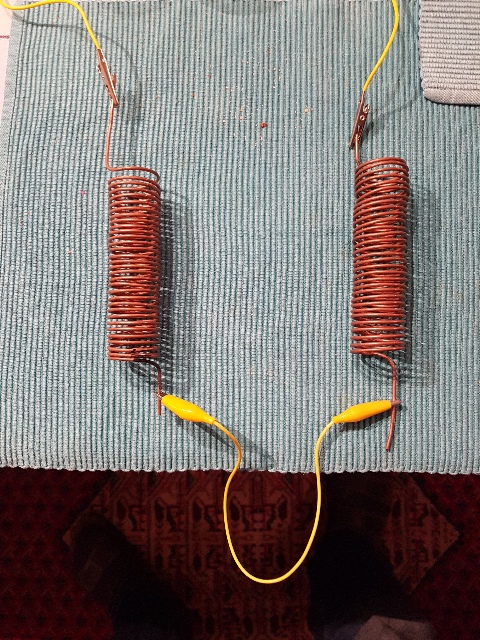 |
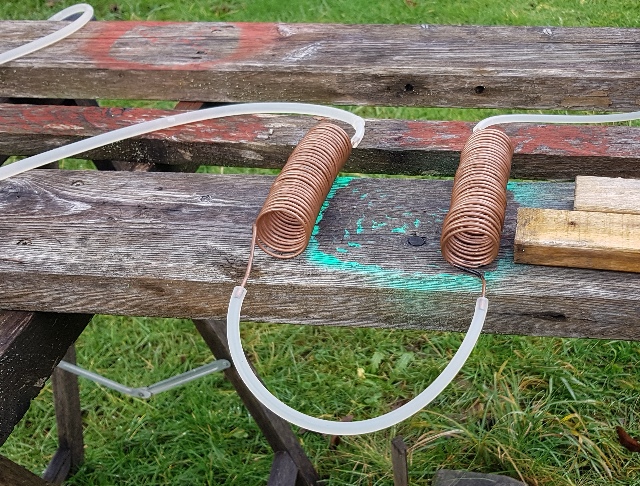
Abb. 03-01-17: jeweils dreißig
Windungen, der Antrieb einer Strömung erfolgt über
die mechanischen Zuleitungen thirty turns each; the flow is
driven by the mechanical supply lines aus ostwind.htm#kapitel-04-02-03 |
 |
| Abb. 03-01-18: jeweils 31 Windungen,
links und rechts gewendelt hier fließt Wasser durch die Spulen aus ostwind.htm#kapitel-04-02-0531 turns each, wound in a left- and right-handed direction water flows through the coils here Fig. 04-02-05-02: The water flows from right to left, thus following the direction of the capillaries. (FB) |
mögliche Formen der feinstofflichen Strukturen : Kugelflächenfunktionen
Possible forms of subtle structures: spherical harmonics
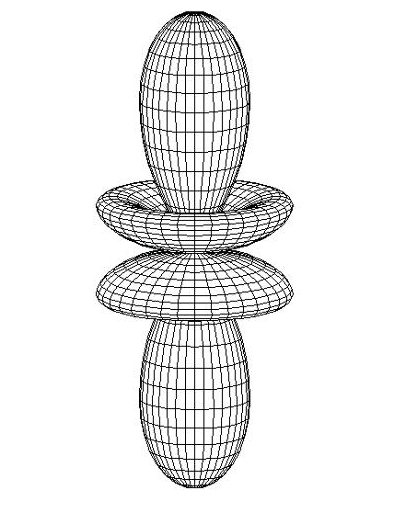 |
| Abb. 03-01-19: Vorlage für die
feinstoffliche Struktur von einem länglichen Objekt:
Kugelflächenfunktion Template for the subtle structure of an elongated object: spherical surface function aus stromleiter-rotierend.htm#kapitel-03-03 |
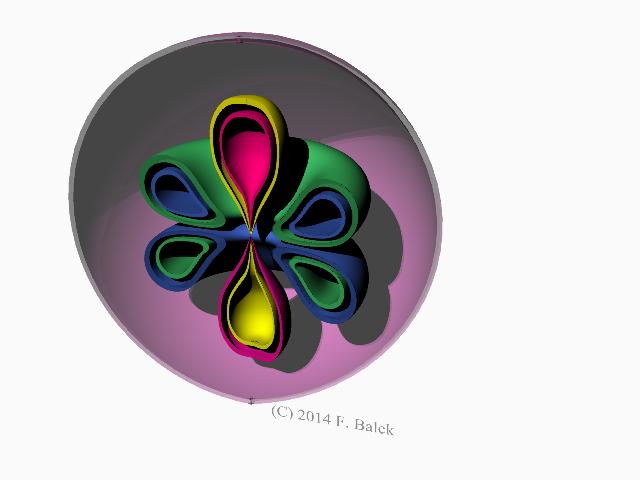 |
| Abb. 03-01-20: (schematisch)
Beobachtung bei einem realen Objekt, feinstoffliche Strukturen bei einer Magnetscheibe aus stromleiter-rotierend.htm#kapitel-03-03 |
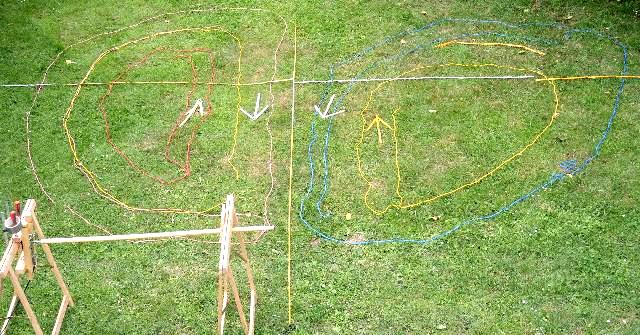 |
Abb. 03-01-21: Beobachtung bei einem
rotierenden Magneten. Querschnitt durch die
zweischalige Struktur. Wenn der Magnet um
seine Achse rotiert wird, wachsen/schrumpfen
die Strukturen an beiden Enden.aus stromleiter-rotierend.htm#kapitel-03-02 |
Doppelstrahl: zwei Wirbel als parallele gegenläufige "Walzen" - auch fokussierbar auf einen Punkt
Double jet: two vortices forming parallel, counter-rotating ‘rolls’ – which can also be focused onto a single point
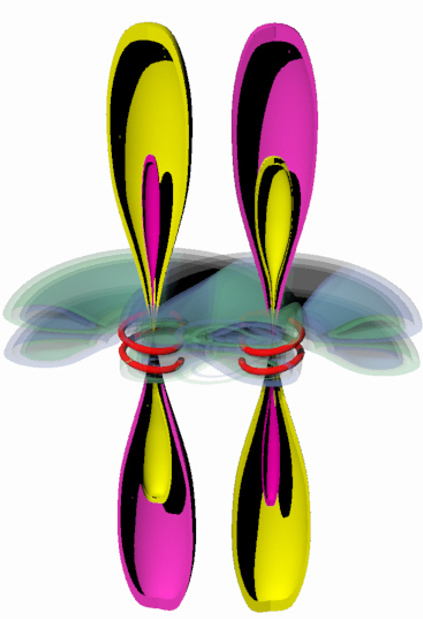 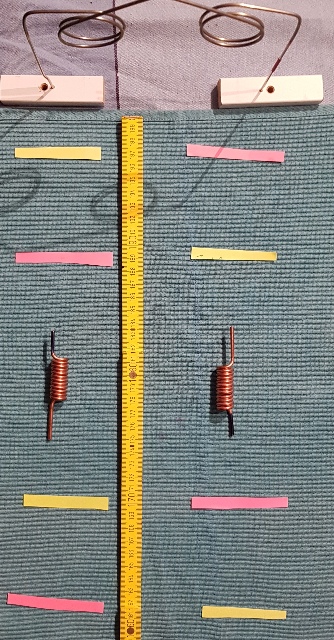 |
| Abb. 03-01-22: links: schematisch:
Überlagerung der Strukturen der spiegelbildlich
angeordneten Spulen mit jeweils zwei Windungen
(rot). Da sich beim Spiegeln auch die jeweilige Drehrichtung einer Struktur umkehrt, gibt es hier unterschiedliche Qualitäten auf beiden Seiten mit unterschiedlichen Drehrichtungen der Wirbel. rechts: in Originalgröße eine CCW-Spule links und eine CW-Spule rechts Left: schematic: superimposition of the structures of the mirror-image coils, each with two turns (red). Since mirroring also reverses the direction of rotation of a structure, there are different qualities on both sides, with the vortices rotating in opposite directions. Right: full size – a CCW coil on the left and a CW coil on the right (FB) |
|
| Abb. 03-01-23: schematisch, Ergänzung
durch die angedeuteten Drehrichtungen der
zylindrischen Wirbel in den axialen Elementen schematic, supplemented by the indicated directions of rotation of the cylindrical swirls in the axial elements (FB) |
|
| Abb. 03-01-24: sind die Achsen nicht
parallel, lassen sich die Strömungen auf einen
Bereich fokussieren. If the axes are not parallel, the flows can be concentrated in a specific area. (FB) |
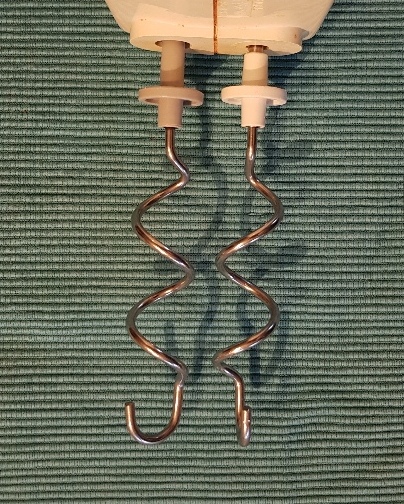 |
| Abb. 03-01-25: Rührgerät aus
der Küche, gegenläufige Drehrichtung Hand mixer from the kitchen, counter-rotating (FB) |
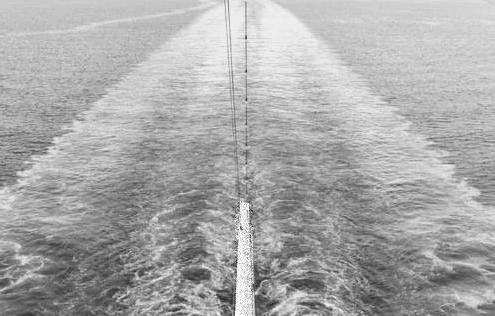 |
| Abb. 03-01-26: Doppelschraubenantrieb
Schiff Twin-screw
propulsion system for ships (FB) |
 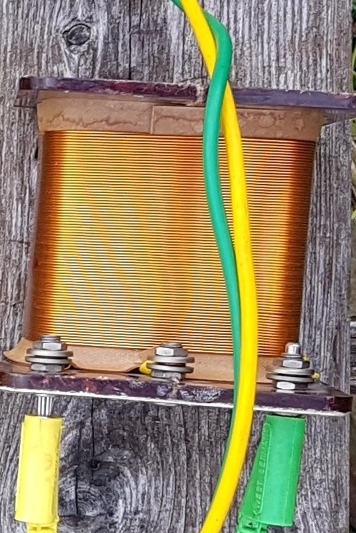 |
| Abb. 03-01-27: Mit diesen zwei Spulen
lassen sich die Strömungen auf einen Punkt in vielen
Metern Entfernung "fokussieren". Antrieb durch
einen kurzen Laserpuls entlang der Spulenachse These two coils allow the currents to be ‘focused’ onto a single point many metres away. Driven by a short laser pulse along the axis of the coils (FB) |
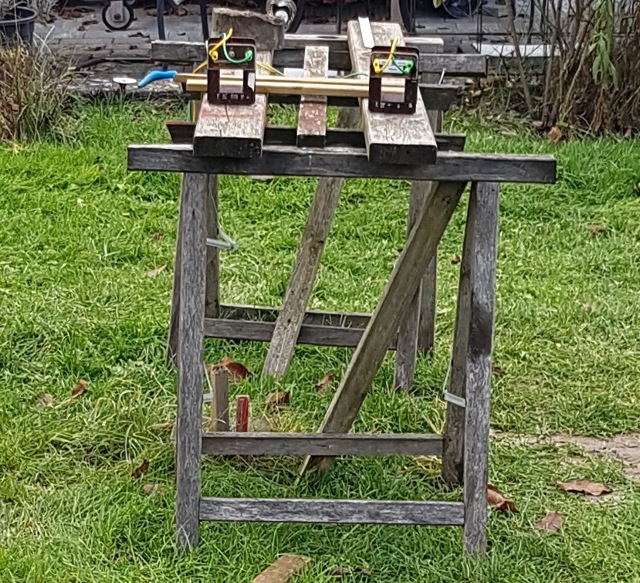 |
| Abb. 03-01-28: Die Kamera ist im
Fokus der beiden Strömungen, sie haben
entgegengesetzte Richtungen / Qualitäten The camera is at the centre of these two currents; they have opposite directions / qualities aus ostwind.htm#kapitel-04-02-01 |
 |
Abb. 03-01-29: Hier die
"Fokussierung" mit zwei Flußbeschleunigern aus Eisen
und Kupferdraht auf wenige Dezimeter Entfernung (FB)aus ostwind.htm#kapitel-04-02-04 |
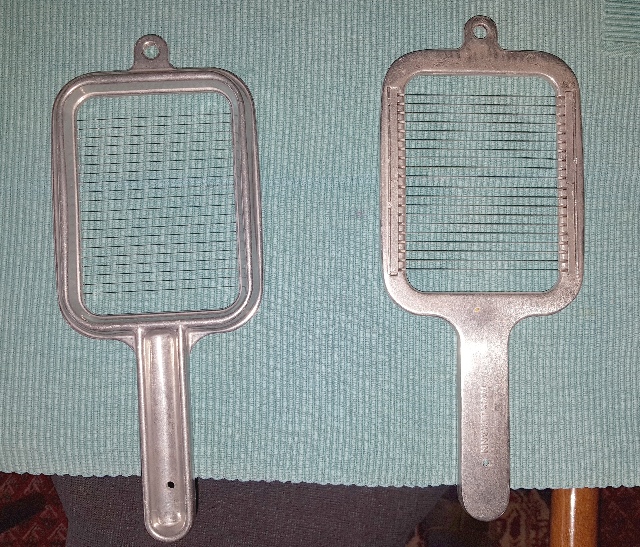 |
| Abb. 03-01-30: Kartoffel-Schneider,
gespannte Drähte in regelmäßigem Abstand wirken als
zwei gleichartig polarisierende "Sender" im Ostwind.
Auch mit ihnen lassen sich zwei Strömungen auf einen
Punkt "fokussieren". Potato slicer: taut wires spaced at regular intervals act as two similarly polarised ‘transmitters’ in an easterly wind. They too can be used to ‘focus’ two currents onto a single point. (FB) |
 |
| Abb. 03-01-31: wie gekreuzte
Polarisatoren, es ist keine Wechselwirkung
spürbar like crossed polarizers; there is no detectable interaction (FB) |
 |
| Abb. 03-01-32: Zwei Holzstäbe mit Wendel aus
hartem PE. links CCW, rechts CW Die Markierungen für die Ziehrichtung sind am (kurzen) hinteren Ende. Two wooden rods with a spiral made of hard PE. Left: CCW, right: CW The markings indicating the direction of pull are located at the (short) rear end. aus wasser-ader-drei-02.htm#kapitel-06-02 |
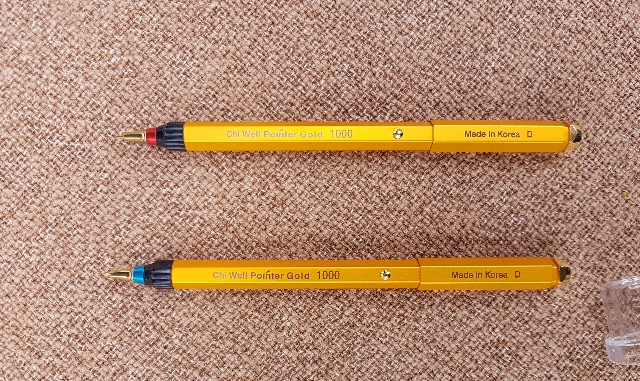 |
| Abb. 03-01-33: "Chi-Well
Pointer", zwei Magnetstifte mit
unterschiedlicher Polung two magnetic pens with different polarities(FB) |
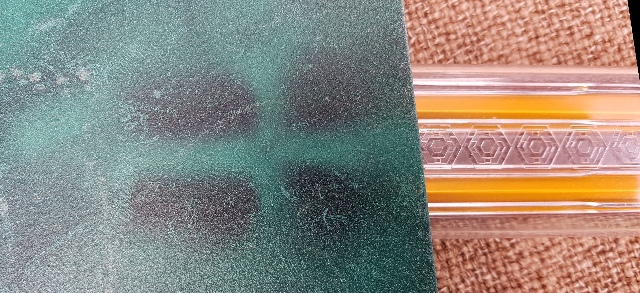 |
| Abb. 03-01-34: "Chi-Well
Pointer", beide Stifte liegen nebeneinander,
die Magnetfolie zeigt die Intensitäten der Magnete
z.B. N---S S---N ‘Chi-Well Pointer’, both pens are placed side by side; the magnetic strip indicates the strength of the magnets (FB) |
Werkzeuge für die Analyse der physikalischen Eigenschaften der Augenstrahlen
Tools for analysing the physical properties of eye rays
 |
| Abb. 03-01-35: Plexiglasscheibe
1 mm dick, durch einen Walzvorgang bei der
Herstellung wirkt diese Scheibe ebenfalls als
Polarisator, je nach Orientierung läßt sie den
Augenstrahl durch oder sperrt ihn. 1 mm thick plexiglass sheet; due to a rolling process during manufacture, this sheet also acts as a polariser; depending on its orientation, it either allows the light beam to pass through or blocks it. aus ostwind.htm#kapitel-03-01 |
 |
| Abb. 03-01-36: Überlagerung der beiden Augenstrahlen durch die beiden reflektierenden Plexiglasscheiben. Brewster Winkel Plexiglas 56°, Brechungsindex = 1,49 Blick man in Richtung der Symmetrieachse, dann ist der Auftreffwinkel auf jede der Scheiben 20° und somit kleiner als der Brewster Winkel. Der Strahl wird also total reflektiert. Superposition of the two eye rays via the two reflective Plexiglas plates. Brewster angle for Plexiglas: 56°, refractive index = 1.49 If one looks towards the axis of symmetry, the angle of incidence on each of the plates is 20°, and is therefore smaller than the Brewster angle. The ray is therefore totally reflected. aus aus ostwind.htm#kapitel-03-01(FB) |
 |
| Abb. 03-01-37: Eigenschaften bei
unterschiedlicher Orientierung der beiden "Spiegel". Properties depending on the different orientations of the two ‘mirrors’. aus ostwind.htm#kapitel-03-01 |
Augenstrahl wirkt nur zusammen mit beiden Augen und dem "dritten Auge"
Der Augenstrahl ist nicht wirksam beim Blick durch
- Lesebrille mit Rahmen und entspiegelten
Kunststoffgläsern
- "Nachtfahr- Brille" mit gelben "Gläsern" und
Rahmen
- "Nachtfahr-Brille" ohne "Gläser"
- dicke Rahmen mit breitem Nasensteg ohne "Gläser"
- Drahtschleifen der Aura-Sehen-Test-Brille bei geeigneter Polung
- Brillen mit linearen Polarsationsfiltern bei
entsprechender Orientierung
- Polarisationsfolie (Haushaltsfolie) oder gewalzte Plexiglasscheiben bei geeigneter Polung
- Dunkelgrüne oder blaue "Gläser"
- Kopf auf die Seite gelegt, ein Auge über dem
anderen
- Lesebrille mit Plastikgestell und Linsen aus einfachem Glas, nicht entspiegelt.
- Randlose Brille mit gelben Kunststoff-Gläsern.
- farbige Gläser ohne Rahmen im Bereich von 550 bis
650 nm
The eye beam is not effective when looking through
reading glasses with frames and anti-reflective plastic lenses
‘night driving glasses’ with yellow “lenses” and frames
‘night driving glasses’ without ‘lenses’
Thick frames with a wide nose bridge without “lenses”
Wire loops of the Aura Vision Test glasses with suitable polarisation
Glasses with linear polarisation filters when correctly oriented
Polarising film (cling film) or rolled plexiglass sheets with suitable polarisation
Dark green or blue ‘lenses’
Head tilted to one side, one eye over the other
effective
Reading glasses with plastic frames and lenses made of plain glass, non-anti-reflective.
Rimless glasses with yellow plastic lenses.
Coloured lenses without frames in the range of 550 to 650 nm
3.2 Physikalische Experimente zum Nachweis der Welleneigenschaften
Physical experiments to demonstrate wave properties
3.2.0
3.2.1 Polarisation, Wellenlänge Polarisation, wavelength
a) Der Augenstrahl hat linear polarisierte Komponenten. The light beam has linearly polarised components.
Analyse mit einem Hohlkörper mit einstellbarer Polarisationsrichtung
Der Hohlkörper, abgedeckt mit einer Polarisationsfolie (Haushaltsfolie) an der Vorderseite,
a) läßt sich mit dem Augenstrahl anregen, sofern die Ziehrichtung der Folie eine zu der Verbindungsachse beider Augen parallele Komponente hat. (man legt einen PSI-Track)
(wie bei gekreuzten Polarisationsfiltern)
Analysis using a hollow body with an adjustable polarisation direction
The hollow body, covered with a polarising film (cling film) on the front,
a) can be stimulated by the eye’s gaze provided that the direction in which the film is stretched has a component parallel to the axis connecting both eyes. (a PSI track is applied)
b) no stimulation is possible when the head is upright, both eyes at the same level, and the direction of the film’s grain is exactly perpendicular.
If the hollow body is rotated or the head is tilted, stimulation is possible again.
(as with crossed polarising filters)
 |
Abb. 03-02-01-00: Hohlspiegel,
Haushaltfolie Concave mirror,
cling film(FB)aus ostwind.htm#kapitel-03-08 |
 |
| Abb. 03-02-01-01: Hohlraum
(Hohlspiegel mit Frischhalte-Folie bespannt),
drehbar montiert. Auf der Folie sind die Ziehrichtung und weitere Hilfslinien im Abstand von 15° markiert. Jeder Versuch beginnt mit Löschen (Klatschen) soliton.htm#kapitel-04-04 und intensivem Anstarren für einige Sekunden. aus ostwind.htm#kapitel-03-08Cavity (concave mirror covered with cling film), mounted so that it can rotate. The direction of pull and other guide lines are marked on the cling film at 15° intervals. Each experiment begins with a clap soliton.htm#chapter-04-04 and intense staring for a few seconds. Fig. 03-08-11: View towards the north; along the axis, there are noticeably increased intensities at regular intervals when the operator looks towards the mirror. |
 |
| Abb. 03-02-01-02: Je mehr die
Ziehrichtung der Folie senkrecht zur Horizontalen
(durch die Verbindungsachse beider Augen) angenähert
wird, um so geringer wird der Hohlraum von dem
Augenstrahl angeregt. Steht die Ziehrichtung exakt senkrecht, verschwindet die Anregung. Sie kann aber durch leichtes Schrägstellen des Kopfes wieder aktiviert werden. wie bei "gekreuzte Polarisatoren" Nach jeder Änderung der Winkel ist die feinstoffliche Struktur durch akustische Impulse (lautes Klatschen) zu löschen und der Körper durch intensives Anstarren wieder zu aktivieren. aus ostwind.htm#kapitel-03-08Fig. 03-02-01-02: The closer the direction in which the film is pulled is to the vertical (through the axis connecting both eyes), the less the cavity is excited by the eye’s beam. If the direction of pull is exactly perpendicular, the excitation disappears. However, it can be reactivated by tilting the head slightly. as with ‘crossed polarizers’ After each change of angle, the subtle structure must be cleared by acoustic impulses (loud clapping) and the body reactivated by staring intently. Fig. 03-08-14: Position along the measurement path with increased intensity at different inclinations of the foil’s direction of pull, 0° horizontal, 90° vertical. Height of the axis above the ground 1.42 m. All measurements except one on the north-south axis; the other on the east-west axis As the angle increases, the number of elements along the measurement path decreases. At 90°, there are no structures! (FB) |
b) Wellenlänge liegt im Bereich von wenigen Zentimetern, Hohlkörper mit einstellbarer Tiefe
The wavelength is in the range of a few centimetres; hollow bodies with adjustable depth
 |
| Abb. 03-02-01-03: Hohlkörper
mit verschiebbarer Rückwand, vorne ist er mit
Frischhaltefolie abgeschlossen. Jeder Versuch beginnt mit Löschen (Klatschen) soliton.htm#kapitel-04-04 und intensivem Anstarren für einige Sekunden. aus ostwind.htm#kapitel-03-10A hollow container with a sliding back panel; the front is sealed with cling film. Each experiment begins with a clap and intense staring for a few seconds. Fig. 03-10-05: HT 100 tube on a stand, tube axis north-south (FB) |
 |
| Abb. 03-02-01-04:
Frischhaltefolie und verschiebbarer Kolben. Cling film and a sliding plunger. aus ostwind.htm#kapitel-03-10 |
 |
Abb. 03-02-01-05: Je nach
Kolbenstellung gibt es Positionen mit erhöhten
spürbaren Intensitäten, die periodisch
angeordnet sind. rote Marken: große Periode, grüne
Marken: kurze Periodenaus ostwind.htm#kapitel-03-10Depending on the position of the piston, there are points of increased, noticeable intensity that are arranged in a periodic pattern. Red marks: long periods; green marks: short periods Fig. 03-10-09: the axis points south; various marking options include tent pegs and clothes pegs (FB) |
 |
Abb. 03-02-01-06: Auch im
Seitenbereich des Kolben wechselt die spürbare
Intensität mit der Länge des Hohlraumes.
mittlere Periode: 28 mmaus ostwind.htm#kapitel-03-10The intensity felt on the sides of the piston also varies with the length of the cavity. Average period: 28 mm Fig. 03-10-11: Observed whilst moving the piston by hand: immediately next to the piston, there are areas of strong and weak intensity |
 |
Abb. 03-02-01-07: Entlang der
Meßachse markierte Positionen mit erhöhter spürbarer
Intensität bei unterschiedlichen Kolbenstellungen.
Es gibt Einstellung mit auf der Meßachse dicht
nebeneinander liegenden Maxima. Solche Positionen
wiederholen sich beim Verschieben des Kolben um
einen Abstand von etwa 35 mm.aus ostwind.htm#kapitel-03-10Positions marked along the measurement axis where the perceived intensity is heightened at different piston positions. There are settings where maxima lie close together along the measurement axis. Such positions recur when the piston is moved by a distance of approximately 35 mm. Fig. 03-10-12: blue: Positions recorded along the measurement path with high perceptible intensity at different piston positions (length of the resonator) The diagram shows a sequence of vertical blue lines with widely and closely spaced measurement points black: reciprocal distance between two positions light green: guide lines at intervals of 35 mm, starting at 40 mm (FB) |
3.2.2 Beugungsbilder bei periodisch angeordneten Objekten, Gitterbeugung
Diffraction patterns for periodically arranged objects, diffraction from a grating
Wellenlänge ist im Bereich von wenigen Zentimetern
Wenn die Ziehrichtung der Folien senkrecht zur Verbindung beider Augen steht, gibt es keine Anregung.
Jeder Versuch beginnt mit Löschen (Klatschen) soliton.htm#kapitel-04-04
und Aktivieren, d.h. intensivem Anstarren für einige Sekunden. (PSI-Track legen)
The wavelength is in the range of a few centimetres
If the direction of the film’s stretch is perpendicular to the connection between the two eyes, no stimulation occurs.
Each experiment begins with erasing (clapping)
and activating, i.e. staring intently for a few seconds. (Set up PSI-Track)
 |
| Abb. 03-02-02-01:
Beugungsbild bei zwei Eisenkugeln, die vom
Augenstrahl angeregt wurden. Diffraction pattern produced by two iron balls excited by a beam of light. aus ostwind.htm#kapitel-03-15 |
 |
| Abb. 03-02-02-02: Bestimmung der
Wellenlänge --> hellblauer Bereich Determination of the wavelength --> light blue region aus ostwind.htm#kapitel-03-15 |
 |
Abb. 03-02-02-03: Wenn die
Striche für die Ziehrichtung exakt senkrecht stehen,
ist eine Anregung mit einem horizonalen Augenstrahl
nicht möglich. (wie bei gekreuzten
Polarisationsfiltern)aus ostwind.htm#kapitel-03-16 |
 |
Abb. 03-02-02-04:
aus ostwind.htm#kapitel-03-16 |
 |
| Abb. 03-02-02-05: Wellenlänge
--> hellblauer Bereich Wavelength --> blue-green region aus ostwind.htm#kapitel-03-16 |
3.2.3 Weitere Eigenschaften der Wellen, zirkulare Polarisation?
Any other properties of the waves, such as circular polarisation?
Ausdehnung der Struktur bei Stab-und-Spirale als meßbare Größe für die Stärke der Anregung
The expansion of the structure in the rod-and-spiral system as a measurable parameter for the intensity of the excitation
Die Größe der feinstofflichen Struktur von einer Kombination aus einem Stab und einer Spirale läßt sich mit einem Augenstrahl vergrößern (PSI-Track?). Vermutlich werden durch den Strahl Strömungen und/oder Wirbel angeregt. Die Kombination wirkt als "Flußverstärker": die Strömung im Stab regt eine Strömung in den Windungen an und umgekehrt. Wenn der Kreis mechanisch oder elektrisch geschlossen ist, können diese Strömungen ungebremst sehr lange Zeit fließen (dauerhaft?), etwa wie der Strom in einem elektrischen Supraleiter und das zugehörige Magnetfeld.
Die Größe der Struktur
- Sie nimmt mit der Dauer des Anstarrens zu.
- Wenn der Kreis aus Stab und Spirale offen ist (violette Brücke in Abb. 03-02-03-02 entfernt), schrumpft die Struktur, wenn der Augenstrahl nicht mehr aktiv ist.
- Wenn der Kreis geschlossen ist, bleibt die
Größe nach Abschalten des Strahls erhalten.
Sie wächst bei erneutem Einschalten jedesmal um ein kleines Stück an.
The size of the subtle structure formed by a combination of a rod and a spiral can be magnified using a beam of light (PSI-Track?). Presumably, the beam induces currents and/or vortices. The combination acts as a ‘flow amplifier’: the current in the rod induces a current in the coils, and vice versa. If the circuit is closed mechanically or electrically, these flows can continue unchecked for a very long time (permanently?), much like the current in an electrical superconductor and the associated magnetic field.
The size of the structure
It increases with the duration of the gaze.
If the circuit comprising the rod and spiral is open (the violet bridge in Fig. 03-02-03-02 removed), the structure shrinks
when the eye beam is no longer active.
If the circuit is closed, the size remains unchanged after the beam is switched off.
It grows by a small amount each time it is switched on again.
Im Sichtbereich scheint die Entfernung zwischen dem Augenstrahl-Generator als Sender und Stab-und-Spirale unerheblich zu sein.
Es geht auch über größeren Strecken ohne Blickkontakt.
Dann läuft die Anregung vermutlich über den Mechanismus von einem PSI-Track.
Within the field of vision, the distance between the eye-beam generator (acting as a transmitter) and the rod-and-spiral appears to be negligible.
It also works over greater distances without visual contact.
In that case, the stimulation presumably occurs via the mechanism of a PSI track.
wbm-2019-teil06-low.pdf
Mit Stab-und-Spirale als Meßgerät läßt sich der zeitliche Verlauf des Verbindungsaufbaus gut verfolgen. Bei einer Strecke (15 m Luftlinie) von außen in das Gebäude hinein war die Ausdehnung der Struktur erst nach über einer Minute an ihrem Endwert angekommen.1.3.2 Eigenschaften
Zum Erschaffen des Tracks reicht es aus, wenn sich ein Mensch das Ziel intensiv im Kopf hinter der Mitte der Stirn d.h. vor der Zirbeldrüse vorstellt. Man spricht hier vom „dritten Auge“. In Gedanken formuliert wäre dies: „zu diesem Ziel!“ Während dieser Phase sollte man möglichst die Augen geschlossen halten und keine anderen Gedanken verfolgen. Danach breiten sich die Strukturen des Tracks bis zum Zielpunkt hin aus (Abb. 2). Es vergeht dabei je nach Entfernung eine Zeit bis zu wenigen Minuten. Bei dem Experiment (Abb. 13 bis 15) war der Track bei einer Entfernung von 1200 m nach etwa 50 Sekunden am Ziel angekommen. Das Ziel kann ein einmalig existierendes dem Sendenden bekanntes Objekt sein, das durch Erinnerung, Foto oder Beschreibung klar definiert ist. Es ist aber auch möglich, nur Eigenschaften des Objekts zu beschreiben wie etwa „zur nächsten Wasserkreuzung“ oder „zur nächsten Apotheke“*. Auf gleiche Weise lassen sich auch Tracks löschen etwa mit den Gedanken: „diese Verbindung dort soll gelöscht werden!“ Eine wichtige Voraussetzung ist allerdings, daß das Geschlecht des Trackautors mit dem der löschenden Person übereinstimmt.
1.3.2 Characteristics
To create the track, it is sufficient for a person to visualise the target intensely in their mind, behind the centre of the forehead – that is, in front of the pineal gland. This is referred to as the ‘third eye’. Expressed in thought, this would be: ‘to this target!’ During this phase, one should keep one’s eyes closed if possible and not entertain any other thoughts. The track’s structures then extend outwards towards the target point (Fig. 2). Depending on the distance, this takes up to a few minutes. In the experiment (Figs. 13 to 15), the track reached its destination after approximately 50 seconds at a distance of 1,200 metres. The destination can be a unique object known to the sender, clearly defined by memory, a photograph or a description. However, it is also possible to describe only characteristics of the object, such as “to the nearest water crossing” or “to the nearest pharmacy”*. In the same way, tracks can also be deleted, for example with the thought: “that connection over there is to be deleted!” An important prerequisite, however, is that the gender of the track’s author must match that of the person deleting it.
Using a rod-and-coil antenna as a measuring device, it is easy to track the time taken for the connection to be established. Over a distance of 15 metres (as the crow flies) from outside into the building, it took over a minute for the signal strength to reach its maximum level.
|
Abb. 03-02-03-01:
aus stab-und-spirale.htm#kapitel-00-01 |
|
Abb. 03-02-03-02: Stab und
Spirale in Reihe Rod and coil in seriesaus stab-und-spirale.htm#kapitel-02 |
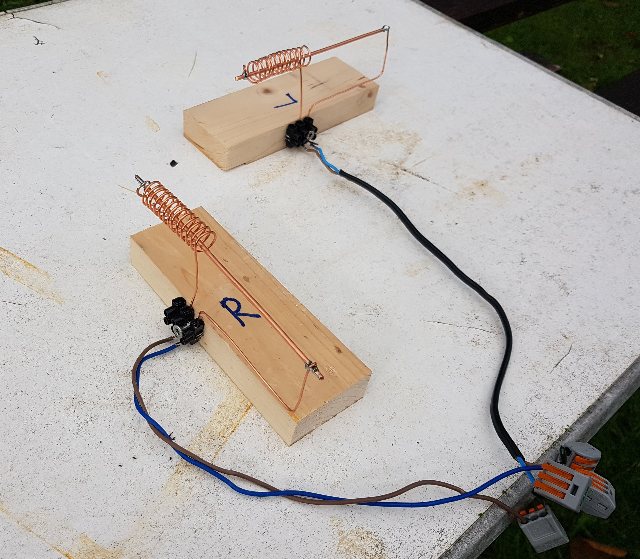 |
Abb.
03-02-03-03: beide Bauarten, mit den Klemmen
lassen sich die Anschlußdrähte auf einfache Weise
zusammenschalten oder offen betreiben.aus stab-und-spirale.htm#kapitel-01-01 |
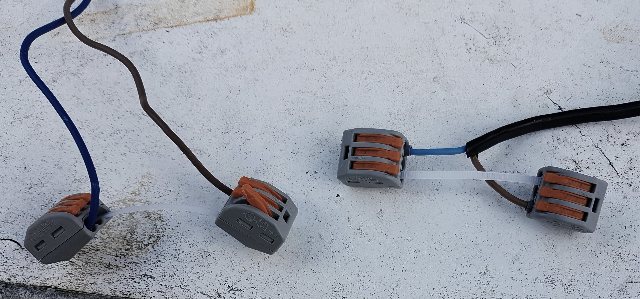 |
Abb. 03-02-03-04:
mit den Klemmen lassen sich die Anschlußdrähte auf
einfache Weise zusammenschalten oder offen
betreiben.
aus stab-und-spirale.htm#kapitel-01-01 |
Anregung mit dem Augenstrahl
- Die Länge der Struktur in Achsenrichtung nimmt mit der Dauer der Anregung zu.
- Bei geschlossenem Leiterkreis bleibt sie über lange Zeit (Stunden, Tage) konstant.
- Bei offenem Leiterkreis schrumpft sie mit der Zeit (Sekunden).
- Die Abnahmegeschwindigkeit ist nahezu unabhängig
von der Anregezeit.
Aus dem nahezu linearen Zusammenhang zwischen der Zeit und der Wurzel aus der Länge läßt sich folgern, daß die Abnahmegeschwindigkeit von der Größe einer Oberfläche und nicht von einem Radius bestimmt wird.
Stab-und-Spirale Version L (CCW gewickelt) Ausrichtung Ost-West
Excitation using an optical beam
The length of the structure in the axial direction increases with the duration of the excitation.
When the circuit is closed, it remains constant over long periods (hours, days).
When the circuit is open, it shrinks over time (seconds).
The rate of decrease is virtually independent of the excitation time.
From the virtually linear relationship between time and the square root of the length, it can be concluded that the rate of decrease is determined by the size of a surface area and not by a radius.
Rod-and-spiral Version L (CCW wound) Orientation East-West
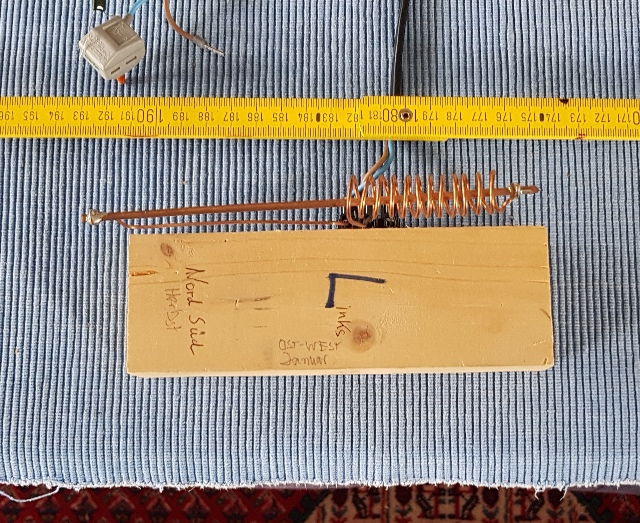 |
| Abb. 03-02-03-05: Version L, CCW
gewickelt, links: West, rechts: Ost Die beiden Anschlußdrähte blau und braun lassen sich mit der Klemme (oben im Bild) kurzschließen. Der blaue Draht geht nach links zum Stab, der braune zur Spirale Version L, CCW winding, left: West, right: East The two connection wires, blue and brown, can be short-circuited using the terminal (at the top of the picture). The blue wire goes to the left to the rod, the brown one to the coil (FB) |
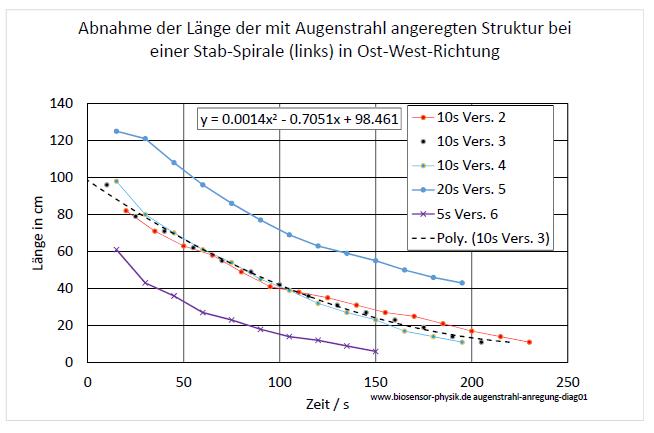 |
| Abb. 03-02-03-06: Anregezeiten mit
dem Augenstrahl 20s, 10s, 10s, 10s, 5s Die Trendlinie (Parabel, Polynom 2. Grades) ist eine gute Näherung der drei Meßreichen mit 10s Anregung, wobei diese Zeit mit einem größeren Fehler behaftet war. Je länger die Anregezeit um so länger ist die Struktur. Die Kurven verlaufen am Anfang nahezu parallel, d.h. die Abnahmegeschwindigkeiten sind ähnlich. Excitation times with the eye beam 20s, 10s, 10s, 10s, 5s The trend line (parabola, second-degree polynomial) is a good approximation of the three measurement ranges with a 10-second excitation, although this time was subject to a greater error. The longer the excitation time, the longer the structure. The curves run almost parallel at the start, i.e. the rates of decline are similar. (FB) |
 |
| Abb.
03-02-03-06a: Anregezeiten mit dem
Augenstrahl 20s, 10s, 10s, 10s, 5s Die Kurven für 20s (blau) und 5s (violett) wurden auf der Zeitachse verschoben um -70 s und 65 s. Dann reihen sie sich besser in die Kurvenschar der 10s Werte ein, d.h. die Abnahmegeschwindigkeiten sind ähnlich. Stimulation times using the eye beam: 20s, 10s, 10s, 10s, 5s The curves for 20s (blue) and 5s (purple) have been shifted on the time axis by -70 s and 65 s. This allows them to fit in better with the set of 10s curves, i.e. the rates of decline are similar. (FB) |
 |
| Abb. 03-02-03-07: Die Auftragung der
Wurzel aus den Längen ergibt geradenähnliche
Verläufe. Dies als Argument für einen quadratischen Zusammenhang. Taking the square root of the lengths produces curves that resemble straight lines. This serves as an argument for a quadratic relationship.(FB) |
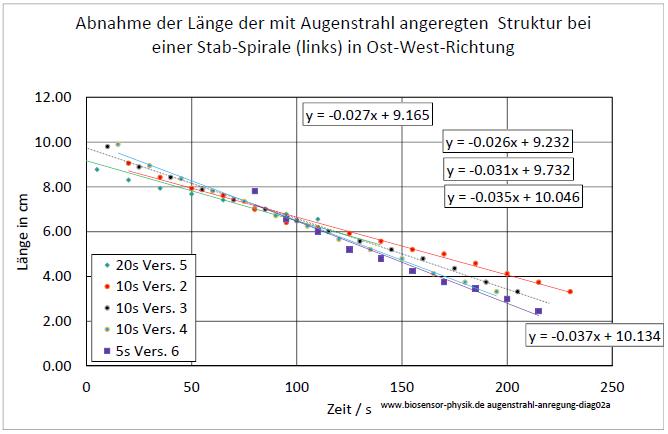 |
| Abb. 03-02-03-07a: mit
verschobenen Zeitachsen with
shifted timelines (FB) |
Anregung durch Erwärmung mit Flamme Excitation by heating with a flame
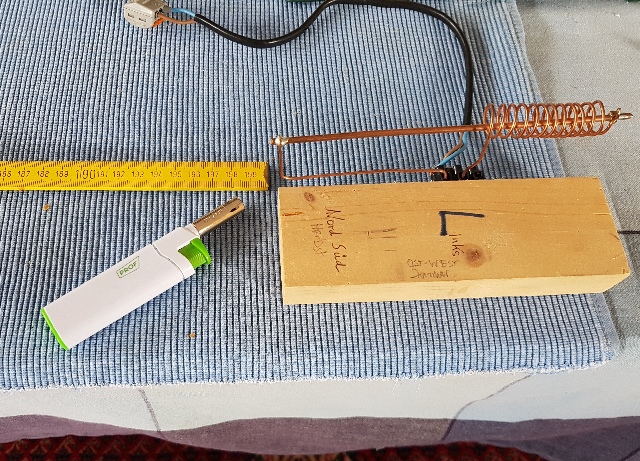 |
| Abb. 03-02-03-08: Anregung: etwa eine
Sekunde die Flamme des Feuerzeugs an den Knick des
dünnen Kupferdrahtes gehalten. In der Klemme sind
beide Drähte elektrisch/mechanisch verbunden. Die Länge der durch die Anregung erweiterten Struktur bleibt über lange Zeit (Minuten) konstant. Excitation: hold the flame of the lighter against the bend in the thin copper wire for about a second. In the clamp, the two wires are electrically and mechanically connected. The length of the structure expanded by the excitation remains constant for a long time (minutes).(FB) |
Durchleitung der Anregung bei verschiedenen Objekten
Verbindung der Anschlußdrähte mechanisch, mit Berührung
Die Strömung kann ungehindert fließen.
Current flow through different objects
Mechanical connection of the lead wires, with contact
The current can flow unimpeded.
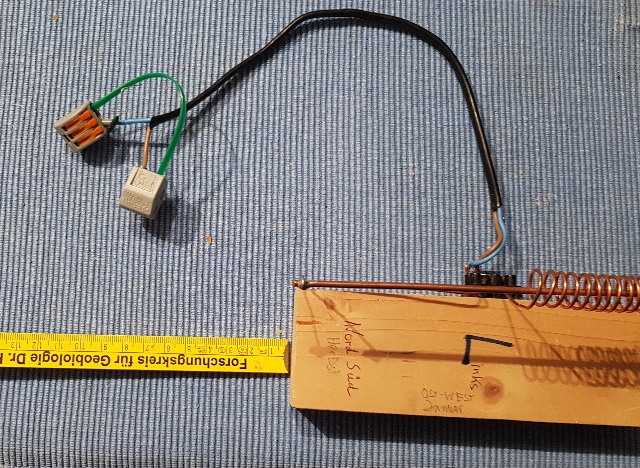 |
| Abb. 03-02-03-09: der grüne
Kabelbinder verbindet beide Anschlußdrähte,
mechanisch, mit Berührung The green cable tie connects the
two connecting wires mechanically, by contact (FB) |
Durchleitung über die Anschlußdrähte berührunglos über Objekte mit eigener Strömung
Wenn das lange Ende der Struktur des Objektes zum blauen Draht zeigt, kommt es zur Anregung.
Die Strömung kann ungehindert fließen.
Zeigt es zum braunen Draht, gibt es keine Anregung.
Current flows through the connecting wires without contact via objects with their own current
If the long end of the object’s structure faces the blue wire, excitation occurs.
The current can flow unimpeded.
If it faces the brown wire, there is no excitation.
 |
| Abb. 03-02-03-10: Neodym-Magnet
(Pinwand), zwischen den Anschlußdrähten, Nordpol
zeigt zum blauen Draht. Durchleitung ohne
Berührung Neodymium magnet (pinboard), positioned between the connecting wires, with the north pole facing the blue wire. Current flows without contact (FB) |
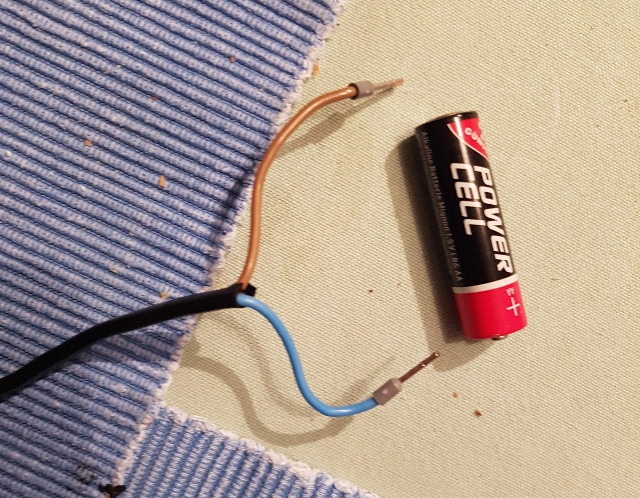 |
| Abb. 03-02-03-11: AA-Batterie,
Pluspol zeigt zum blauen Draht, Durchleitung ohne
Berührung AA battery, positive terminal facing the blue wire, connect without touching (FB) |
 |
| Abb. 03-02-03-11: Blattspitze einer
Aloe arborescens, die Wachstumsrichtung zeigt zum
blauen Draht, Durchleitung ohne Berührung The tip of an Aloe arborescens leaf, with the direction of growth pointing towards the blue wire; the current flows without contact (FB) |
 |
| Abb. 03-02-03-12: Preßrichtung der Salzstange (langes Ende) zeigt zum blauen Draht, Durchleitung ohne Berührung The long end of the pretzel stick should face the blue wire; pass it through without touching (FB) |
 |
| Abb. 03-02-03-12: rechte Hand einer
weiblichen Person, Herbst 26.11.2025, der
Zeigefinger (lange Struktur) raunaechte.htm#kapitel-03
zeigt zum blauen Draht, der Daumen (kurze Struktur)
zum braunen Draht, Durchleitung ohne
Berührung Right hand of a woman, Autumn 26 November 2025; the index finger (long structure) points to the blue wire, the thumb (short structure) to the brown wire; current flows without contact(FB) |
 |
| Abb. 03-02-03-12: Cabanossi,
die Pressrichtung der Wurst zeigt zum blauen Draht,
Durchleitung ohne Berührung Cabanossi: the direction of the sausage’s compression is towards the blue wire; pass through without touching (FB) |
Stab und Spirale Version R (CW gewickelt) Ausrichtung Nord-Süd
Rod and coil Version R (CW-wound) North-south orientation
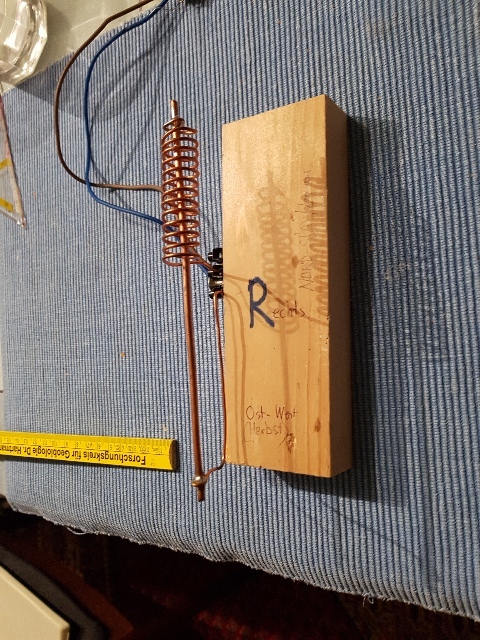 |
| Abb. 03-02-03-13: Die Kamera blickt
nach Westen, der Kupferstab zeigt oben nach Norden The camera is facing west; the copper rod points north at the top (FB) |
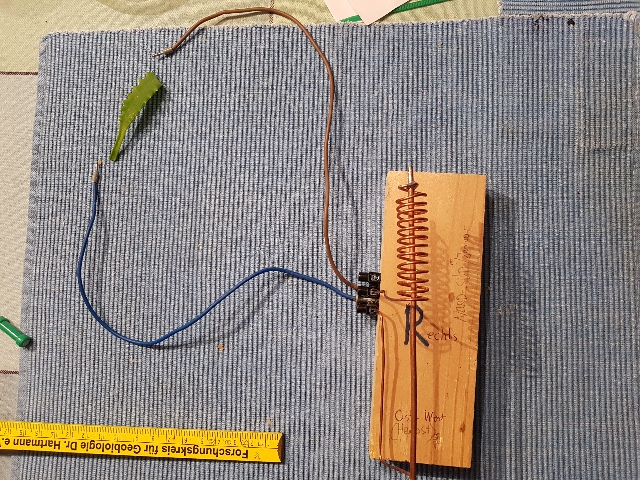 |
| Abb. 03-02-03-14: Blattspitze einer Aloe arborescens zeigt zum blauen Draht, Durchleitung ohne Berührung The tip of an Aloe arborescens leaf points towards the blue wire; the current flows without contact (FB) |
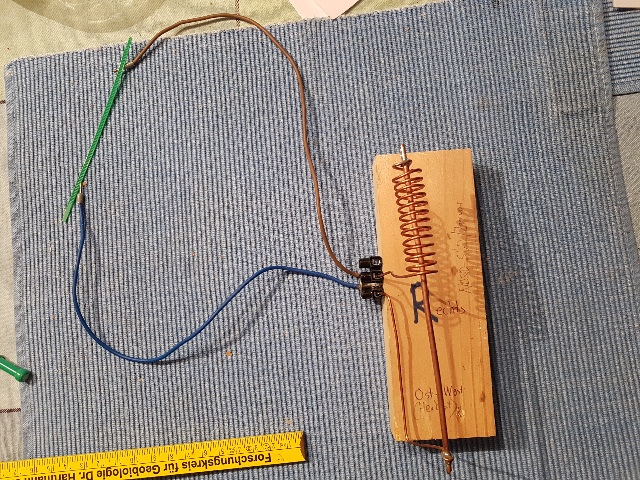 |
| Abb. 03-02-03-15: Kabelbinder,
Durchleitung mit Berührung Cable ties, feed-through with
contact (FB) |
 |
| Abb. 03-02-03-16: Cabanossi, die
Pressrichtung der Wurst zeigt zum blauen Draht,
Durchleitung ohne Berührung Cabanossi: the direction of the sausage’s compression is towards the blue wire; pass through without touching (FB) |
 |
| Abb. 03-02-03-17:
Arzneimittelverpackung mit Inhalt (Walzrichtung der
Blister?), Durchleitung ohne Berührung Medicine packaging with contents (direction of roll for the blister packs?), contactless handling (FB) |
3.3 Erzeugen von Wirbeln mit dem Augenstrahl bei zylindrischem Objekt
Creating vortices with the eye beam when using a cylindrical object
Der Augenstrahl ist ein ganz wichtiger Schlüssel, um
einige beobachteten Effekte physikalisch erklären zu
können.
- In jedem Auge ist ein Sender, Wellenlänge ca. Augendurchmesser oder Augenbreite.
- Dazu gehört auch die Zirbeldrüse in der Mitte darüber.
- Die Stahlen beide Augen haben entgegengesetzte
Richtungen und erzeugen so eine
Ringströmung.
Auge1 -- Ziel --- Auge2
von oben gesehen CW (clockwise) oder CCW (counterclockwise). - Bei Mann und Frau sind die Richtungen komplementär -
so wie bei den Strömungen aus den Händen.
(vermutlich Jahreshalbjahr bedingt) raunaechte.htm#kapitel-02 - Bei Überkreuzen der Beine sind die Seiten
(links/rechts, spezifisch für Mann und Frau)
getauscht.
Test: Man nehme einen Stab / ein Rohr
gezogen/gewachsen, dieser hat an dem einen
Ende eine kurze und an dem anderen Ende eine lange
Struktur ( z.B. 20 cm / 10 cm.)
Jeder Versuch beginnt mit Löschen
(Klatschen) soliton.htm#kapitel-04-04
und intensivem Anstarren für einige Sekunden.
The eye beam is a crucial key to
physically explaining some of the observed effects.
Each eye contains a transmitter, with
a wavelength approximately equal to the diameter or
width of the eye.
This also includes the pineal gland
situated in the centre above it.
The beams from both eyes travel in
opposite directions, thereby creating a ring-shaped
current.
Eye1 -- Target --- Eye2
viewed from
above CW (clockwise) or CCW
(counterclockwise).
In men and women, the directions are
complementary – just as with the currents emanating from
the hands.
(presumably due to the half-year
cycle)
When crossing the legs, the sides (left/right, specific
to men and women) are swapped.
Test: Take a rod /
tube drawn/grown,
which has a short structure at one end and a long
structure at the other (e.g. 20 cm / 10 cm.)
Each attempt begins with clapping and
staring intently for a few seconds.
 |
| Abb. 03-03-01: Das Rohr wird
von der Person links mit beiden Augen angestarrt. Der Strich markiert die Ziehrichtung/Wachstumsrichtung des Objektes, sie zeigt nach oben. Die feinstoffliche Struktur ist normalerweise an diesem Ende lang. Durch das Anstarren verändert sich die Länge der Struktur. Sie kann länger werden, kürzer bzw. sogar in die entgegengesetzte Richtung gehen. The person on the left stares at the tube with both eyes. The line marks the direction of movement/growth of the object; it points upwards. The subtle structure is normally long at this end. Staring at it changes the length of the structure. It can become longer, shorter, or even move in the opposite direction. (FB) |
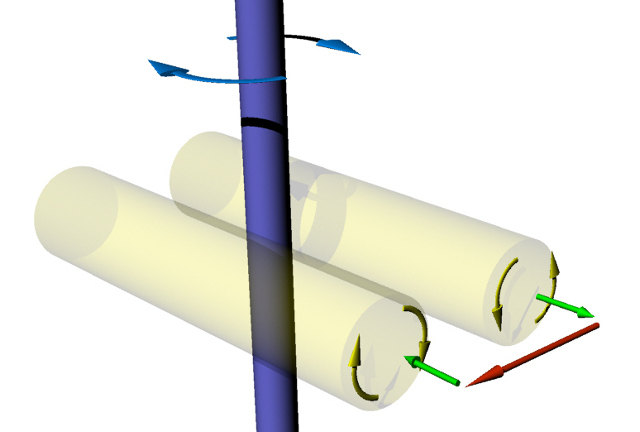 |
| Abb. 03-03-02:
Schematisch: die beiden Augenstrahlen
umschließen das Objekt. Die grünen Pfeile sind die hypothetischen Richtungen der Strahlen. Die gelben Pfeile markieren die hypothetischen Rotationen um die Längsache der Strahlen - CW und CCW gemäß der Korkenzieher-Regel. Der rote Pfeil ist die Verbindung der beiden grünen Pfeile und markiert die Strömung vor dem rechten zum linken Auge. Blaue Pfeile deuten die Rotation der Strömung im Rohr an. Schematically: the two ocular rays enclose the object. The green arrows represent the hypothetical directions of the rays. The yellow arrows indicate the hypothetical rotations about the longitudinal axis of the rays – CW and CCW according to the corkscrew rule. The red arrow connects the two green arrows and indicates the flow from the right eye to the left eye. Blue arrows indicate the rotation of the flow within the tube. (FB) |
 |
Abb. 03-03-03:
Korkenzieher-Regel für zwei feinstoffliche
Strömungen, hier CW aus ostwind.htm#kapitel-03-13 Corkscrew rule for two subtle-matter flows, here CW Fig. 03-13-03: Golden rule of subtle-matter fluid dynamics: coupled flows, applies to both eye rays. Fig. 00d: coupled with one another: ring flow (yellow) in a disc and linear flow (black) In classical physics, the black arrow is the angular momentum vector. It is a mathematical auxiliary quantity. In the subtle world, it describes an actually existing flow. The length of the perceptible structure associated with the linear flow is a measure of the strength of the ring flow in the disc. In classical physics, this corresponds to the magnitude of the angular momentum. It has the same unit as energy. Measuring this length enables the non-contact observation of the ring flow in the disc. In classical physics, this coupling is known as the right-hand rule, the right-thumb rule or the corkscrew rule and applies, for example, to angular momentum (FB) |
 |
| Abb. 03-03-04: Feinstoffliche Zonen
bei gewachsenen oder gezogenen Objekten. Die eine Qualität ist intensiver spürbar als die andere. d.h. wenn man sich auf eine der beiden einstellt, dann gibt es an dem einen Ende eine lange und an dem anderen Ende eine kurze Struktur. Gut zum Testen oder Üben sind Teile von Pflanzen aktive-elemente.htm#kapitel-02 aus wasser-ader-drei-02.htm#kapitel-06-11-00Subtle energy zones in natural or cultivated objects. One quality is more intensely perceptible than the other. In other words, when one tunes into one of the two, there is a long structure at one end and a short structure at the other. Parts of plants are good for testing or practising Fig. 06-11-00-21: schematic: two zones within one another, with different qualities, length approximately in a ratio of 1:2; the two sides are complementary to one another. (FB) |
Versuchsablauf:
Objekt senkrecht stellen, hart aufschlagen, um vorherige
Einflüsse zu löschen.
Abstand zur Nase ca. 30 cm. Dann mit beiden Augen
intensiv das Objekt anvisieren (daran vorbei
visieren).
Anschließend sind die Maße der Strukturen an den Enden des
Objektes verändert.
Es gibt drei Möglichkeiten:
(a) vorher
<++++O|OOOOOOOOO--<
(b) die vorhandene wurde verlängert
<+++++++++O|OOOOOOOOO-<
(c) die Richtung hat sich umgedreht
>--O|OOOOOOOOO+++++++++>
je nach Intensität und Dauer des Anvisierens ist der
Effekt schwächer oder stärker
Den Versuch mit einer Person des anderen Geschlechts
wiederholen, dazu vorherige Struktur löschen.
Anschließend sollten die Akteure mit überkreuzten Beinen
(im Stehen) den Versuch wiederholen.
Es gibt vier Möglichkeiten je nach Geschlecht und
Ausrichtung des Objektes
(Ziehrichtung/Wachstumsrichtung oben/unten. )
| Ziehrichtung des Rohrs nach |
Mann, Beine normal, |
Mann, Beine überkreuzt, |
Frau, Beine normal, |
Frau, Beine überkreuzt. |
| unten |
(a)
> (b) |
(a) > (c) | (a) > (c) | (a) > (b) |
| oben |
(a)
> (c) |
(a) > (b) | (a) > (b) | (a) > (c) |
Aus der Richtung des Wechsels läßt sich nach der
Korkenzieher-Regel die Richtung einer Strömung im Rohr
bestimmen.
Jahreshälfte 2, November 2025: beim Mann wird eine
vorher nach oben zeigende Struktur in eine nach unten
zeigende umgewandelt.
D.h. im Rohr fließt beim Wandeln eine Strömung nach unten
und dreht die vorhandene um.
Laut Korkenzieherregel gibt es entlang der Rohrachse von
oben gesehen eine CW-Rotation.
Dazu muß es aus dem linken Auge heraus und in das
rechte Auge hineinströmen.
Damit ist die Hypothese verifiziert.
Experiment procedure:
Place the object vertically and tap it firmly to clear
any previous influences.
Position it approximately 30 cm from the nose. Then
focus intently on the object with both eyes
(looking past it).
Afterwards, the dimensions of the structures at the ends
of the object will have changed.
There are three possibilities:
(a)
before
<++++O|OOOOOOOOO--<
(b) the existing one has been
extended
<+++++++++O|OOOOOOOOO-<
(c) the direction has
reversed
>--O|OOOOOOOOO+++++++++>
Depending on the intensity and duration of the focus,
the effect is weaker or stronger
Repeat the experiment with a person of the opposite sex,
erasing the previous structure first.
The participants should then repeat the experiment with
their legs crossed (whilst standing).
There are four possibilities depending on gender and the
orientation of the object (direction of
pull/direction of growth: top/bottom)
Direction of pull
legs
normal, Man,
legs crossed, Woman,
legs normal, Woman,
legs crossed.
bottom (a) >
(b) (a) >
(c) (a) >
(c) (a) > (b)
top (a) >
(c) (a) >
(b) (a) >
(b) (a) > (c)
Using the corkscrew rule, the direction of flow within
the tube can be determined from the direction of the
change.
Second half of the year, November 2025: in the man, a
structure previously pointing upwards is transformed
into one pointing downwards.
This means that, during the transformation, a flow moves
downwards within the tube and reverses the existing one.
According to the corkscrew rule, there is a clockwise
rotation along the pipe axis when viewed from above.
For this to happen, the flow must exit the left eye and
enter the right eye.
This verifies the hypothesis.
3.4 Erzeugen von Wirbeln
mit dem Augenstrahl beim Blick durch zwei Löcher
3.4 Creating vortices with the
eye’s beam when looking through two holes
Jeder Versuch beginnt mit Löschen
(Klatschen) soliton.htm#kapitel-04-04
und intensivem Anstarren für einige Sekunden.
Every attempt begins with
clapping and staring intently for a few seconds.
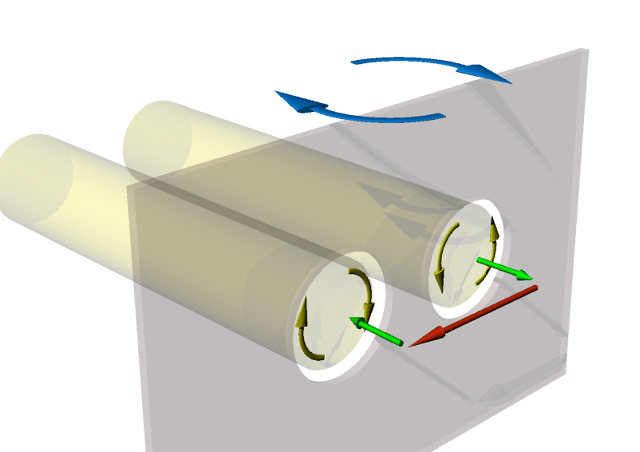 |
| Abb. 03-04-01: Strahlen vor den
beiden Augen In einen Karton sind zwei Öffnungen geschnitten. Hypothese: die beiden Augenstrahlen haben Strömungen mit entgegengesetzten Richtungen, bei männlichen Personen: links hinaus rechts herein. Der rote Pfeil markiert die Strömung vor dem rechten zum linken Auge Die zugehörigen Wirbel sind links CW und rechts CCW. Die blauen Pfeile deuten einen Wirbel durch die beiden Öffnungen an. Rays in front of both eyes Two openings have been cut into a piece of cardboard. Hypothesis: the two eye rays have flows in opposite directions, in males: out on the left, in on the right. The red arrow indicates the flow from the right eye to the left The corresponding vortices are clockwise on the left and anticlockwise on the right. The blue arrows indicate a vortex passing through the two openings. (FB) |
 |
| Abb. 03-04-02: einfacher Versuch mit
Fotokarton A simple experiment using card (FB) |
Man kann auch durch ein Stück Karton schauen, in den zwei
Gucklöcher (im Abstand der Augen) geschnitten
wurden.
Bei der Herstellung ist das Papier gewalzt worden. Daher
gibt an einer der vier Seiten eine längere feinstoffliche
Struktur.
Nach dem Durchvisieren hat der Karton eine lange
Struktur (senkrecht zur Knickfalte) je nach
Geschlecht der Person am oberen Ende bzw. am unteren Ende.
"Sehende" können beim Karton eine Ringströmung
finden und zwar z.B. bei männlichen Personen auf der
Vorderseite durch das linke Loch nach draußen und in das
rechte wieder hinein. Dazu gehört dann eine CW-Strömung
beim Blick von der oberen Kante zur unteren.
Vor der Nase eines männlichen Beobachters strömt es
demnach vom rechten Auge zum linken Auge*.
* in der zweiten Jahreshälfte
You can also look through a
piece of cardboard in which two peepholes have been cut
(spaced at eye level).
During manufacture, the paper was rolled. Consequently,
one of the four sides features a longer, fine-textured
structure.
After looking through it, the cardboard displays a long
structure (perpendicular to the fold) at either
the top or bottom end, depending on the person’s gender.
‘Seers’ may observe a circular flow in the
cardboard; for example, in the case of male individuals,
the flow emerges through the left hole on the front and
re-enters through the right. This is accompanied by a CW
flow when viewing from the upper edge to the lower.
In front of a male observer’s nose, the flow
therefore moves from the right eye to the left eye*.
* in the second half of the year
 |
| Abb. 03-04-03: männliche
Person male (FB) |
Bei einem weiblichen Beobachter ist es umgekehrt.
For a female observer, the opposite is true.
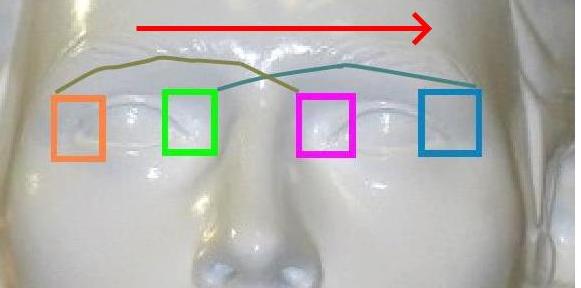 |
| Abb. 03-04-04: weibliche
Person a woman
(FB) |
Jeder Versuch beginnt mit Löschen
(Klatschen) soliton.htm#kapitel-04-04
und intensivem Anstarren für einige Sekunden.
Every attempt begins with
clapping and staring intently for a few
seconds.
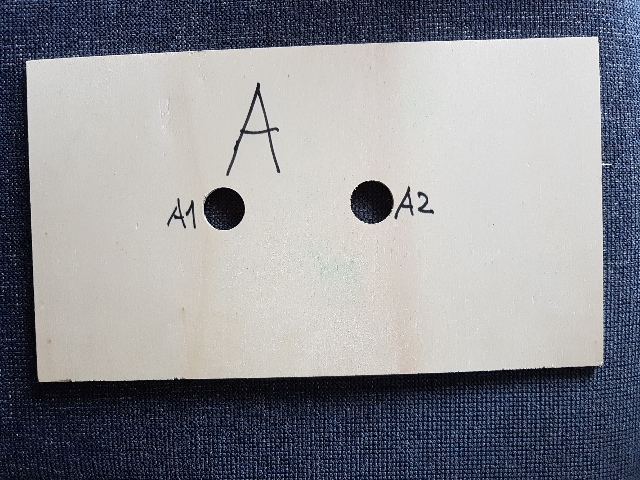 |
| Abb. 03-04-05: verbesserte Version
mit Sperrholz. Blickt eine männliche Person angestrengt durch die beiden Löcher, entsteht durch die beiden Augenstrahlen angeregt, ein Wirbel mit senkrechter Achse, von oben gesehen CW. Dreht man die A-Seite der Tafel um 180°, löscht den Wirbel durch hartes Aufklopfen und blickt erneut hindurch - diesmal linkes Auge A2 und rechtes Auge A1, dann hat der neue Wirbel die umgekehrte Drehrichtung. Improved version made of plywood. If a man looks intently through the two holes, the rays of light from his eyes create a vortex with a vertical axis, rotating clockwise when viewed from above. If you rotate the A-side of the board by 180°, tap it firmly to cancel the vortex and look through it again – this time with the left eye at A2 and the right eye at A1 – the new vortex will have the opposite direction of rotation.(FB) |
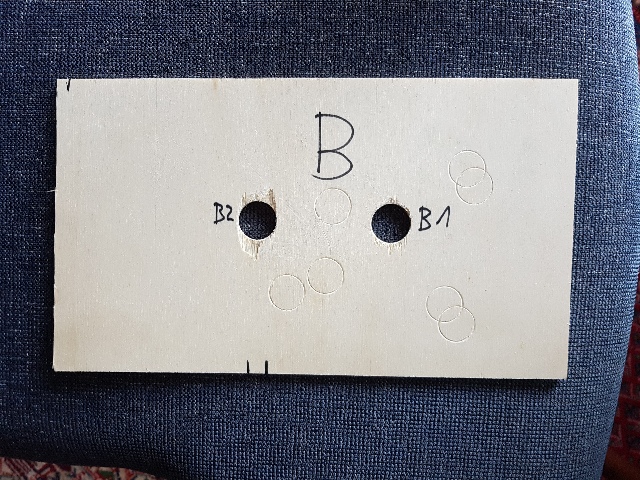 |
| Abb. 03-04-06: Rückseite der
Sperrholztafel. Tauscht man nur die Seiten beim
Versuch, linkes Auge B2 / A1 und rechtes Auge B1
/A2, bleibt die Drehrichtung des Wirbels gleich. Rückseite der Sperrholztafel. Tauscht man nur die Seiten beim Versuch, linkes Auge B2 / A1 und rechtes Auge B1 /A2, bleibt die Drehrichtung des Wirbels gleich. (FB) |
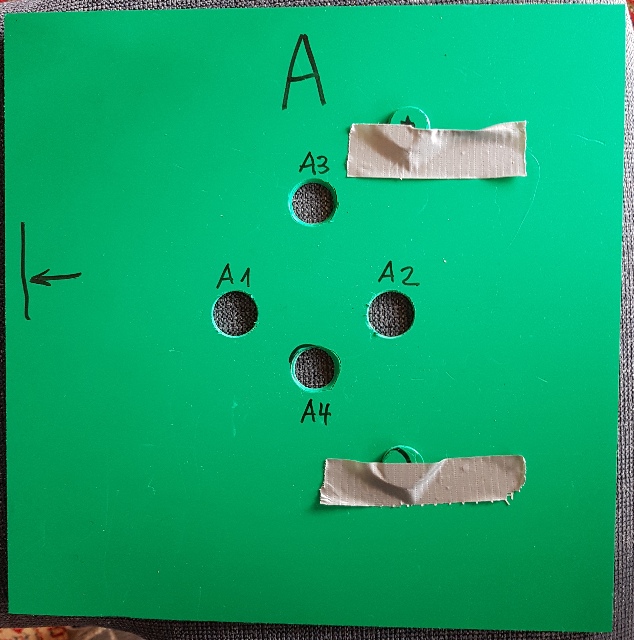 |
| Abb. 03-04-07: PVC-Platte mit vier
Löchern. Zwei davon sind verschließbar. Die Ziehrichtung ist mit dem Pfeil rechts markiert. Nach dem Durchblicken durch A1 (linkes Auge) und A2 (rechtes Auge) sind die Verhältnisse wie bei dem Vorversuch mit der Sperrholzplatte (sofern A3 und A4 verschlossenen sind). Der Abstand von A3 zu der Linie A1-A2 ist größer als der von A4 zu der Linie A1-A2. Damit läßt sich erproben, ob es ein "Drittes Auge" gibt und falls ja, welchen Einfluß es hat. PVC panel with four holes. Two of these can be closed. The direction of viewing is indicated by the arrow on the right. When looking through A1 (left eye) and A2 (right eye), the conditions are the same as in the preliminary experiment with the plywood panel (provided that A3 and A4 are closed). The distance from A3 to the line A1-A2 is greater than that from A4 to the line A1-A2. This allows one to test whether there is a ‘third eye’ and, if so, what influence it has. (FB) |
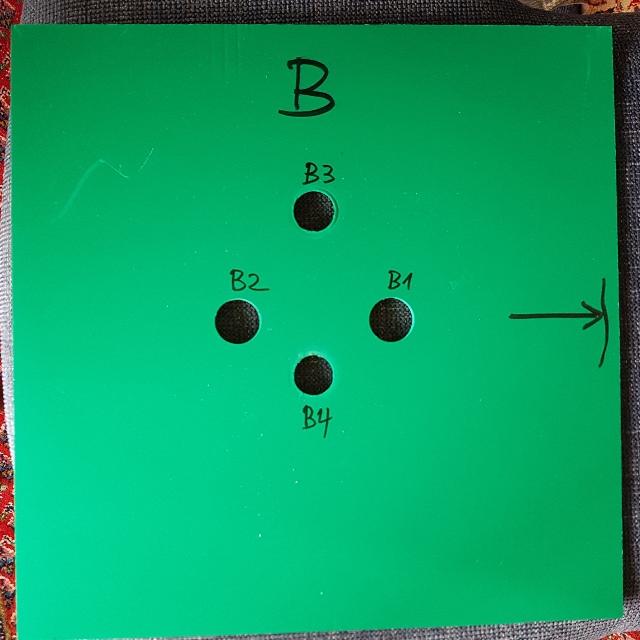 |
| Abb. 03-04-08: Rückseite der
Platte. The back of the
panel. (FB) |
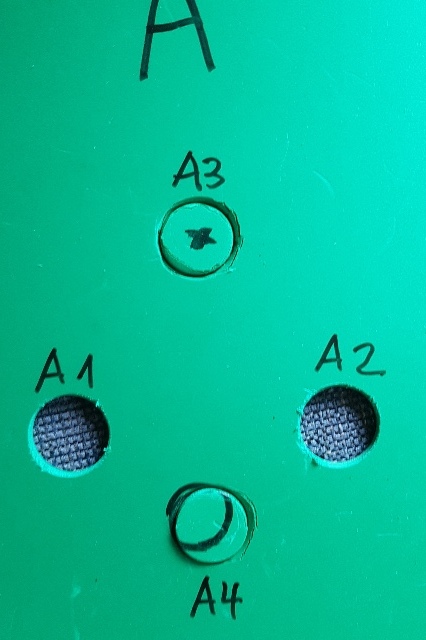 |
| Abb. 03-04-09: 21.11.2025 Die Löcher 3 und 4 sind verschlossen. Holes 3 and 4 are blocked. (FB) |
gesucht: die Position des
"Dritten Auges"
Wanted: the location of the “third eye” |
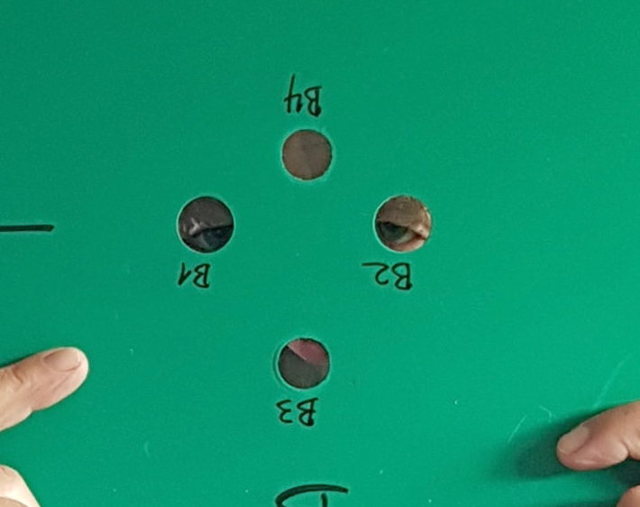 |
| Abb. 03-04-10: 26.03.2026,
beide Augen und das Loch B4 direkt über der Nase Version 1, geeignet für das "Sehen" , Abstand zum oberen Loch: 25 mm both eyes and the B4 hole directly above the nose Version 1, suitable for ‘seeing’, distance to the upper hole: 25 mm(FB) |
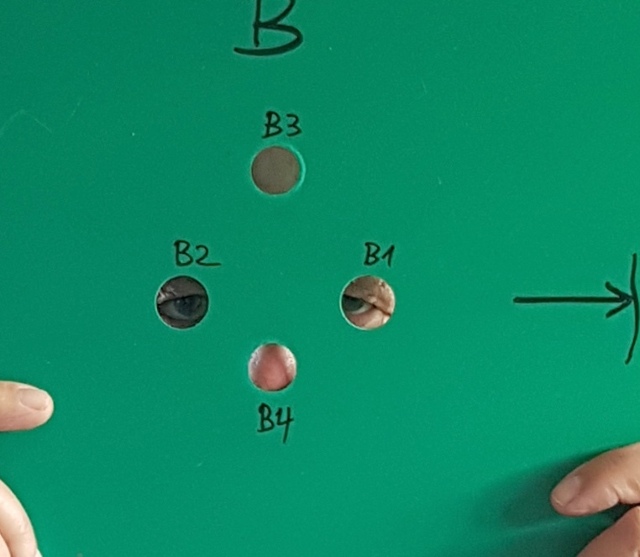 |
| Abb. 03-04-11: 26.03.2026,
beide Augen und das Loch B3 weit über der Nase Version 2, ungeeignet für das "Sehen" , Abstand zum oberen Loch: 55 mm 26 March 2026, both eyes and the B3 hole well above the nose Version 2, unsuitable for ‘viewing’, distance from the upper hole: 55 mm (FB) |
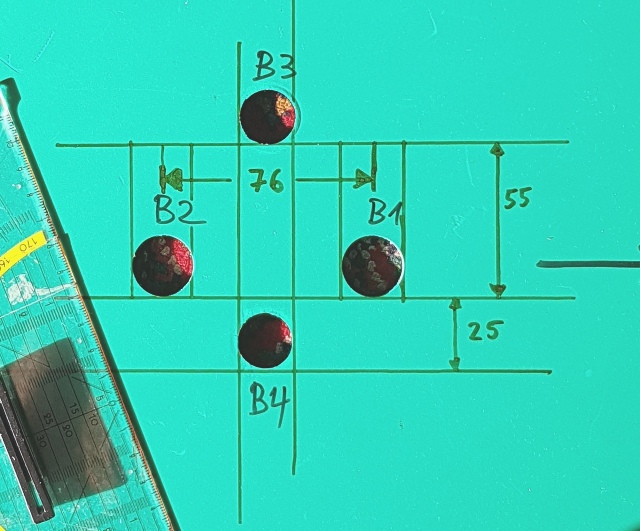 |
| Abb. 03-04-12: 26.03.2026,
Löcher mit Maßen Holes
with dimensions(FB) |
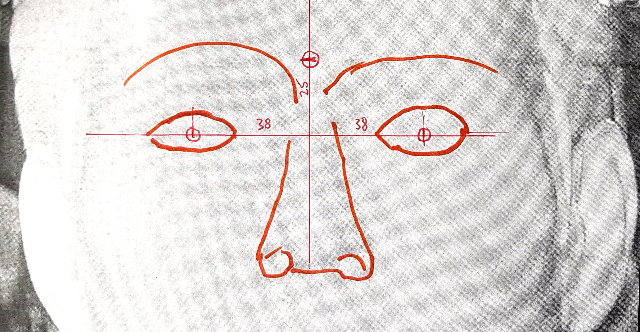 |
| Abb. 03-04-13: 26.03.2026,
Übernahme der Daten bei geeignetem Lochabstand Data transfer with suitable hole spacing (FB) |
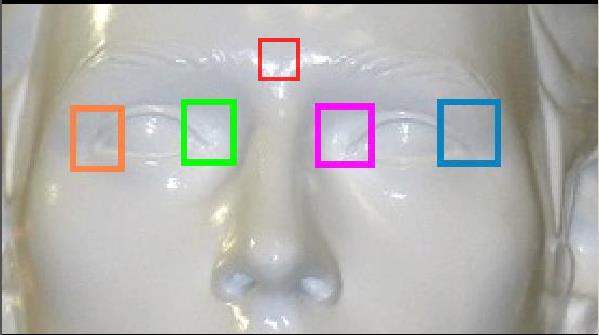 |
| Abb. 03-04-14: 26.03.2026, Übertragung
der Position auf die Schaufensterpuppe das "Dritte Auge" Transferring the position to the mannequin the ‘third eye’(FB) |
3.5 Aktivieren eines Drehpendels beim Anstarren mit dem Augenstrahl, Charles Russ Patent
Activating additional energy sources on the body whilst focusing with the eye beam
C. Russ
An Instrument which is set in motion by vision or by proximity of the human body. The Lancet, July 30 (1921) 222-224
https://rexresearch.com/RussEyeRayDetector/RussEyeRayDetector.htm....????..
 |
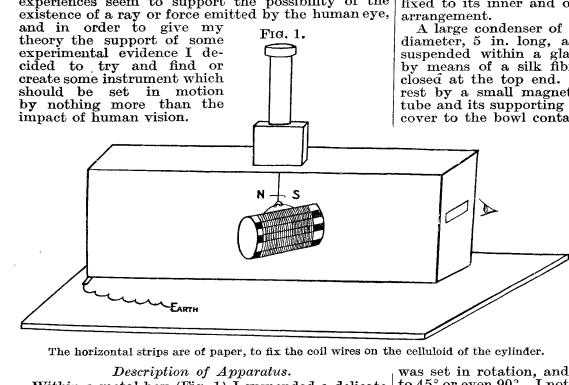 |
| Abb. 03-05-01: C. Russ, The Lancet, July 30, (1921) 222 |
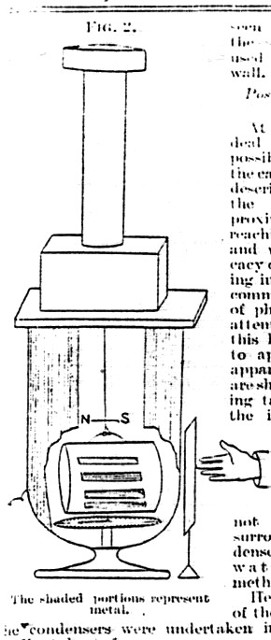 |
| Abb. 03-05-02: https://rexresearch.com/RussEyeRayDetector/RussEyeRayDetector.htm |
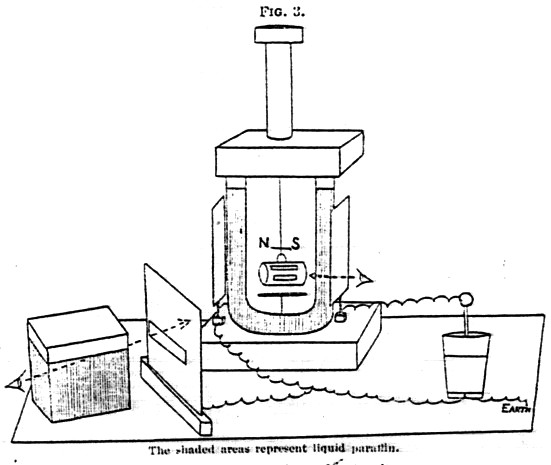 |
| Abb. 03-05-03: https://rexresearch.com/RussEyeRayDetector/RussEyeRayDetector.htm |
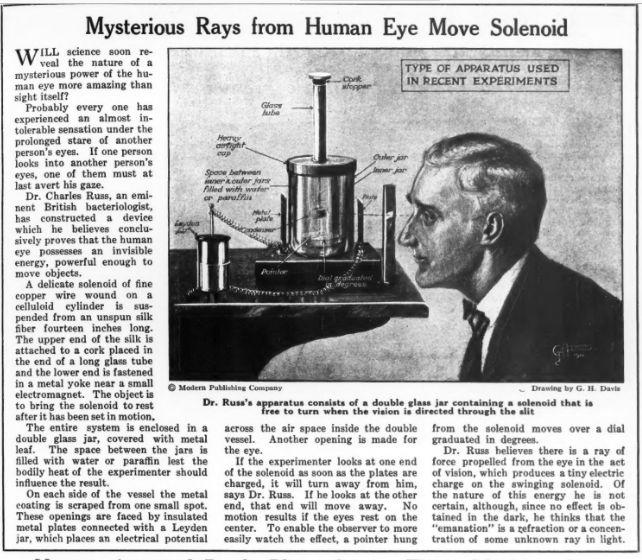 |
| Abb. 03-05-04: Popular Science
( January 1922 ) Will science soon reveal the nature of a mysterious power of the human eye more amazing than sight itself? https://rexresearch.com/RussEyeRayDetector/RussEyeRayDetector.htm |
|
New
York Times (1921)
FINDS A NEW FORCE IN THE HUMAN EYEEnglish Scientist Demonstrates Invention Which Registers the Power in a Glance. DISTINCT FROM OCCULTISM |
| New York Times (1921) ENTDECKUNG EINER NEUEN KRAFT
IM MENSCHLICHEN AUGE
Englischer Wissenschaftler demonstriert Erfindung, die die Kraft eines Blickes registriert.translated by deepl |
British Patent # 124,288 ( 24 March 1919) This invention consists in an instrument which is set in motion and whose motion is controlled by the human eye, i.e., by vision.https://rexresearch.com/RussEyeRayDetector/RussEyeRayDetector.htm |
Britisches Patent Nr.
124.288 (24. März 1919)
Ein Gerät, das in Bewegung
gesetzt wird und dessen Bewegung
vom menschlichen Auge, d. h. durch das Sehen, gesteuert wird Diese Erfindung besteht aus einem Gerät, das in Bewegung versetzt wird und dessen Bewegung durch das menschliche Auge, d. h. durch das Sehen, gesteuert wird.translated by deepl |
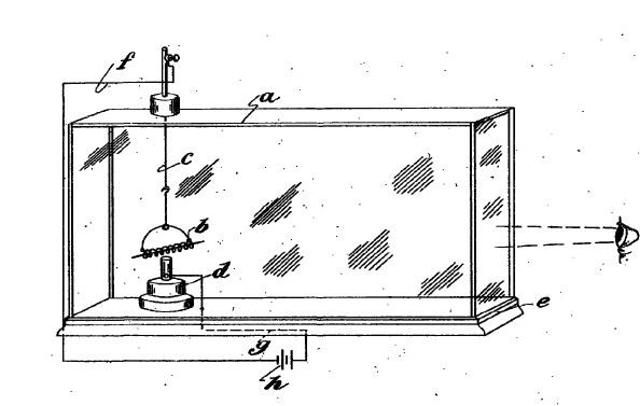 |
| Abb. 03-05-05: https://rexresearch.com/RussEyeRayDetector/RussEyeRayDetector.htm |
https://blog.world-mysteries.com/science/how-we-sense-when-we-are-being-stared-at/
3.6 Aktivieren von Objekten mit dem Augenstrahl Selecting objects using the eye cursor
3.6.1 Anregung von Spulen etc.
die nachfolgenden Objekte konnten aktiviert werden.
The following objects were selected.
siehe auch Abb. 03-02-03-05
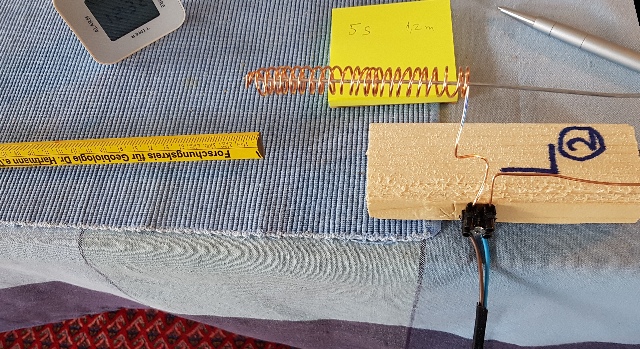 |
| Abb. 03-06-01-01: Stab-und-Spirale,
verzinkter Eisendraht, Kupferspule linksgewendelt.
23 Windungen Rod and coil,
galvanised iron wire, left-handed copper coil. 23
turns (FB) |
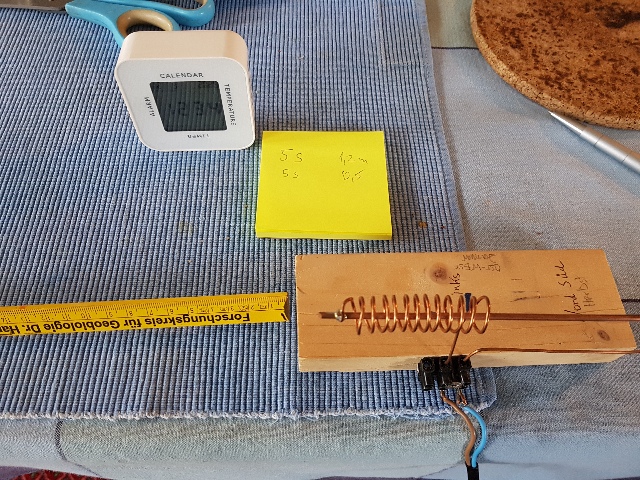 |
| Abb. 03-06-01-02: Stab-und-Spirale,
Kupferstab, Kupferspule linksgewickelt. 12 Windungen Rod and coil, copper rod, left-handed copper coil. 12 turns(FB) |
 |
| Abb. 03-06-01-03: Kupfer Klingeldraht
auf HT-Rohr, 36 Windungen linksgewickelt. Copper bell wire on HT tubing, 36 left-handed turns (FB) |
 |
| Abb. 03-06-01-04: Klingeldraht als
Rechteckschleife Bell wire in a rectangular loop (FB) |
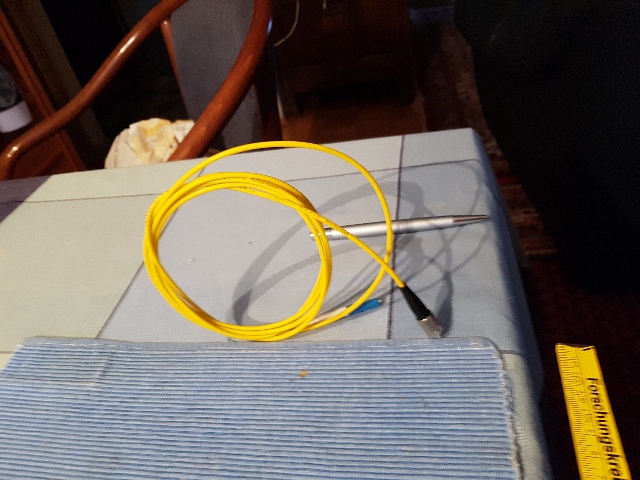 |
| Abb. 03-06-01-05: Glasfaser in
Kunststoffmantel Fibre-optic cable with a plastic sheath (FB) |
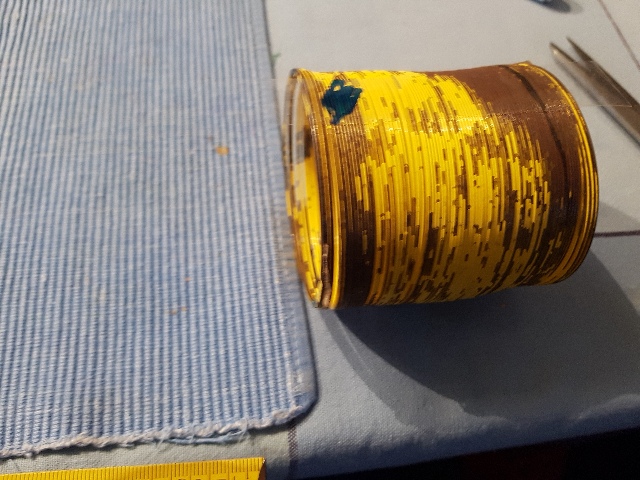 |
| Abb. 03-06-01-06: Stahlfeder ,
SLINKY, Ziehrichtung zeigt nach links Steel spring, SLINKY, pulling direction to the left (FB) |
 |
| Abb. 03-06-01-07: Piezozylinder in
Plastikgehäuse Piezoelectric cylinder in a plastic housing(FB) |
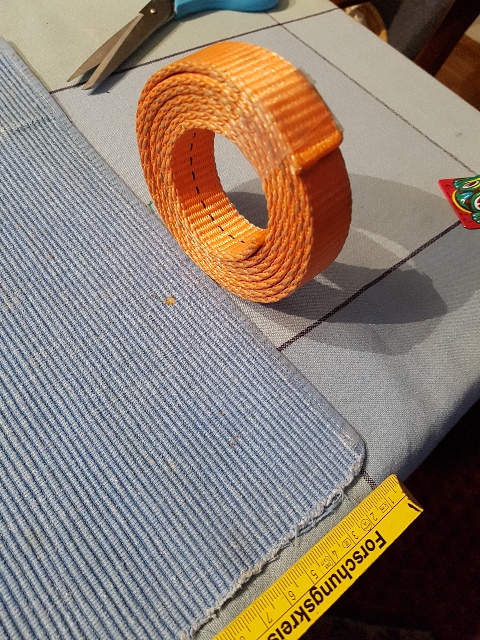 |
| Abb. 03-06-01-08: Spanngurt Tension strap (FB) |
 |
| Abb. 03-06-01-09: konische Spule mit
Garn conical bobbin with
thread (FB) |
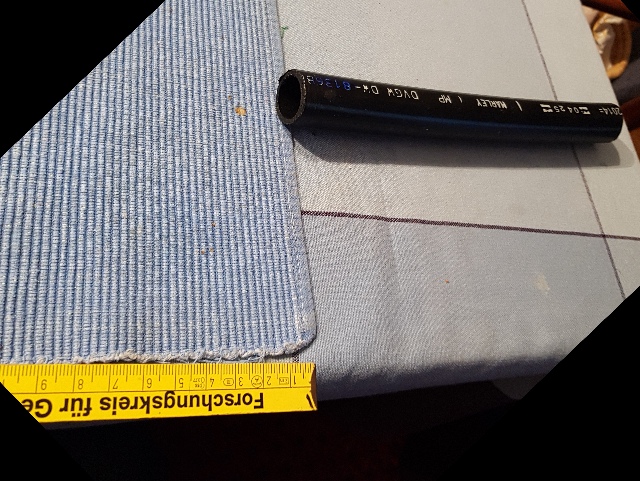 |
| Abb. 03-06-01-10: Hartes PE-Rohr, 25
mm Durchmesser, Ziehrichtung zeigt nach links Rigid PE pipe, 25 mm diameter, with the direction of draw pointing to the left (FB) |
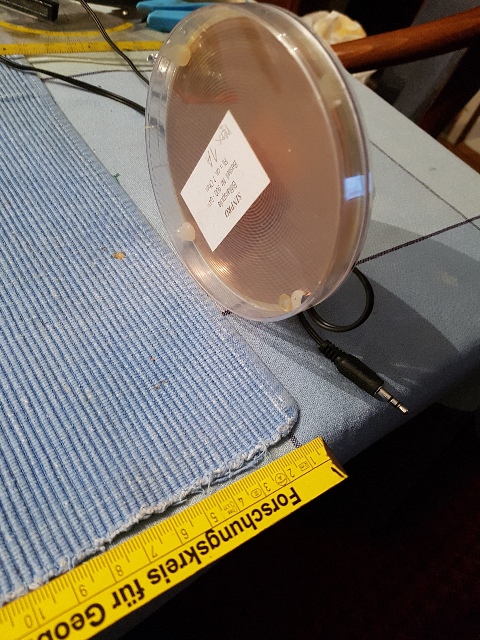 |
| Abb. 03-06-01-11: Bifilare Spule, Fa.
Schwille Bifilar coil,
Schwille(FB) |
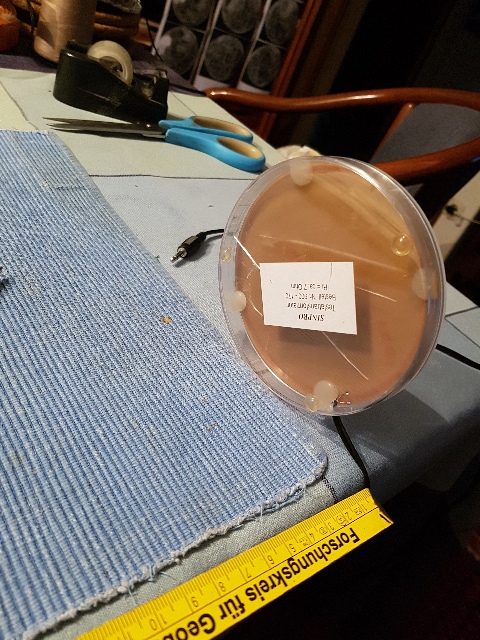 |
| Abb. 03-06-01-12: Tesla Spule, Fa.
Schwille (FB) |
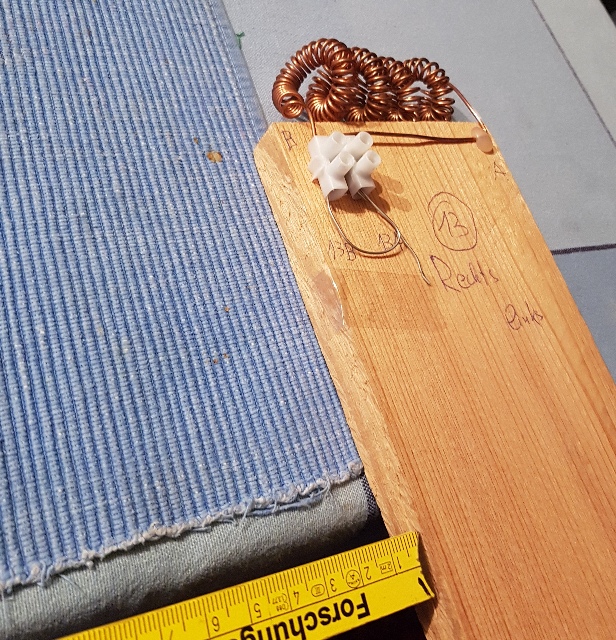 |
| Abb. 03-06-01-13: Doppelwendel aus
Kupferdraht Nr. 13, kleiner Radius: links,
großer Radius rechts Double coil made of No. 13 copper wire, small radius: left, large radius: right seums-drei.htm#kapitel-06-01 (FB) |
 |
| Abb. 03-06-01-14: Doppelwendel aus
Kupferdraht Nr. 14, kleiner Radius: links,
großer Radius links (FB) Double coil made of No. 14 copper wire, small radius: left, large radius: left (FB) |
 |
| Abb. 03-06-01-15: Doppelwendel aus
Kupferdraht Nr. 10, kleiner Radius: rechts,
großer Radius links Double coil made of No. 10 copper wire, small radius on the right, large radius on the left (FB) |
 |
| Abb. 03-06-01-16: Doppelwendel aus
Kupferdraht Nr. 13, kleiner Radius: rechts,
großer Radius rechts Double coil made of No. 13 copper wire, small radius: right-hand, large radius: right-hand (FB) |
 |
| Abb. 03-06-01-17: Zweiadrige Litze,
am Ende verbunden, Caducaeus Spule Two-strand stranded wire, joined at the ends, Caducaeus coil seums-drei.htm#kapitel-06-01 physik-neu-006.htm (FB) |
 |
| Abb. 03-06-01-18: Flachbandkabel 40
adrig, jeweils benachbarte Adern bifilar verbunden 40-core ribbon cable, with adjacent cores connected in a bifilar configuration seums-drei.htm#kapitel-06-01 |
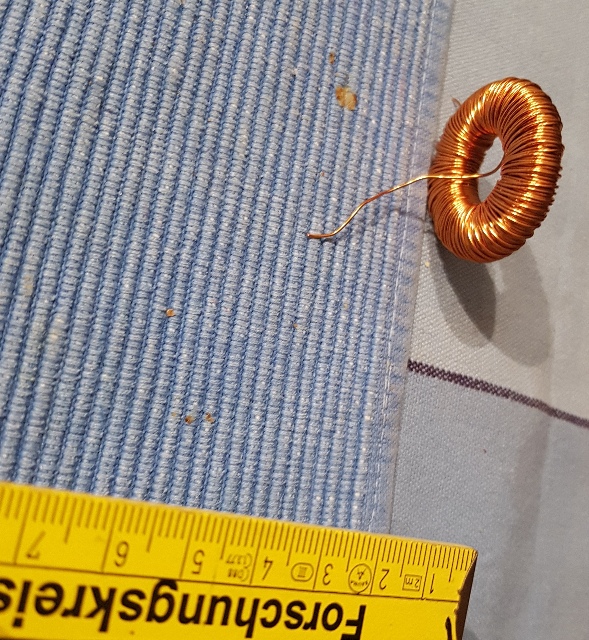 |
| Abb. 03-06-01-19: FerritRing mit
Kuperdraht (Drossel) Ferrite ring with copper wire (throttle) (FB) |
 |
| Abb. 03-06-01-20: kleine Toroidspule,
Kupferdraht small toroidal
coil, copper wire (FB) |
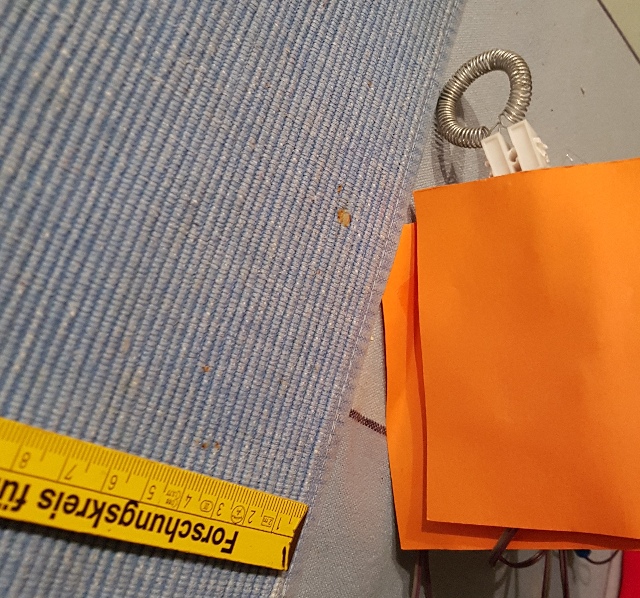 |
| Abb. 03-06-01-21: Als Toroid
gebogene Stahlfeder A steel
spring bent into a toroid shape(FB) |
 |
| Abb. 03-06-01-22: Spulenpaar von
einer Waschmaschinenpumpe Pair of coils from a washing machine pump (FB) |
 |
| Abb. 03-06-01-23: Spulenpaar von
einer Waschmaschinenpumpe, aufgeklappt Pair of coils from a washing machine pump, opened up(FB) |
 |
| Abb. 03-06-01-24: Toroidspule Nr. 5,
28 Windungen rechts, Toroidal coil No. 5, 28 turns clockwise physik-neu-006.htm (FB) |
 |
| Abb. 03-06-01-25: Toroidspule Nr. 2,
60 Windungen rechts, Toroidal coil No. 2, 60 turns clockwise, physik-neu-006.htm (FB) |
 |
| Abb. 03-06-01-26: Toroidspule Nr. 1,
60 Windungen rechts, Toroidal coil No. 1, 60 turns clockwise, physik-neu-006.htm (FB) |
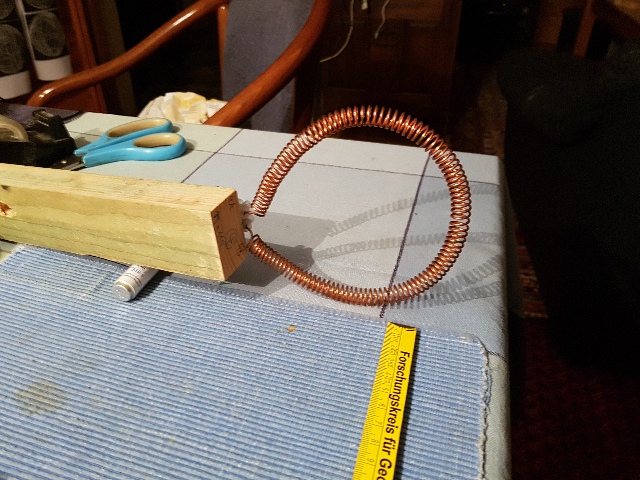 |
| Abb. 03-06-01-27: Toroidspule Nr. 4,
110 Windungen rechts, Toroidal coil No. 4, 110 turns, clockwise physik-neu-006.htm (FB) |
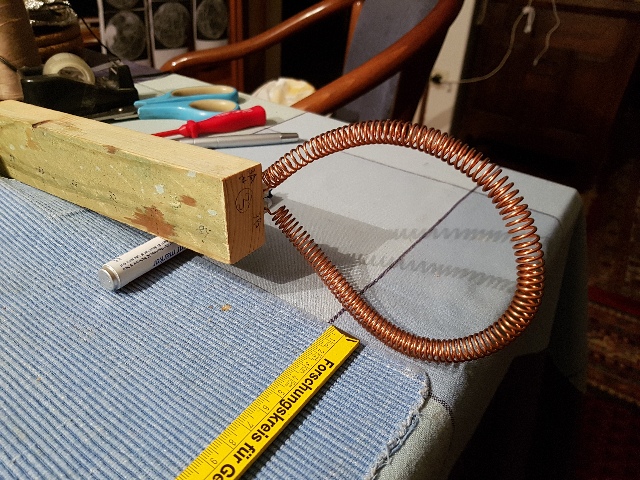 |
| Abb. 03-06-01-28: Toroidspule
Nr. 3, 110 Windungen rechts, Toroidal coil No. 3, 110 turns clockwise, physik-neu-006.htm (FB) |
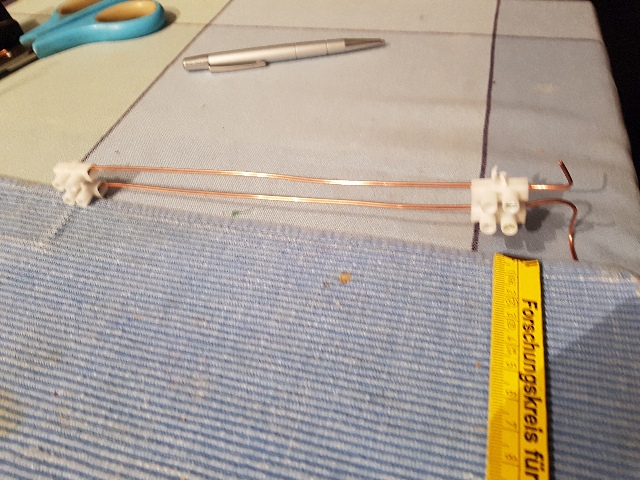 |
| Abb.
03-06-01-29: U-förmiges Kupferdrahtschleife U-shaped copper wire loop (FB) |
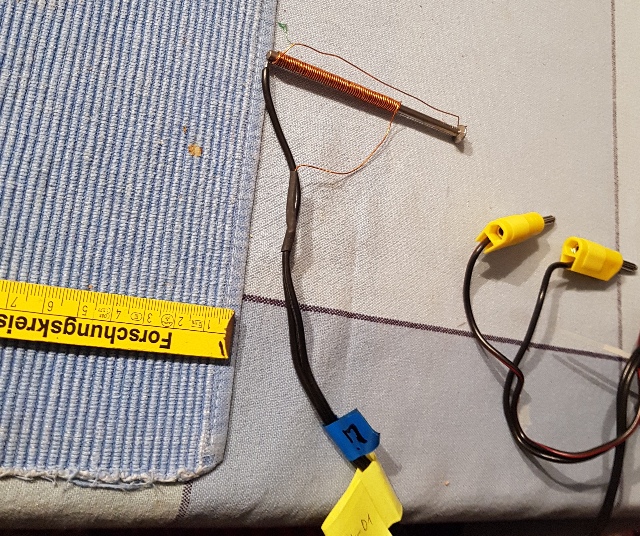 |
| Abb. 03-06-01-30: Stab-und-Spirale
aus Eisennagel und Kupferdraht links gewickelt Flußbeschleuniger, Aufbau nach Coler Rod-and-spiral made from an iron nail and copper wire, wound in a left-hand direction Current accelerator, constructed according to Coler (FB) |
 |
| Abb. 03-06-31: Stab-und-Spirale aus
Eisennagel und Kupferdraht rechts gewickelt. Flußbeschleuniger, Aufbau nach Coler Rod-and-spiral made from an iron nail and copper wire, wound clockwise. Current accelerator, constructed according to Coler (FB) |
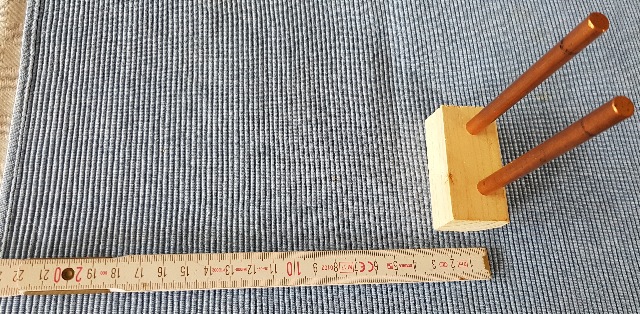 |
| Abb. 03-06-01-32: zum Vergleich: zwei
Hindernisse im "Ostwind" an der
gleichen Position For comparison: two obstacles in ‘Ostwind’ at the same position aus stroemung.htm#kapitel-10-06 |
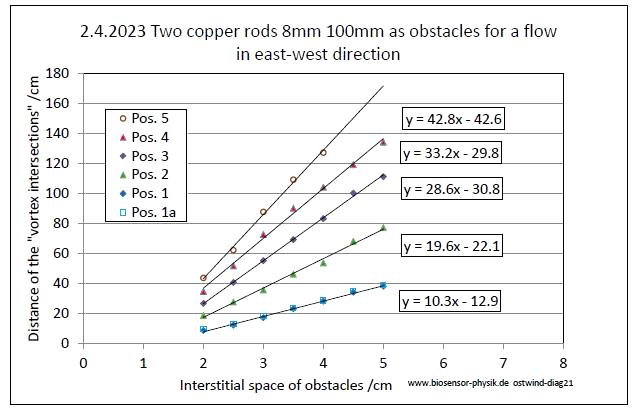 |
| Abb. 03-06-01-33: je weiter die
beiden Hindernisse auseinander sind, um so größer
werden die Abstände der Strukturelemente in
Fließrichtung West. The further apart the two obstacles are, the greater the spacing between the structural elements in the westward flow direction. aus stroemung.htm#kapitel-10-06 |
Ergebnisse der Anregung mit dem Augenstrahl 5 Sekunden
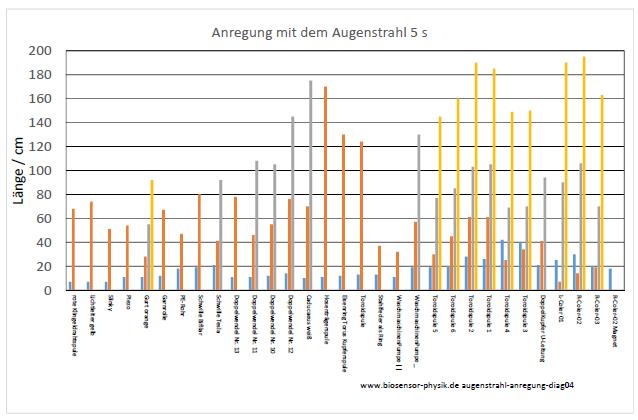 |
||||||||||||||||||||||||||||||||||||||||||||||||||||||||||||||||||||||||||||||||||||||||||||||||||||||||||||||||||||||||||||||||||||||||||||||||||||||||||||||||||||||||||||||||||||||||||||||||
| Abb. 03-06-01-31: An der
Skala vom Zollstock gemessene Längen in cm erste Spalte: nach Klopfen (Löschen vorheriger Anregung) und ohne Anregung mit Augenstrahl zweite und weitere Spalte: nach einer 5 Sekunden Anregung (eine bzw. mehrere Positionen) Die Spalte "vorher" (blaue Säulen im Diagramm) zeigen meist nur Längen unter 20 cm. Spalte "mit Anregung", (orange Säulen) variieren stark. Bei V15 sind viele bifilare Drähte parallel Spalte "zweite", "dritte" beschreibt Serien von Position zu gleichen Zeiten. wie in Abb. 10-06-18: ostwind.htm#kapitel-10-06
|
||||||||||||||||||||||||||||||||||||||||||||||||||||||||||||||||||||||||||||||||||||||||||||||||||||||||||||||||||||||||||||||||||||||||||||||||||||||||||||||||||||||||||||||||||||||||||||||||
3.6.2 Anregung von Glaskugel und Reflektor Prisma
 |
| Abb. 03-06-02-01: Reflektorprisma und
Glaskugel (FB) |
 |
| Abb. 03-06-02-02: Wenn das Prisma
einige Sekunden angestarrt wird - sogar wie in
diesem Bild von der Seite aus, entsteht ein
spürbarer Strahl in Prismenachse. Dessen Länge kann
bis über 15 m betragen. Nach Aufklopfen des Prismas
auf eine harte Unterlage (Holzbrett) verschwindet
der Strahl wieder. (FB) |
 |
| Abb. 03-06-02-03: Teile der
Farbstrich sind ein gutes Zeile für das Anstarren
mit dem Augenstahl. Schon nach wenigen Sekunden Anstarren geht von dieser Stelle senkrecht zur Kugeloberfläche ein viele Meter langer Strahl nach außen weg. Er scheint wie angeheftet zu sein, denn er dreht sich beim Drehen der Kugel mit. Schlägt man die Kugel auf eine vergleichsweise harte Unterlage (Korkplatte, Buch) auf, verschwindet der Strahl. (FB) |
 |
| Abb. 03-06-02-04: Mit dem leeren
Brillengestell (Abb. 02-02-13) vor den Augen
lassen sich Glaskugel oder Prisma nicht anregen.
(FB) |
Ein mechanischer Schlag löscht die Strukturen wasser-ader-drei-02.htm#kapitel-06-07
Blick in die Glaskugel
Wenn man sich mit geschlossenen Augen mit der Stirn (drittes Auge) von etwa einem Meter Abstand bis etwa 10 cm nähert, dann werden Teile in der rückwärtigen Umgebung "wahrnehmbar". Bewegt man bei 20 cm -10 cm Abstand zur Kugel die Augen von links nach rechts, so folgt der Bereich der Wahrnehmung dieser Augenbewegung, obwohl die Augenlider geschlossen sind.
Hat man bei weiterhin geschlossenen Lidern die Brille aufgesetzt Abb. 02-02-01, so ist diese Art der Wahrnehmung nicht möglich.
Wiederholt man den Versuch mit der Annäherung bei geöffneten Augen - und vorher kurzzeitigem Anstarren der Kugel - so ist die "Wahrnehmung" im rückwärtigen Bereich sehr intensiv.
Hierbei handelt es sich um
Beobachtungen physikalischer Art, die von sensitiven Personen nachvollziehbar sein können.
z.B. eine Person starrt die Kugel intensiv für einige Sekunden an. Dazu wählt sie eine von mehreren markierten Zielposition aus. Anschließend wird die Kugel verdreht. Ein sensitiver Beobachter soll danach die in der Kugel angeregte Struktur suchen und herausfinden, welche der vielen Zielpositionen angestarrt worden war.
Über eine anderweitige Verwendung von Glaskugeln in der Vergangenheit ist z.B. in vielen Märchen nachzulesen.
4. Erweiterung der Untersuchungen mit gerader oder ungerader Anzahl von Öffnungen und Sendern
4. Extension of the investigations to include an even or odd number of openings and transmitters
4.1 Löcher, Kerzenflammen, "Dowsing a Dot"*
Holes, candle flames,
* J. Keen The Mind's Interaction with the Laws of Physics and Cosmology, Cambridge scholars publishing (2018)
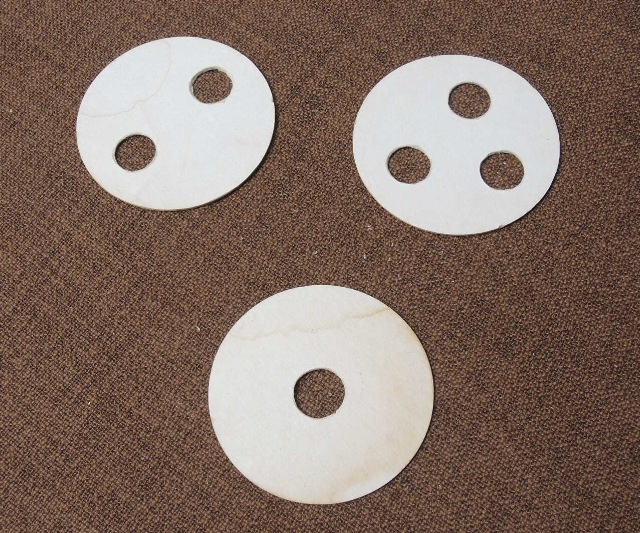 |
Abb. 04-01-01:aus seums-drei.htm#kapitel-10-03 |
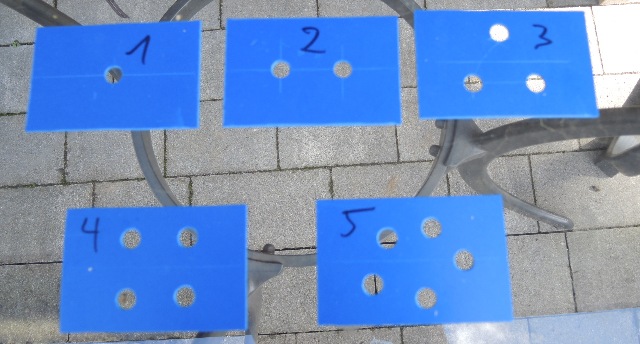 |
Abb. 04-01-02:aus stroemung.htm#kapitel-04-01 |
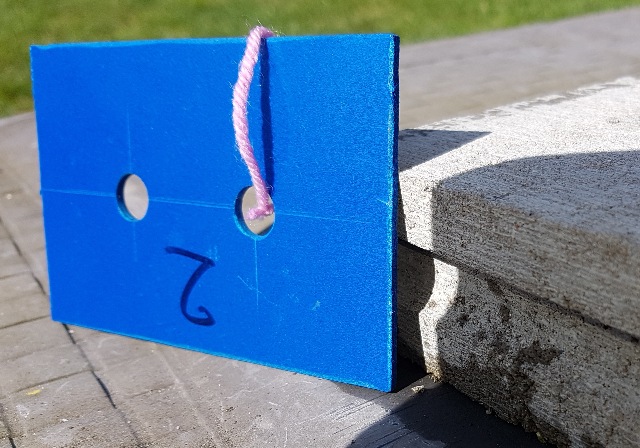 |
|
Abb. 04-01-03:
aus stroemung.htm#kapitel-04-03 |
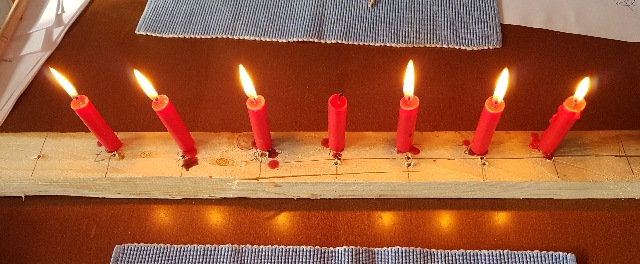 |
| Abb. 04-01-04: bei gerader Anzahl
gibt es nur kurze Wirbel zwischen benachbarten
Strömungsquellen. Bei ungerade Anzahl bleibt ein Wirbel übrig, der auch noch in größerer Entfernung "nach einem Partner sucht". With an even number, there are only brief vortices between neighbouring flow sources. With an odd number, one vortex remains, which continues to ‘search for a partner’ even at a greater distance. aus stroemung.htm#kapitel-04-02 |
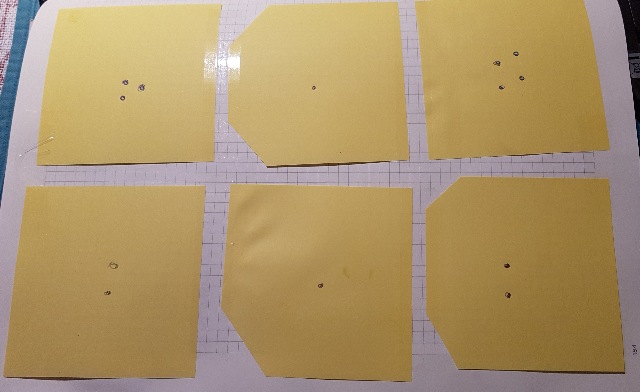 |
| Abb. 04-01-05: Anregung mit dem
Augenstrahl Jeffrey Keen "Dowsing a Dot", paarweise, gerade, ungerade ...... Jeweils zwei Löcher/Markierungen mit gleichen Eigenschaften können verschränkt sein. Dann haben Sie einen gemeinsamen Wirbel mit kurzer Reichtweite und sind für den Beobachter in zwei Meter Entfernung nicht zu finden. Stimulation with the eye beam Jeffrey Keen ‘Dowsing a Dot’, in pairs, even, odd ...... Any two holes/markings with the same properties can be interlaced. This creates a shared vortex with a short range. In that case, you have a shared vortex with a short range and cannot be detected by an observer two metres away. aus stroemung.htm#kapitel-06 |
 |
| Abb. 04-01-06: feinstoffliche
Energie-Strukturen bei Zweikörper-Wechselwirkung J. Keen The Mind's Interaction with the Laws of Physics and Cosmology, Cambridge scholars publishing (2018) |
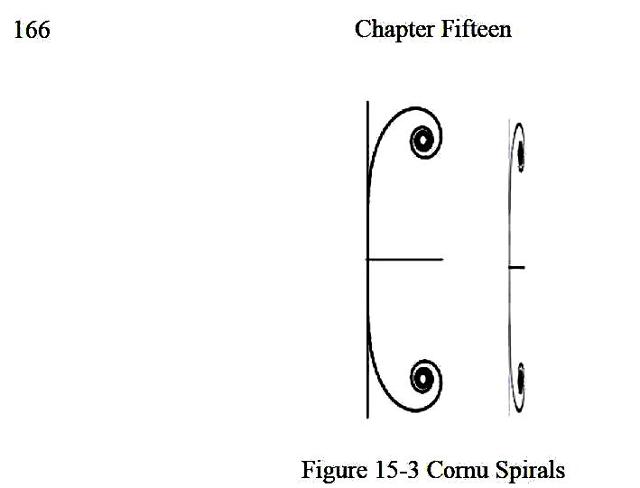 |
| Abb. 04-01-07: Horn-Spiralen Cornu Spirals, J. Keen The Mind's Interaction with the Laws of Physics and Cosmology, Cambridge scholars publishing (2018) |
 |
Abb. 04-01-08: an dem oberen
Rand geht es von einer hauptsächlich rotierenden
Strömung über in eine überwiegend vertikale. Das
könnten die Cornu Spirals sein. aus soliton.htm#kapitel-01-05 |
4.2 Drittes Auge
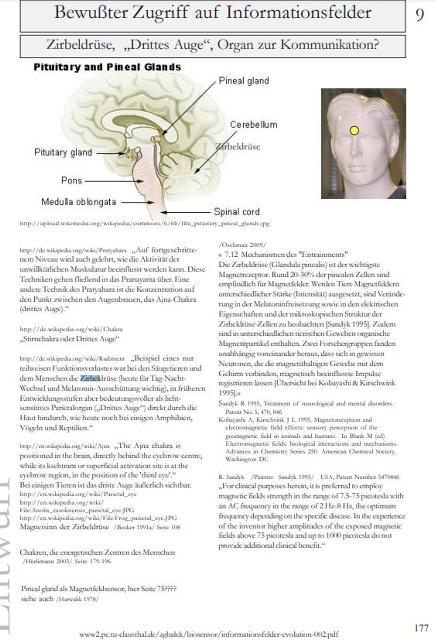 |
Abb. 04-02-00:
Zirbeldrüse
Stand 2010aus informationsfelder-evolution-002.pdf |
 |
Abb. 04-02-01: das Dritte Auge, etwas
oberhalb der Verbindung beider Augenbrauenaus kopf-sensor.htm#kapitel-01 |
 |
Abb. 04-02-02:aus kopf-sensor.htm#kapitel-01 |
 |
Abb. 04-02-03: drittes Auge , auch
bei Tieren?aus kopf-sensor.htm#kapitel-01 |
4.3 weitere Sensoren am Körper
Auch an den Füßen: Rückseite der Fersen
Vorderseite Oberkörper
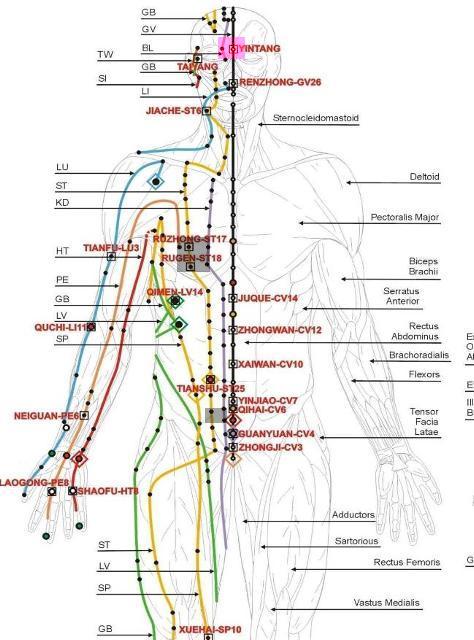 |
| Abb. 04-03-01: Vorderseite des
Körpers, drei weitere "Sender", von denen ein Strahl
ausgeht. graue Rechtecke: rosa Rechteck: "Drittes Auge", Front of the body, three further ‘transmitters’ from which a beam emanates. Grey rectangles: Pink rectangle: ‘Third eye’, aus raunaechte.htm#kapitel-04 |
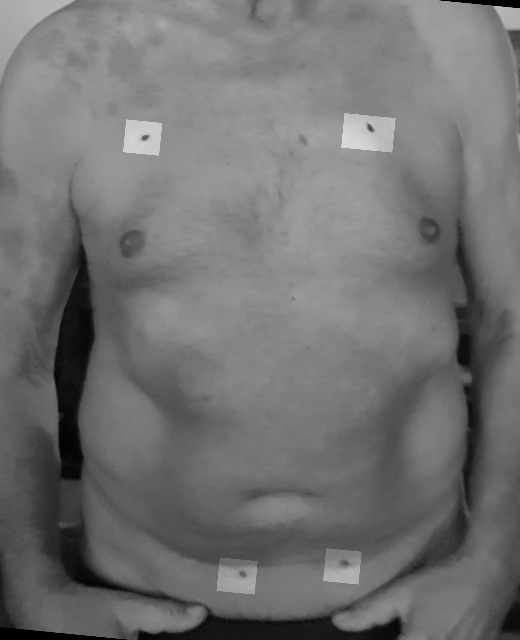 |
| Abb. 04-03-04: Zwei Sensorpaare
auf dem Oberkörper beim Mann Richtung der strömungen in der zweiten Jahreshälfte obere Punkte: links: vom Körper weg, rechts: in den Körper hinein Two pairs of sensors on the man’s upper body Direction of the currents in the second half of the year Upper points: left: away from the body, right: towards the body (FB) |
 |
| Abb. 04-03-05: Oberkörper,
Markierung der Sensorpaare Upper body, marking of the
sensor pairs DavidShankbone https://commons.wikimedia.org/wiki/File:Male_Chest_by_David_Shankbone.jpg |
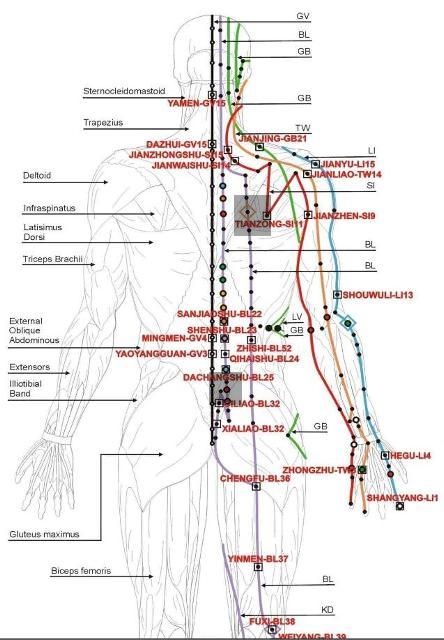 |
| Abb. 04-03-02: Rückseite des
Körpers, zwei weitere "Sender", von denen ein Strahl
ausgeht. graue Rechtecke: The back of the body, with two further ‘transmitters’ from which a beam emanates. Grey rectangles: aus raunaechte.htm#kapitel-04 |
 |
| Abb. 04-03-06: Oberkörper mit
zwei Sensorpaaren. Markierungen durch Kreuze Richtung der Strömung in der zweiten Jahreshälfte obere Punkte: rechts: vom Körper weg, links: in den Körper hinein gleiche Richtung wie auf der Vorderseite, d.h. links in den Körper hinein und vorne wieder heraus. Upper body with two pairs of sensors. Markings indicated by crosses Direction of flow in the second half of the year Upper points: right: away from the body, left: into the body Same direction as on the front, i.e. into the body on the left and out again at the front. (FB) |
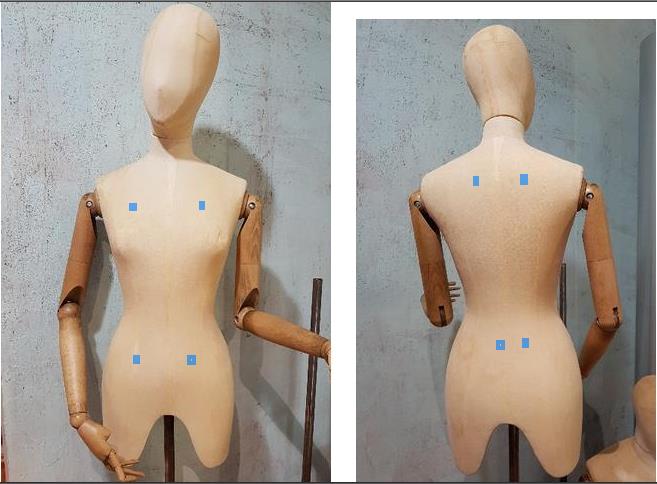 |
| Abb. 04-03-07: weibliche
Schaufensterpuppe mit markierten Positionen female mannequin with marked positions (FB) |
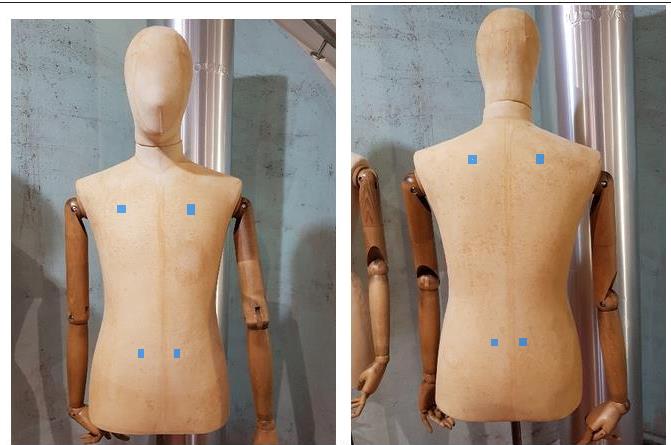 |
| Abb. 04-03-08: männliche
Schaufensterpuppe die beiden unteren Punkte auf der Vorderseite sind dichter zusammen als bei einer weiblichen Person. male mannequin the two lower points on the front are closer together than on a female mannequin. (FB) |
5. PSI-Track Brille, Ziel sichtbar / nicht sichtbar
PSI-Track Goggles, Target visible / not visible
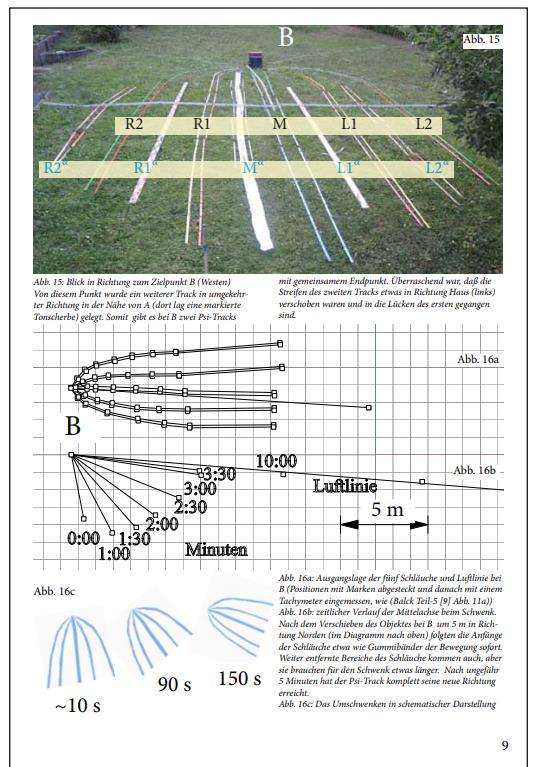 |
| Abb. 05-00-01: Beim Legen einer
Gedankenverbindung stellt man sich das Ziel intensiv
im Bereich der Stirn vor (einige Sekunden, mit
geschlossenen Augen). Anschließend bildet sich eine Struktur aus mehren Schläuchen zwischen Start und Ziel aus, die einige Tage erhalten bleibt. Diese Struktur ist elastisch wie ein Gummiband und folgt im Prinzip der Luftlinie. Sind Hindernisse im Weg, weicht die Struktur seitlich aus und umrundet diese. Verschiebt man z.B. den Startpunkt um mehrere Meter, dann dauert es wenige Minuten bis die neue Luftlinie eingerichtet ist. Die Tracks von Männern und Frauen sind unterscheidbar. Es können mehrere Tracks zwischen zwei Punkten eingerichtet werden. Diese sind dann ineinander verschachtelt. Vermutlich spielt die Neigung des Kopfes (Verbindungslinie zwischen den Augen horizontal / geneigt) eine Rolle. When establishing a mental connection, you visualise the destination vividly in the area of your forehead (for a few seconds, with your eyes closed). A structure then forms, consisting of several tubes between the starting point and the destination, which remains in place for a few days. This structure is elastic, like a rubber band, and generally follows the shortest route. If there are obstacles in the way, the structure veers off to the side and goes round them. If, for example, you move the starting point by several metres, it takes a few minutes for the new straight line to be established. The tracks of men and women are distinguishable. Several tracks can be established between two points. These are then interlaced. Presumably, the angle of the head (connection line between the eyes horizontal / tilted) plays a role. aus wbm-2019-teil06-low.pdf from wbm-2019-teil06-english-low.pdf |
5.1 PSI-Track legen mit gelber Brille
Recording a PSI track with yellow goggles
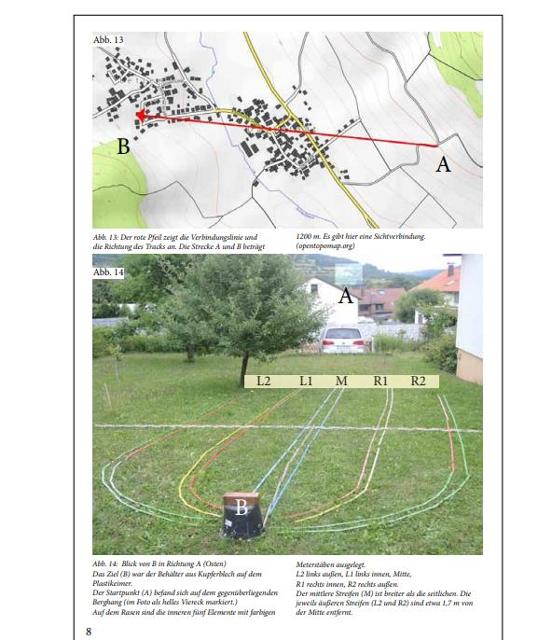 |
Abb. 05-01-01: ohne Brille
experimentiert tried
it without glassesaus subtile-verbindung-zwei.htm#kapitel-05-02 |
|
Abb. 05-01-02: wie Abb.
02-00aus ostwind.htnm#kapitel-03-13 |
Der Versuch, mit aufgesetzter Brille vom Standort B aus erneut einen PSI-Track zum Ziel bei A zu legen, scheiterte.
Der Augenstrahl ging nicht durch die Brille hindurch sondern wurde an der Brille reflektiert und nach hinten umgelenkt.
Stattdessen entstand auf der Rückseite von B eine große Struktur von vielen Quadratmetern Grundfläche, in der das Bausmaterial für den Track "so herumlag".
Mit der üblichen mentalen Aktion " PSI-Track löschen" - ohne aufgesetzte Brille - ließen sich die Strukturen wieder auflösen.
The attempt to lay another PSI track from location B to the target at A whilst wearing glasses failed.
The eye beam did not pass through the glasses but was reflected by them and deflected backwards.
Instead, a large structure covering many square metres of floor space formed at the rear of B, within which the building material for the track was ‘scattered about’.
Using the usual mental action “delete PSI track” – without the glasses on – the structures could be dissolved again.
5.2 PSI-Ringabstand Knoten PSI ring spacing node
Struktur vom Augenstrahl des Beobachters angeregt?
Das Ziel war sichtbar
Was the structure stimulated by the observer’s line of sight?
The target was visible
 |
Abb. 05-02-01: Der Beobachter hat aus
der Ferne das Fahrrad angepeilt.aus psi-ringabstand.htm |
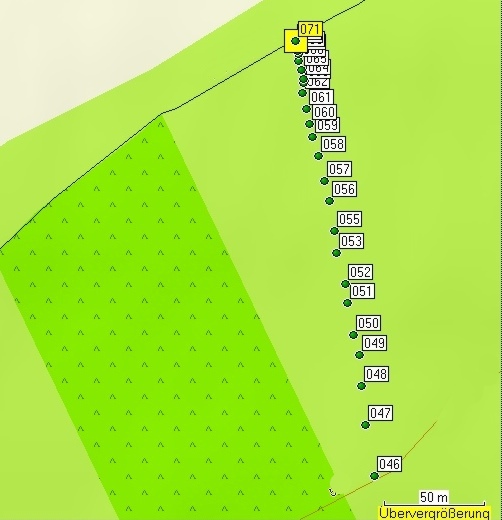 |
Abb. 05-02-02:
aus psi-ringabstand.htm |
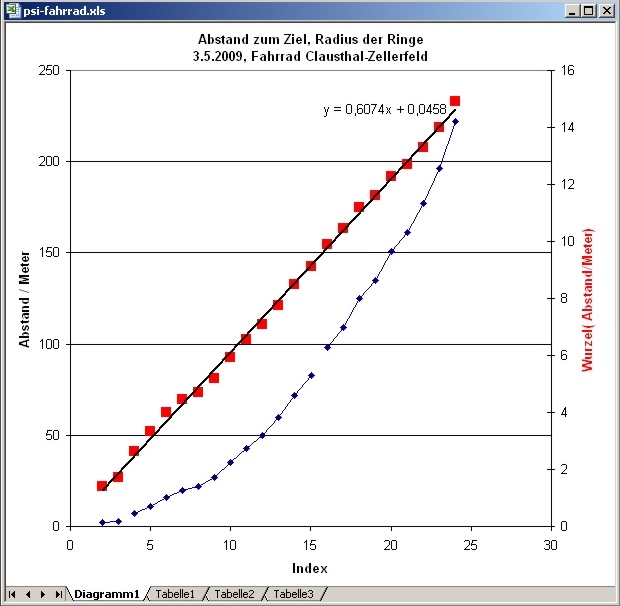 |
Abb. 05-02-03:
aus psi-ringabstand.htm |
Ziel nicht sichtbar, mental anvisiert
Target not visible, visually locked on
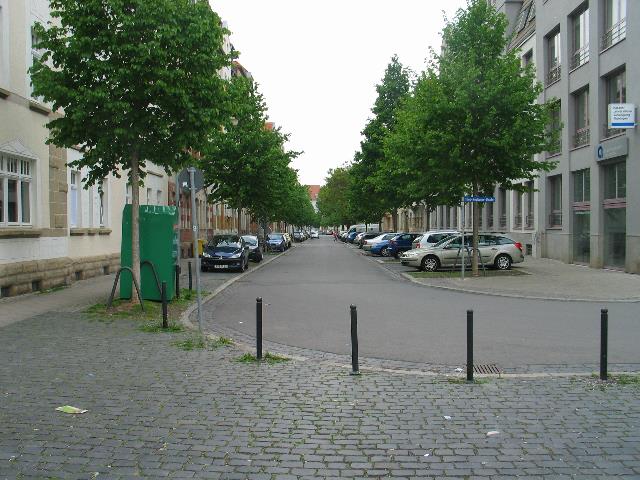 |
Abb. 05-02-04:
aus psi-ringabstand.htm |
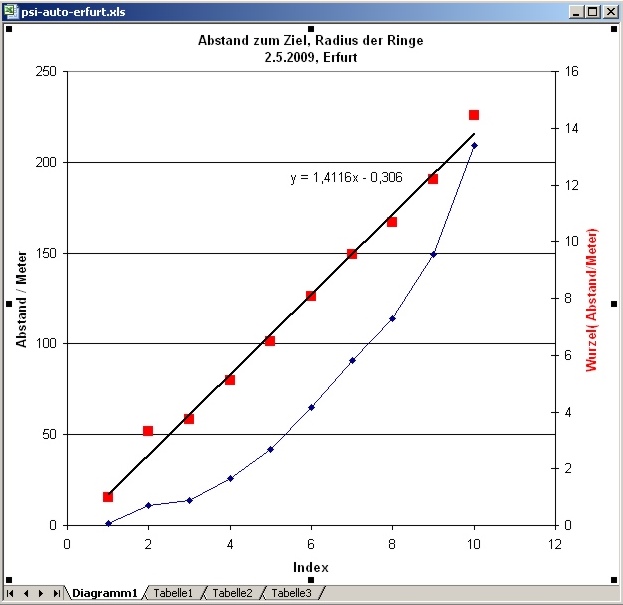 |
Abb. 05-02-05:
aus psi-ringabstand.htm |
5.3 Resonanz
vom Augenstrahl des Beobachters angeregt? inspired by the observer’s gaze?
bernstein-resonanz.htm
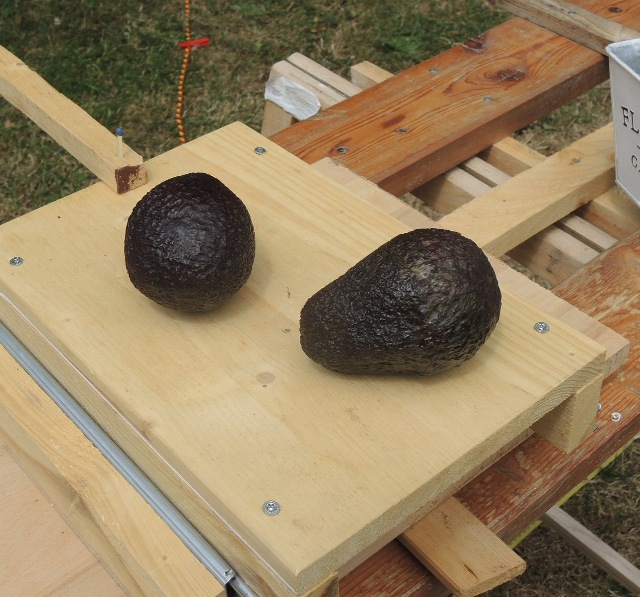 |
Abb. 05-03-01:aus bernstein-resonanz.htm |
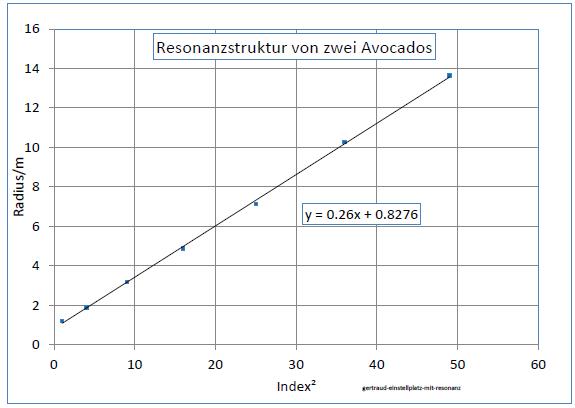 |
| Abb. 05-03-02: die Radien der Ringe
wachsen nach außen hin quadratisch an. the radii of the rings increase quadratically towards the outside aus bernstein-resonanz.htm |
6. Hörgeräte Batterien oder Magnete können Augenstrahl anregen
Hearing aid batteries or magnets can stimulate the optic nerve
Zum Aktivieren des "Sehens" von feinstofflichen Objekten ist es erforderlich,
den Augenstrahl eingeschaltet zu haben. (d.h. die Sinne im Bereich der Stirn "anspannen"/aktivieren)
To enable the ‘vision’ of subtle objects, it is necessary to
have activated the eye beam. (i.e. to ‘focus’/activate the senses in the forehead area)
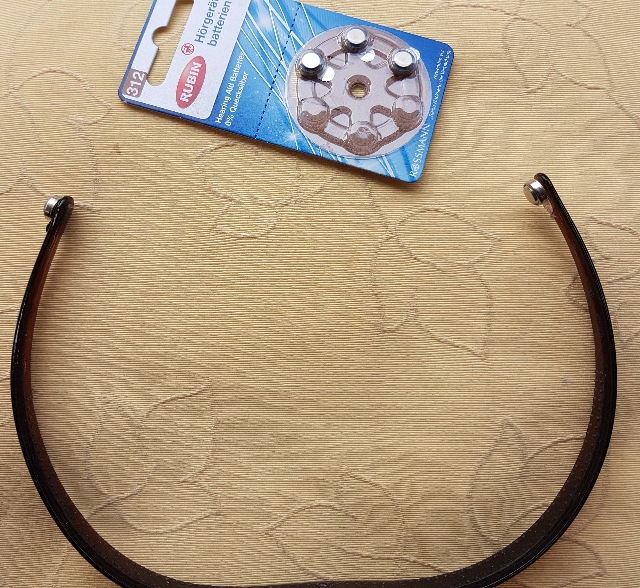 |
||||
Abb. 06-01: Die beiden Pluspole
zeigen in die gleiche Richtung, nach rechts.aus kopf-sensor.htm#kapitel-05-03 |
||||
 |
||||
| Abb. 06-02: Strahlen vor den beiden
Augen, Anregung mit zwei Batterien, beide Pluspole zeigen nach links, (wie die Richtung vom rechten Auge zum linken Auge) Beams in front of both eyes, powered by two batteries, both positive terminals facing left (in the direction from the right eye to the left eye)(FB) |
||||
 |
||||
| Abb. 06-03: Pluspole zeigen im Bild
nach rechts, am Kopf nach links Zweite Jahreshälfte, November 2025 Positive poles point to the right in the image, to the left at the top Second half of the year, November 2025
*Bei überkreuzten Beinen sind die Geschlechter getauscht. When the legs are crossed, the genders are swapped. (FB) |
||||
 |
||||
| Abb. 06-04: Batterien, Anordnung
umgepolt, Pluspole zeigen im Bild nach links,
am Kopf nach rechts Zweite Jahreshälfte, November 2025 Batteries, reversed polarity; the positive terminals point to the left in the image, but to the right at the top Second half of the year, November 2025
(FB) |
||||
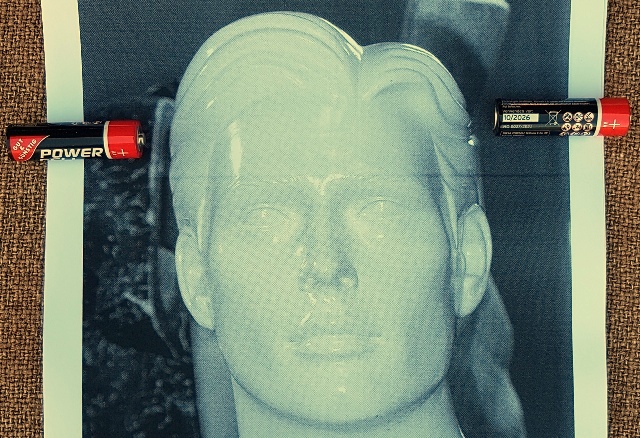 |
||||
Abb. 06-05: Batterienaus kopf-sensor.htm#kapitel-05-03 |
||||
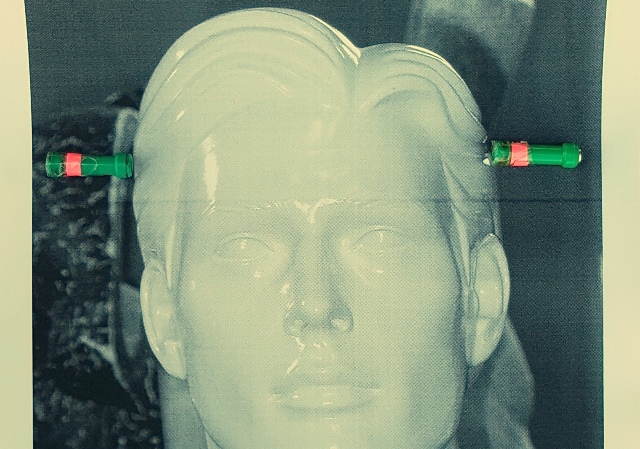 |
||||
Abb. 06-06: Magneteaus kopf-sensor.htm#kapitel-05-03 |
||||
 |
||||
| Abb. 06-07: Über die linke
Augenbraue führt unser Stromkreis einen
horizontalen Draht, durch den ein Strom fließt, dessen Richtung entgegengesetzt zu dem ist, der Kopf des Probanden Elektrischer Draht Abb. 11.3 durch denselben Draht fließt, der vor der rechten Augenbraue gespannt ist. aus magnetsinn.htmOur circuit runs a horizontal wire across the left eyebrow, through which a current flows in the opposite direction to that Subject’s head Electrical wire Fig. 11.3 flowing through the same wire stretched across the right eyebrow. Fig. 01: Humans have sensitive magnetic sensors, for example on the brow ridge above the eyes (arcade sourcilière) |
||||
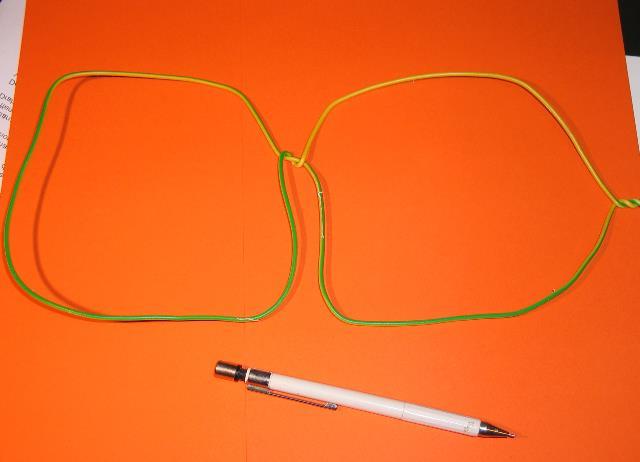 |
||||
Abb. 06-08:
aus magnetsinn.htm |
7. Drahtbrille , Chi-Stabilisator
siehe ostwind.htm#kapitel-04-02-03
chi-stabilisator
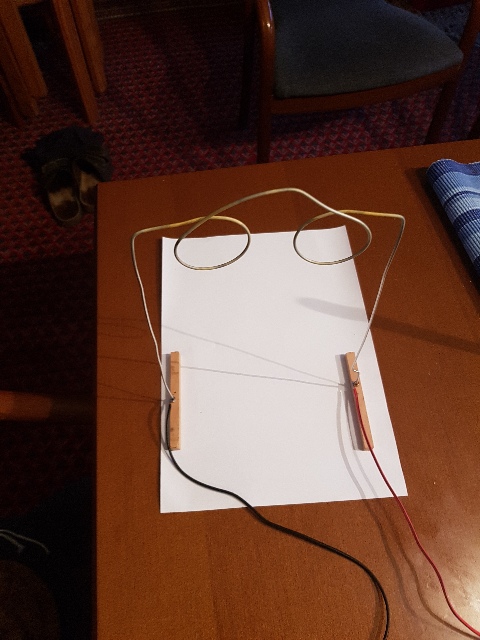 |
| Abb. 07-01: verzinkter Eisendraht,
geglüht galvanised
iron wire, annealed (FB) |
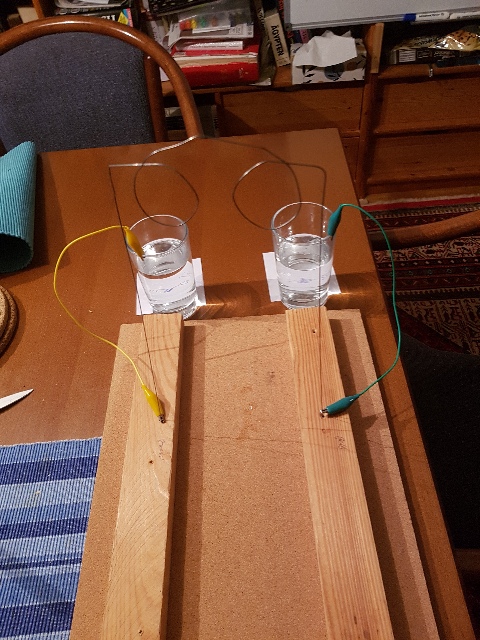 |
Abb. 07-02: Edelstahl-Schweißdrahtaus ostwind.htm#kapitel-04-02-03 |
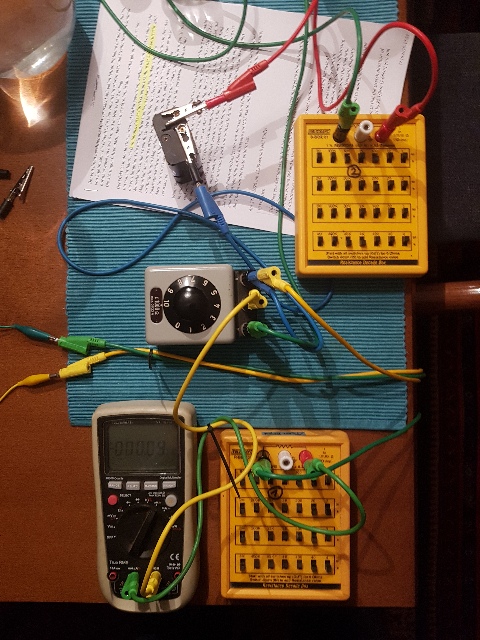 |
| Abb. 07-03: Anregung der Strömung in
der Drahtbrücke mit kleinstem Gleichstrom (FB) |
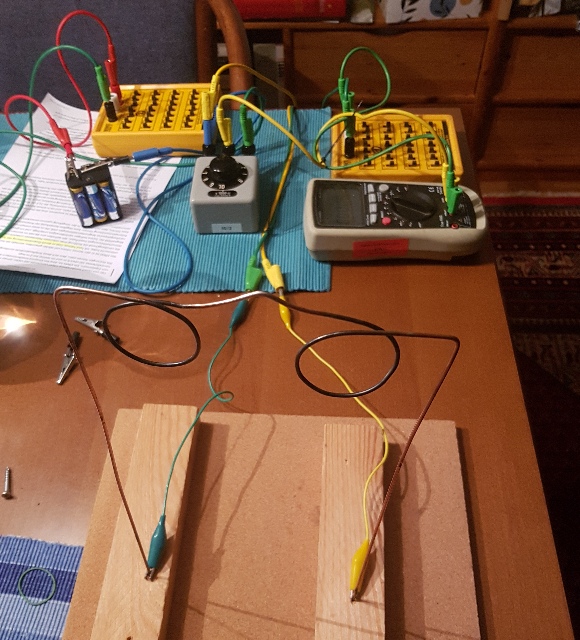 |
Abb. 07-04:aus ostwind.htm#kapitel-04-02-03 |
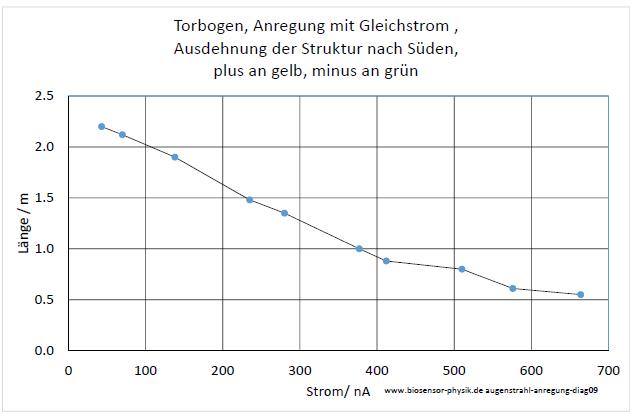 |
Abb. 07-05:aus ostwind.htm#kapitel-04-02-03 |
weitere Versuche zur Anregung ostwind.htm#kapitel-04-02-03
Blick auf sensitive Personen
8. Rupert Sheldrake: The Sense of Being Stared At
https://www.sheldrake.org/research/sense-of-being-stared-at
als App zum Selbertesten
https://www.sheldrake.org/participate/an-app-for-testing-the-sense-of-being-stared-at
Klatschen: Träge Massen
Literatur: b-literatur.htm
 |
www.biosensor-physik.de | (c)
19.11.2025 - 14.04.2026 F.Balck |